
Logo

American Heart Association

  41
  0


Final ID: MPTU11

Prediabetes Progression In Young American Adults: A Pooling Project

Abstract Body: Introduction: There is growing clinical concern about increases in prediabetes and type 2 diabetes in young adults. Novel weight-loss medications, e.g., glucagon-like peptide-1-receptor agonist (GLP1-RA), can prevent progression from prediabetes to diabetes. Characterizing risk and risk factors for progression to diabetes could help identify high-risk subgroups to prioritize for intensive lifestyle interventions and novel medications in the growing population of young adults with prediabetes.

Objective: To characterize 5-year risk and risk factors for progression from prediabetes to diabetes in adults <40 years.

Methods: We pooled and harmonized data from participants aged 18 to 40 years with prediabetes (fasting glucose [FG] 100-125 mg/dL) from three cohorts (HCHS/SOL, CARDIA, FHS-Gen3). We used Poisson regression to estimate 5-year risk and age- and cohort-adjusted rate ratios (95%CI) for incident diabetes (FG ≥126 mg/dL or medication use), overall and according to demographics, FG categories (FG 100-109 mg/dL,110-125 mg/dL), and GLP1-RA eligibility criteria for weight loss (body mass index ≥30 kg/m2 or body mass index ≥27 kg/m2 with dyslipidemia or hypertension) during a median follow-up of 6.2 years.

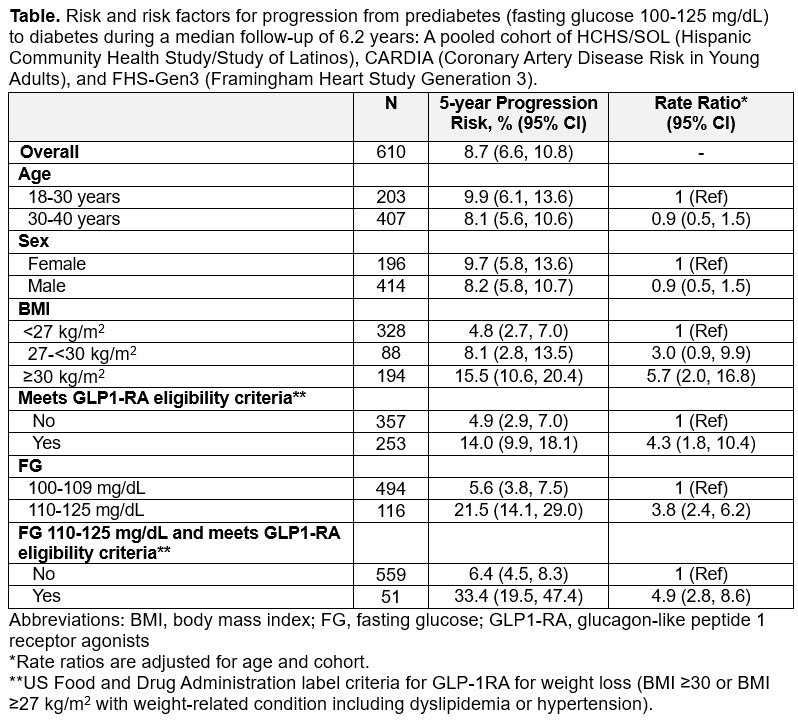
Results: The 610 young adults with prediabetes had a mean age of 32 (SD, 6) years, 32% were women, and 38% self-identified as Hispanic/Latino. The 5-year risk of progression from prediabetes to diabetes was 8.7% (95%CI: 6.6, 10.8) (Table). The 5-year risk of diabetes for young adults with prediabetes who met GLP-1RA eligibility criteria for weight loss was 14.0% (95% CI: 9.9, 18.1), and for those with FG between 110 to 125 mg/dL was 21.5% (95% CI: 14.1, 29.0). The 5-year risk of diabetes was highest for young adults who met GLP1-RA eligibility criteria and FG between 110 to 125 mg/dL (36.1%), which was ~5-times (95% CI: 2.8, 8.6) the risk for those meeting neither criteria.

Conclusion: In young adults with prediabetes, we identified subgroups with elevated risk of progression, with a 5-year diabetes risk of 33% in the highest risk group. This highlights opportunities for targeted approaches for intensive lifestyle and pharmacologic interventions for diabetes prevention.
  • Rooney, Mary  ( Johns Hopkins University , Baltimore , Maryland , United States )
  • He, Jiahuan Helen  ( Johns Hopkins University , Baltimore , Maryland , United States )
  • Wang, Dan  ( Johns Hopkins University , Baltimore , Maryland , United States )
  • Echouffo, Justin  ( Johns Hopkins Hospital , Baltimore , Maryland , United States )
  • Fang, Michael  ( Johns Hopkins University , Baltimore , Maryland , United States )
  • Selvin, Elizabeth  ( Johns Hopkins University , Baltimore , Maryland , United States )
  • Author Disclosures:
Meeting Info:

EPI-Lifestyle Scientific Sessions 2026

2026

Boston, Massachusetts

Session Info:

Diabetes

Tuesday, 03/17/2026 , 05:00PM - 07:00PM

Moderated Poster Session

More abstracts on this topic:
Adiposomal microRNAs Mediate Vascular Dysfunction in Obesity-Associated Type 2 Diabetes

Mirza Imaduddin, Morsy Mohammed, Levitan Irena, Raj Usha, Mahmoud Abeer

A Real-world Evaluation of Longitudinal Healthcare Expenses in a Health System Registry of Type-2 Diabetes Mellitus and Cardiovascular Disease Enabled by the 21st Century Cures Act

Dhingra Lovedeep, Aminorroaya Arya, Pedroso Aline, Rajpura Jigar, Mehanna Sherif, Tonnu-mihara Ivy, Khera Rohan

More abstracts from these authors:
Impact of the DASH4D Diet on Post-prandial Glucose Patterns assessed by Continuous Glucose Monitoring in Adults with Type 2 Diabetes

Sartini Joseph, Zeger Scott, Selvin Elizabeth, Fang Michael, Rooney Mary, Wang Dan, Rebholz Casey, Echouffo Justin, Mitchell Christine, Yeh Hsin-chieh, Appel Lawrence, Pilla Scott

Symptoms of Hypoglycemia in Older Adults With and Without Diabetes

Daya Malek Natalie, Fang Michael, Wang Dan, Windham B Gwen, Valint Arielle, Echouffo Justin, Selvin Elizabeth

You have to be authorized to contact abstract author. Please, Login
Not Available