Logo

American Heart Association

  3
  0


Final ID: MPTH75

Linking Pulmonary Function Decline and Cardiovascular Disease Risk via Plasma Proteomics

Abstract Body: Background: Pulmonary function decline is associated with an increased risk of cardiovascular disease (CVD), yet the underlying molecular mechanisms remain unclear. We aimed to identify plasma proteins associated with forced expiratory volume in one second (FEV1) decline and subsequent CVD risk and to uncover their shared molecular mechanisms.

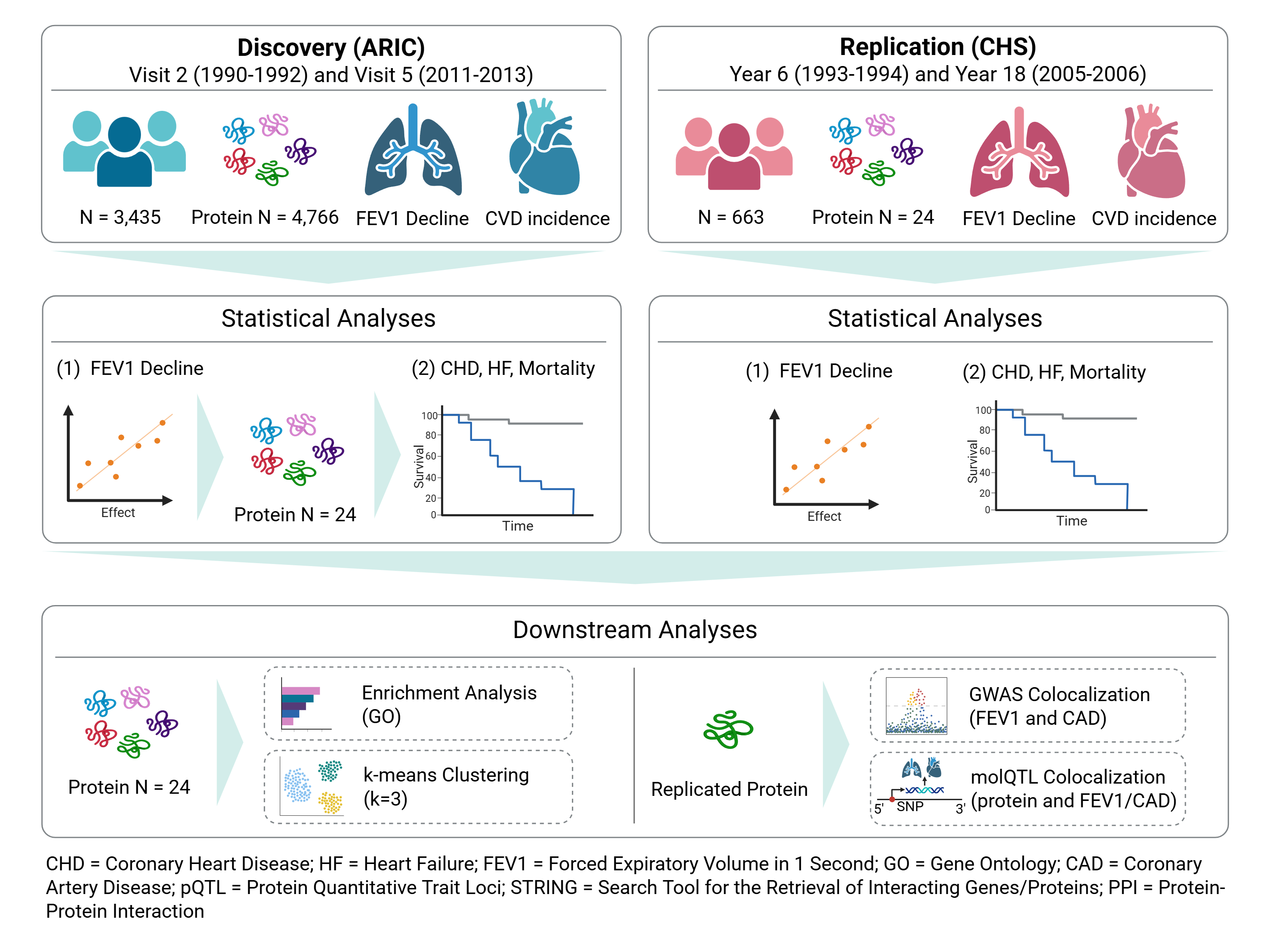
Methods: Spirometric measurements of FEV1 were collected at visits 2 (1990–92) and 5 (2011–13) in the Atherosclerosis Risk in Communities (ARIC) Study for discovery, and at years 6 (1993–94) and 18 (2005–06) in the Cardiovascular Health Study (CHS) for replication (Figure 1). Plasma proteomics (5K SomaScan) were assayed at baseline for each cohort. Annualized FEV1 decline was assessed using linear regression, adjusting for age, sex, race, smoking, BMI, kidney function, and baseline FEV1. Proteins associated with FEV1 decline were examined for incident coronary heart disease (CHD), heart failure (HF), and all-cause mortality, adjusting for clinical risk factors. Colocalization analyses were performed to assess shared genetic architecture between replicated proteins, FEV1, and clinical outcomes.

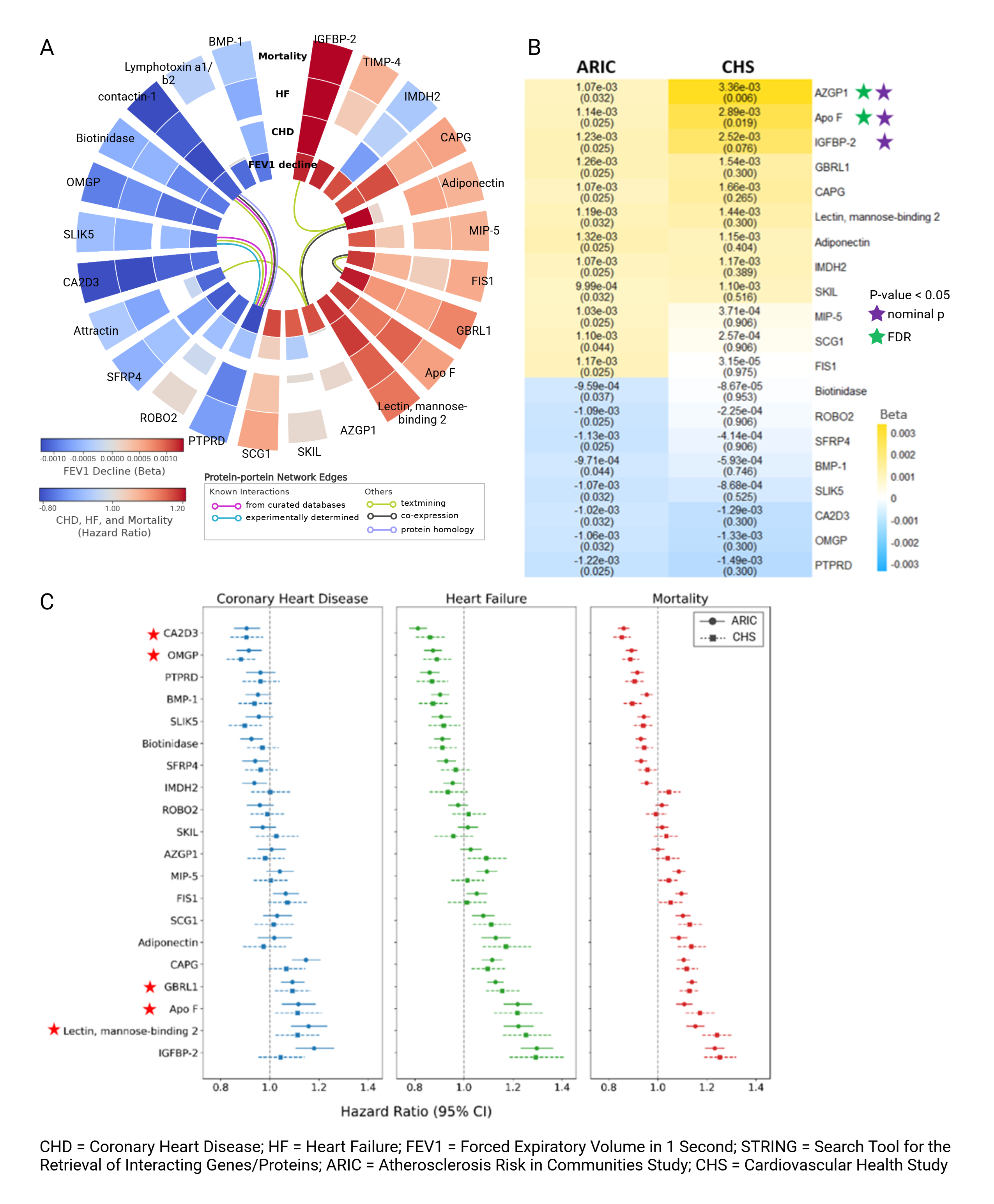
Results: Among 4,766 proteins, 24 were associated with FEV1 decline (FDR<0.05) in ARIC (N = 3,435; baseline mean age: 54 years; 18% Black; 58% female). Of these, eleven were associated with incident CHD, 20 with HF, and 21 with mortality (FDR<0.05) (Figure 2A). Of the 24 proteins from ARIC, 20 (83%) displayed consistent directional effects with FEV1 decline in CHS (N = 663; baseline mean age: 85 years; 16% Black; 64% female) (Figure 2B). Five proteins showed robust replication associations across all outcomes (FDR < 0.05): CA2D3 and OMGP demonstrated risk-decreasing effects, whereas GBRL1, Apo F, and lectin, mannose-binding 2 indicated risk-increasing effects (Figure 2C). Colocalization analyses showed that Apo F and FEV1, and Apo F and CHD shared the same underlying causal variants (posterior probabilities>0.7).

Conclusion: We identified and replicated plasma proteins, notably Apo F, linking pulmonary function decline to cardiovascular outcomes, offering insight into shared molecular mechanisms of cardiopulmonary disorders and providing potential intervention targets.
  • Lee, Yura  ( The University of Texas Health Science Center at Houston , Houston , Texas , United States )
  • Gharib, Sina  ( UNIVERSITY WASHINGTON , Shoreline , Washington , United States )
  • London, Stephanie  ( NIEHS , Research Triangle Park , North Carolina , United States )
  • Yu, Bing  ( The University of Texas Health Science Center at Houston , Houston , Texas , United States )
  • Austin, Thomas  ( UNIVERSITY WASHINGTON , Shoreline , Washington , United States )
  • Bartz, Traci  ( UNIVERSITY WASHINGTON , Shoreline , Washington , United States )
  • Ladd-acosta, Christine  ( Johns Hopkins University , Baltimore , Maryland , United States )
  • Morrison, Alanna  ( The University of Texas Health Science Center at Houston , Houston , Texas , United States )
  • North, Kari  ( The University of Texas Health Science Center at Houston , Houston , Texas , United States )
  • Boerwinkle, Eric  ( The University of Texas Health Science Center at Houston , Houston , Texas , United States )
  • Shah, Amil  ( UT Southwestern Medical Center , Dallas , Texas , United States )
  • Psaty, Bruce  ( UNIVERSITY WASHINGTON , Shoreline , Washington , United States )
  • Author Disclosures:
Meeting Info:

EPI-Lifestyle Scientific Sessions 2026

2026

Boston, Massachusetts

Session Info:

OMICS 2

Thursday, 03/19/2026 , 05:00PM - 07:00PM

Moderated Poster Session

More abstracts on this topic:
A validated metabolite-based biomarker score for fruit and vegetable intake and associations with all-cause mortality and incident cardiometabolic diseases

Oude Griep Linda, Li Chunxiao, Koulman Albert, Imamura Fumiaki, Wareham Nicholas, Forouhi Nita

A Multicentre Study for Hands Only CPR (HOCPR) training assessment towards building a ‘Nation of Life Savers” in India

Ravikumar Thanjavur, Sarma Kvs, Ravikumar Thanjavur, Sarkar Manuj, Debnath Dhrubajyoti, Behera Priyamadhaba, Ghate Jayshri, Trikha Divay, Samantaray A, Madhavi K

More abstracts from these authors:
Multi-trait Polygenic Risk Scores Improve Prediction of Heart Failure

Chung Shinhye, Cheng Susan, Fornage Myriam, Hall Michael, Hidalgo Bertha, Kaplan Robert, Lloyd-jones Donald, Morrison Alanna, Phillips Lawrence, Psaty Bruce, Raffield Laura, Spitzer Brian, Rahafrooz Maryam, Rodriguez Carlos, Rotter Jerome, Shah Sanjiv, Shah Amil, Taylor Kent, Wilson Peter, Xanthakis Vanessa, Joseph Jacob, Sun Yan, Hui Qin, Sofer Tamar, Ramachandran Vasan, Yu Bing, Nguyen Ngoc Quynh, Alkis Taryn, Liu Chang, Bartz Traci, Boerwinkle Eric, Brody Jennifer

Proteomic Profiling of Pulmonary Function Decline and Cardiovascular Disease Risk from Two Cohort Studies

Lee Yura, Gharib Sina, London Stephanie, Yu Bing, Austin Thomas, Bartz Traci, Ladd-acosta Christine, Morrison Alanna, North Kari, Boerwinkle Eric, Shah Amil, Psaty Bruce

You have to be authorized to contact abstract author. Please, Login
Not Available