Logo

American Heart Association

  21
  0


Final ID: MPWE43

Multi-trait Polygenic Risk Scores Improve Prediction of Heart Failure

Abstract Body: Background While clinical risk factors (CRF) have been used to predict heart failure (HF), an end-stage syndrome with high morbidity and mortality, the role of polygenic risk score (PRS) in identifying HF risk prediction remains unclear.
Method Using genome-wide summary statistics, we constructed 52 PRSs, including 1 for HF, 43 for echocardiographic(echo) traits, and 8 for CRF. Associations with incident HF were evaluated in 31,650 trans-ancestry participants (55% non-White; mean follow-up 16 years) from seven cohorts from the Trans-Omics for Precision Medicine (TOPMed) program, randomly divided into training (80%) and testing (20%) sets. Cox regression models adjusted for demographic and CRF were used to relate PRSs and to incident HF. Least absolute shrinkage and selection operator (LASSO) feature selection was performed on HF-related PRSs to build a multi-trait PRS (mPRS) in the training set. Associations of mPRS with incident HF, HF with preserved and reduced left ventricular (LV) ejection fraction (HFpEF and HFrEF, respectively), were examined in the testing set, with predictive performance evaluated by the C-statistic. Replication was conducted in 510,074 participants from the Million Veteran Program (MVP).
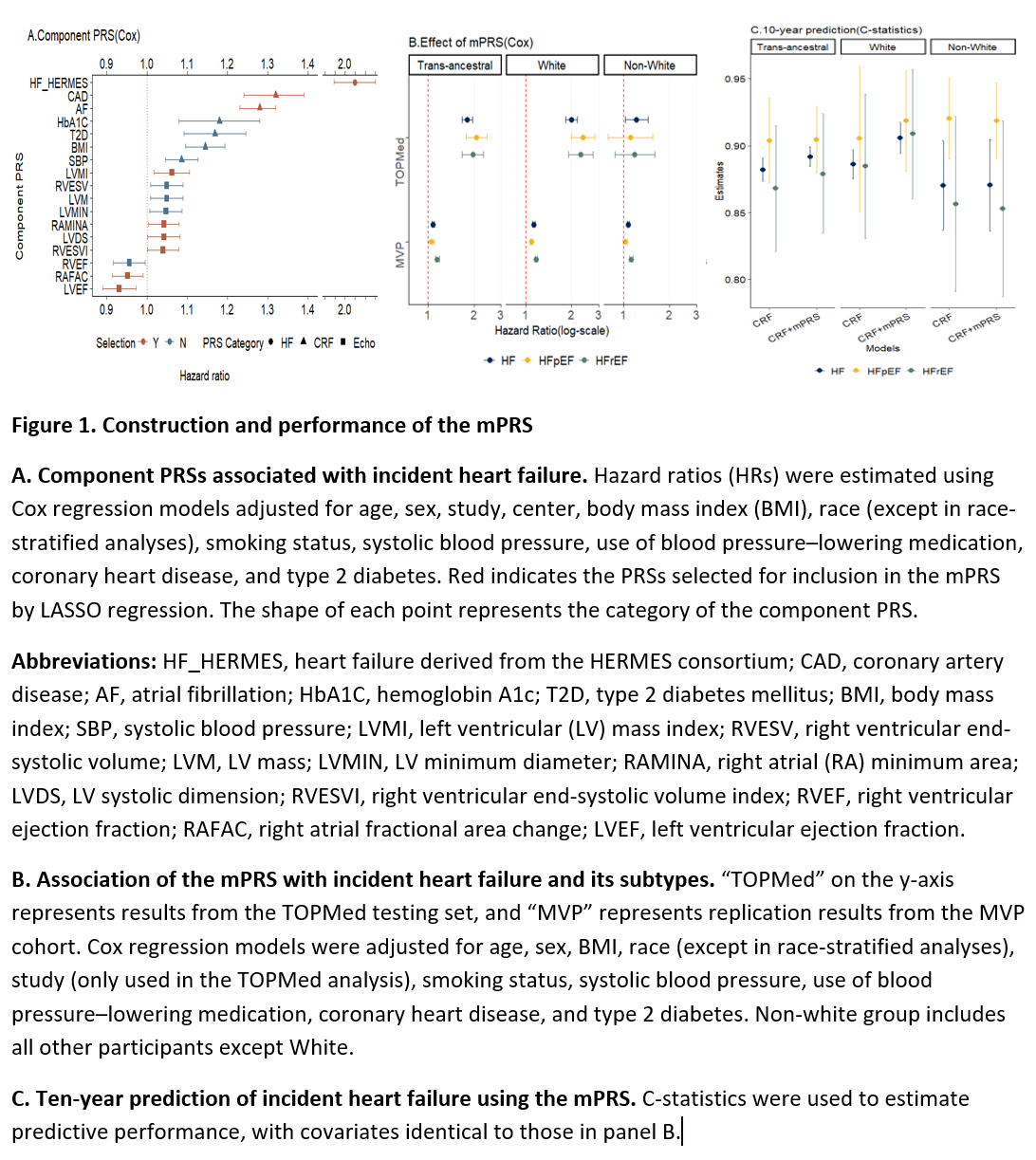
Results In the training set (n=25,320, HF cases=3,380), 17 out of 52 PRSs were associated with incident HF, where PRSs for HF and LV ejection fraction showed the largest effects (Figure 1a, HRHF-PRS: 2.02,95% CI 1.97-2.08, HRLVEF-PRS:0.93, 95% CI 0.89-0.97, p-value <0.05). Nine HF-related PRSs (1 HF, 6 echo, 2 CRF) were selected by LASSO to construct a multi-trait PRS (mPRS). In the testing set (n=6330, HF cases=856), per SD increase of mPRS was associated with about twofold increase in the risk of incident HF and its subtypes (Figure 1b, HRHF: 1.81, 95% CI 1.68–1.96; HRHFpEF: 2.08, 95% CI 1.78-2.43; HRHFrEF:1.97, 95% CI 1.68-2.31), and the associations were stronger in White vs Non-white participants. The associations of mPRS with incident HF and its subtypes were replicated in MVP (Figure 1b, HRHF: 1.13, 95% CI 1.11–1.15; HRHFpEF: 1.09, 95% CI 1.07-1.11; HRHFrEF:1.17, 95% CI 1.15-1.19). Adding mPRS over CRF modestly improved HF and HFrEF prediction in the trans-ancestral and white group (Figure 1c, HFtrans-ancestral: estimated C: 0.89, delta C=1%, all p-values<0.05).
Conclusion: The component PRS and mPRS were associated with HF risk, and mPRS can improve the prediction of incident HF, highlighting the potential for identifying at-risk populations.
  • Chung, Shinhye  ( University of Texas Health Science Center at Houston, School of Public Health , Houston , Texas , United States )
  • Spitzer, Brian  ( Department of Medicine, Harvard Medical School;CardioVascular Institute (CVI), Beth Israel Deaconess Medical Center , Boston , Massachusetts , United States )
  • Hui, Qin  ( Emory University , Decatur; Atlanta , Georgia , United States )
  • Nguyen, Ngoc Quynh  ( University of Texas Health Science Center at Houston, School of Public Health , Houston , Texas , United States )
  • Alkis, Taryn  ( University of Texas Health Science Center at Houston, School of Public Health , Houston , Texas , United States )
  • Liu, Chang  ( Emory University , Atlanta , Georgia , United States )
  • Bartz, Traci  ( University of Washington , Seattle , Washington , United States )
  • Boerwinkle, Eric  ( University of Texas Health Science Center at Houston;Human Genome Sequencing Center, Baylor College of Medicine , Houston , Texas , United States )
  • Brody, Jennifer  ( University of Washington , Seattle , Washington , United States )
  • Cheng, Susan  ( Cedars-Sinai Medical Center , Los Angeles , California , United States )
  • Fornage, Myriam  ( University of Texas Health Science Center at Houston , Houston , Texas , United States )
  • Hall, Michael  ( UNIV OF MISSISSIPPI MEDICAL CENTER , Jackson , Mississippi , United States )
  • Hidalgo, Bertha  ( UNIVERSITY OF ALABAMA AT BIRMINGHAM , Birmingham , Alabama , United States )
  • Kaplan, Robert  ( ALBERT EINSTEIN COLLEGE OF MEDICINE , Bronx , New York , United States )
  • Lloyd-jones, Donald  ( Boston University , Boston , Massachusetts , United States )
  • Morrison, Alanna  ( University of Texas Health Science Center at Houston, School of Public Health , Houston , Texas , United States )
  • Phillips, Lawrence  ( Atlanta VA Medical Center , Decatur , Georgia , United States )
  • Psaty, Bruce  ( UNIVERSITY WASHINGTON , Seattle , Washington , United States )
  • Raffield, Laura  ( University of North Carolina at Chapel Hill , Chapel Hill , North Carolina , United States )
  • Rahafrooz, Maryam  ( Brown University , Providence , Rhode Island , United States )
  • Rodriguez, Carlos  ( Albert Einstein School of Medicine , New York , New York , United States )
  • Rotter, Jerome  ( The Lundquist Institute for Biomedical Innovation at Harbor-UCLA Medical Center , Torrance , California , United States )
  • Shah, Sanjiv  ( NORTHWESTERN UNIVERSITY , Chicago , Illinois , United States )
  • Shah, Amil  ( UT Southwestern Medical Center , Dallas , Texas , United States )
  • Taylor, Kent  ( The Lundquist Institute for Biomedical Innovation at Harbor-UCLA Medical Center , Torrance , California , United States )
  • Wilson, Peter  ( Emory University , Atlanta , Georgia , United States )
  • Xanthakis, Vanessa  ( BU SCHOOL OF MEDICINE , Boston , Massachusetts , United States )
  • Joseph, Jacob  ( Brown University , Providence , Rhode Island , United States )
  • Sun, Yan  ( Emory University , Atlanta , Georgia , United States )
  • Sofer, Tamar  ( Beth Israel Deaconess Medical Center , Boston , Massachusetts , United States )
  • Ramachandran, Vasan  ( The University of Texas San Antonio School of Public Health , San Antonio , Texas , United States )
  • Yu, Bing  ( University of Texas Health Science Center at Houston, School of Public Health , Houston , Texas , United States )
  • Author Disclosures:
Meeting Info:

EPI-Lifestyle Scientific Sessions 2026

2026

Boston, Massachusetts

Session Info:

OMICS 1

Wednesday, 03/18/2026 , 05:00PM - 07:00PM

Moderated Poster Session

More abstracts on this topic:
A Potential Role for NKG2D, an NK cell receptor, in Accelerated CVD risk in African American Women Living in More Adverse Neighborhood Conditions: Data From the Step It Up Physical Activity Digital Health-Enabled, Community-Engaged Intervention

Baez Andrew, Andrews Marcus, Sandler Dana, Aquino Peterson Elizabeth, Sharda Sonal, Tolentino Katherine Joy, Lopez De Leon Shirley, Seo Jein Eleanor, Cintron Manuel, Pita Mario, Tarfa Hannatu, Baumer Yvonne, Reger Robert, Childs Richard, Powell-wiley Tiffany, Dave Ayushi, Saurabh Abhinav, Mendelsohnl Laurel, Chen Long, Igboko Muna, Wells Ayanna, Marah Marie

A machine learning approach to classifying ischemic stroke etiology using variables available in the Get-with-the-Guidelines Stroke Registry

Lee Ho-joon, Schwamm Lee, Turner Ashby, De Havenon Adam, Kamel Hooman, Brandt Cynthia, Zhao Hongyu, Krumholz Harlan, Sharma Richa

More abstracts from these authors:
Association of Circulating Metabolites with Incident Heart Failure and its Subtypes in Multi-ethnic Populations

Moon Eun Hye, Hutton Scott, Kaplan Robert, Lloyd-jones Donald, Psaty Bruce, Raffield Laura, Rodriguez Carlos, Rotter Jerome, Shah Amil, Shah Sanjiv, Taylor Kent, Alkis Taryn, Wong Kari, Xanthakis Vanessa, Ramachandran Vasan, Yu Bing, Luo Kai, Grove Megan, Boerwinkle Eric, Clish Clary, Gerszten Robert, Hall Michael And Jo Alice, Hou Lifang

Metabolomic Profiles of Cardiac Structure and Function and Their Associations with Incident Heart Failure in Multi-Ethnic Populations

Moon Eun Hye, Hall Michael, Hou Lifang, Hutton Scott, Kaplan Robert, Kizer Jorge, Lloyd-jones Donald, Psaty Bruce, Raffield Laura, Rodriguez Carlos, Rotter Jerome, Alkis Taryn, Shah Amil, Shah Sanjiv, Taylor Kent, Wong Kari, Xanthakis Vanessa, Ramachandran Vasan, Yu Bing, Luo Kai, Chung Shinhye, Boerwinkle Eric, Cheng Susan, Clish Clary, Gerszten Robert, Grove Megan

You have to be authorized to contact abstract author. Please, Login
Not Available