
Smoking-Related Proteins and Incident Chronic Obstructive Pulmonary Disease Hospitalizations: The Atherosclerosis Risk in Communities (ARIC) Study
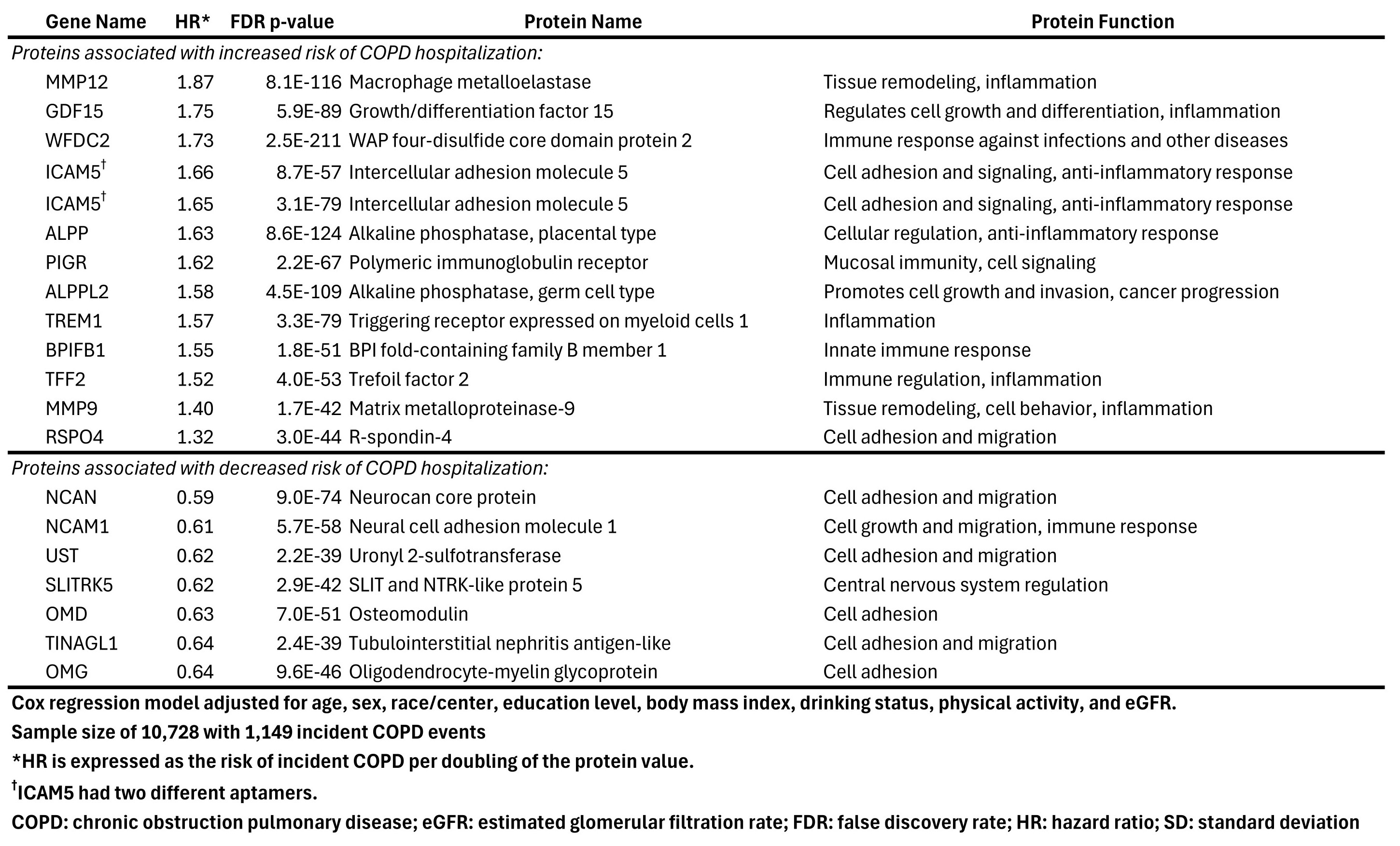
Abstract Body: Background: Cross-sectional studies have identified associations between smoking and various plasma proteins. Some studies have examined the association of these cross-sectional smoking-related proteins with chronic obstructive pulmonary disease (COPD). However, no studies have analyzed longitudinal associations between these proteins and COPD outcomes. Methods: A total of 10,728 participants from the Atherosclerosis Risk in Communities (ARIC) study without a prior hospitalization for COPD had approximately 5,000 plasma proteins measured using the aptamer-based SomaLogic proteomic profiling platform at visit 2 (1990-1992). For this analysis, we included 116 proteins cross-sectionally associated with smoking in a previous ARIC study. Protein concentrations were log2 transformed and then standardized. Incident COPD hospitalizations were ascertained from hospital discharge codes between visit 2 and the end of visit 5 (2013). We used Cox proportional hazards regression to assess the association of smoking-related proteins and incident COPD hospitalization, adjusting for demographics and other potential confounders. To account for multiple comparisons, a false discovery rate (FDR) p-value of less than 0.05 was considered statistically significant. Results: This study sample had a mean age of 57 (range 46-70), 56% were female, and 24% were Black. For smoking status, 21% were current smokers, and 38% were former smokers. A total of 1,149 (11%) participants had an incident COPD hospitalization over a median follow-up of 20.2 years. Out of the 116 smoking-related proteins, 108 (93%) of the smoking-related proteins were associated with COPD hospitalization after FDR correction. The top twenty proteins based on the FDR p-value are presented in the Table and are sorted by the direction of the association and hazard ratio. We performed two sensitivity analyses: 1) restricting follow-up time to 10 years after visit 2, and 2) winsorizing at +/- 5 standard deviation units; both yielded results comparable to the primary analysis. Conclusion: Future research should test whether these smoking-associated proteins are on mechanistic pathways involved in COPD pathogenesis and susceptibility to COPD hospitalization.
Misialek, Jeffrey
(
University of Minnesota
, Minneapolis , Minnesota , United States )
Ru, Meng
(
Johns Hopkins Bloomberg School of Public Health
, Baltimore , Maryland , United States )
Platz, Elizabeth
(
Johns Hopkins Bloomberg School of Public Health
, Baltimore , Maryland , United States )
Macdonald, David
(
University of Minnesota
, Minneapolis , Minnesota , United States )
Wendt, Christine
(
University of Minnesota
, Minneapolis , Minnesota , United States )
Sedaghat, Sanaz
(
University of Minnesota
, Minneapolis , Minnesota , United States )
Guan, Weihua
(
University of Minnesota
, Minneapolis , Minnesota , United States )
Lutsey, Pamela
(
University of Minnesota
, Minneapolis , Minnesota , United States )
Pankow, Jim
(
University of Minnesota
, Minneapolis , Minnesota , United States )