Declining Mortality From Myocardial Infarction in CKD Stage 3 and Above: Persistent Sex and Racial Disparities in the United States, 1999–2020
Abstract Body (Do not enter title and authors here): Background: Chronic kidney disease (CKD) stage 3 and above is strongly linked with increased cardiovascular mortality. Myocardial infarction (MI) in this population carries a particularly poor prognosis. However, long-term trends in MI mortality among CKD patients—and how these vary by sex and race remain underexplored.
Hypothesis: We hypothesized that MI mortality among patients with CKD stage 3 or higher has declined over time, but with persistent disparities by sex and race. We aimed to characterize these temporal patterns and identify inflection points using joinpoint regression.
Methods: Using CDC WONDER data from 1999 to 2020, we extracted age-adjusted mortality rates (AAMRs) for adults aged ≥25 years with advanced CKD and MI. AAMRs were stratified by sex (male, female) and race (White, Black, Asian/Pacific Islander, American Indian/Alaska Native, Hispanic). Linear and joinpoint regression (1 allowed inflection) were used to estimate slope coefficients (β), 95% confidence intervals (CI), and trend shifts.
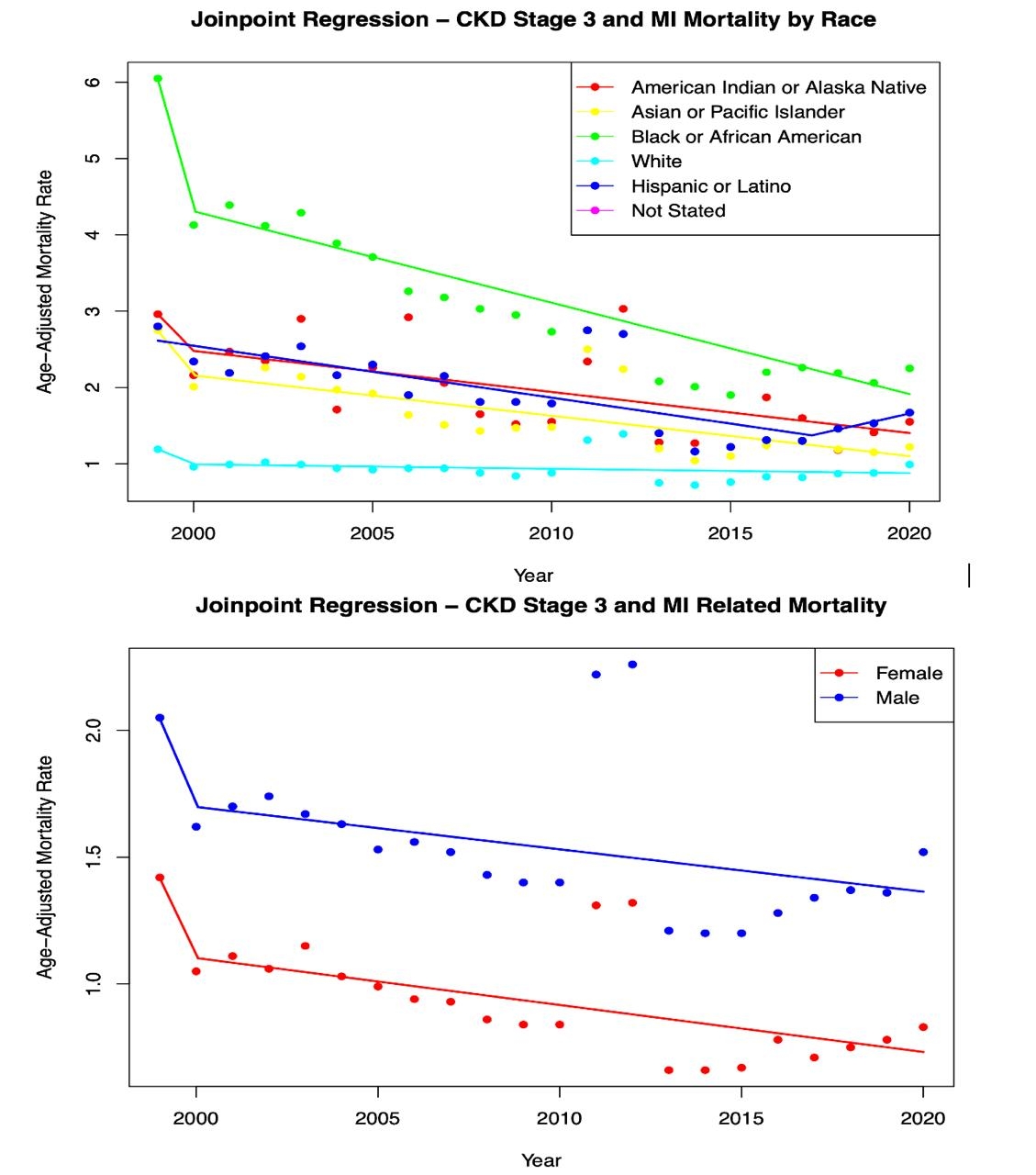
Results: In sex-stratified analyses, mortality declined in both groups: males (β = -0.021, p = 0.036) with early steep decline (slope1 = -0.331) plateauing after 2005 (slope2 = -0.017); females showed greater sustained decline (β = -0.022, p = 0.001, R2 = 0.423). Among racial groups, Black individuals had the sharpest initial decline (slope1 = -1.65) and continued improvement (slope2 = -0.12, p < 0.001). Asian/Pacific Islander and American Indian/Alaska Native groups showed modest declines (slope2 ≈ -0.05, p < 0.01). White patients had stable mortality (slope2 = -0.006, NS). Hispanic mortality declined until 2017 (slope1 = -0.068, p < 0.001), then rose (slope2 = +0.105, NS).
Conclusions: From 1999–2020, MI-related mortality in advanced CKD declined overall, with more consistent reductions among females. Black individuals demonstrated the greatest mortality reduction, though they started at the highest baseline. In contrast, White mortality remained stable, and a concerning uptick was observed in Hispanic populations post-2017. These trends emphasize the need for tailored public health interventions to address persisting disparities in cardiovascular outcomes among CKD patients.
Farooqi, Mashood
(
Central Michigan University
, Saginaw , Michigan , United States )
Yasmeen, Umera
(
Mamata Medical College
, Khammam , India )
Mohammed, Adil
(
Central Michigan University
, Saginaw , Michigan , United States )
Begum, Iramunisa
(
Shadan Institute of Medical Sciences
, Hyderabad , India )
Mohammed, Zaki Ur Rahman
(
Sanford Health
, Moorhead , Minnesota , United States )
Iftikhar, Novfa
(
Government Medical College Srinagar
, Srinagar , India )
Alhaddadin, Robert
(
CMU College of Medicine
, Saginaw , Michigan , United States )
Fayaz, Falah
(
Government Medical College Srinagar
, Srinagar , India )
Beeharry, Sarah
(
Central Michigan University
, Saginaw , Michigan , United States )
Gariaqoza, Yousif
(
Central Michigan University
, Saginaw , Michigan , United States )
Do, Pauline
(
CMUCOM
, Saginaw , Michigan , United States )
Ghantasala, Paritharsh
(
Apogee physicians
, Saginaw , Michigan , United States )
Author Disclosures:
Mashood Farooqi:DO NOT have relevant financial relationships
| Yousif Gariaqoza:DO NOT have relevant financial relationships
| Pauline Do:DO NOT have relevant financial relationships
| paritharsh ghantasala:DO NOT have relevant financial relationships
| Umera Yasmeen:DO NOT have relevant financial relationships
| Adil Mohammed:DO NOT have relevant financial relationships
| Iramunisa Begum:No Answer
| Zaki Ur Rahman Mohammed:No Answer
| Novfa Iftikhar:No Answer
| Robert Alhaddadin:DO NOT have relevant financial relationships
| Falah Fayaz:DO NOT have relevant financial relationships
| Sarah Beeharry:No Answer