Logo

American Heart Association

  6
  0


Final ID: TH842

Machine Learning–Based Analysis of Behavioral and Social Determinants of Cardiovascular Mortality in Adults With Diabetes

Abstract Body: Introduction: Cardiovascular (CV) mortality remains high among adults with diabetes. The impact of behavioral and social factors contributing to this heightened risk is not well understood, and the nonlinear patterns of these determinants can be challenging to capture using traditional linear models.

Hypothesis: We hypothesized that explainable machine learning framework based on a tree-based model with Shapley Additive Explanations (SHAP) can capture nonlinear associations between behavioral and social determinants of CV mortality among individuals with diabetes.
Methods: Adults with diabetes were identified from the National Health and Nutrition Examination Survey 2007–2018 and linked to the National Death Index. CV mortality was modeled with a tree-based gradient boosting classifier. Feature contributions were assessed using SHAP. SHAP-derived odds ratios (ORs) were obtained by exponentiating differences in mean SHAP values between categories or per-unit increases in continuous variables. Confidence intervals (CIs) were estimated from 1,000 bootstrap samples. Nonlinear associations in continuous variables were modeled using piecewise regression of SHAP values.

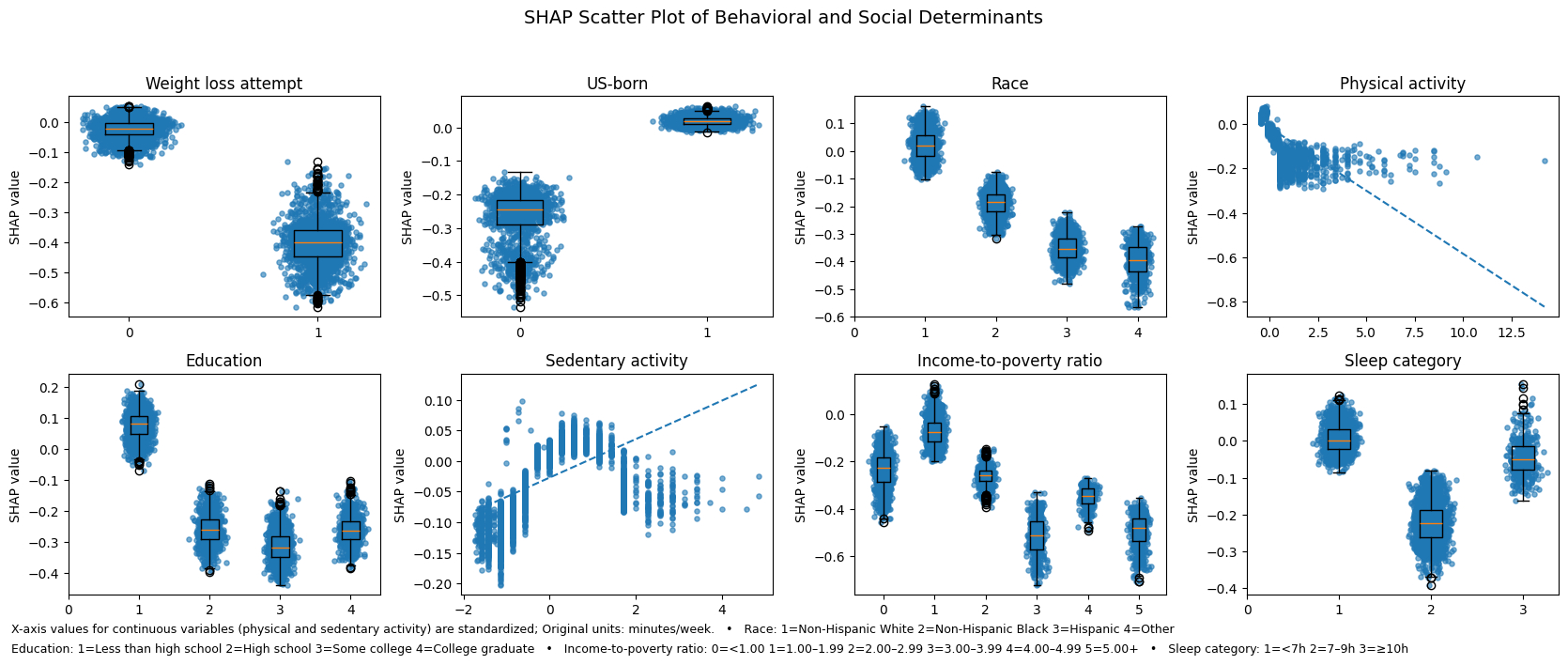
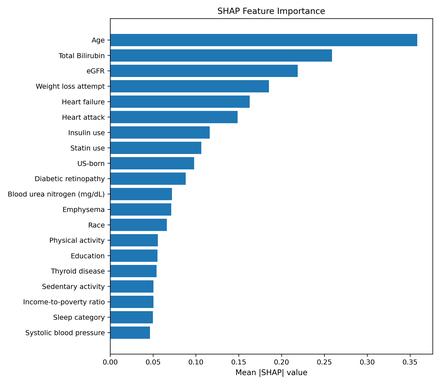
Results: Among 5,734 adults with diabetes, 516 CV deaths were identified. Of the top 20 contributors in the model, 8 were behavioral or social determinants, accounting for 38% of the model’s explainability. Being U.S.-born was associated with higher odds of CV mortality (OR 1.33, 95% CI 1.33–1.34), as were short (<6 h) and long (>9 h) sleep durations compared with 7–9 h (OR 1.26 and 1.19, respectively). In contrast, recent weight-loss attempts were associated with lower odds (OR 0.68, 95% CI 0.68–0.69). Compared with non-Hispanic Whites, odds were lower among Hispanics (OR 0.81, 95% CI 0.81–0.81). Higher education (college graduate vs less than high school) was associated with reduced odds (OR 0.71, 95% CI 0.71–0.72), as was higher income measured by the income-to-poverty ratio (PIR ≥5 vs <1; OR 0.77, 95% CI 0.77–0.78). Physical activity showed a nonlinear relationship, lowering CV mortality by 0.9% per 10 minutes up to approximately 215 minutes per week, after which further activity yielded minimal benefit.

Conclusions: Behavioral and social determinants accounted for a substantial portion of CV mortality risk in adults with diabetes. SHAP-driven interpretability revealed nonlinear relationships, emphasizing modifiable behaviors and social context as key contributors to mortality heterogeneity.
  • Ahn, Woo Jin  ( National Emergency Medical Center , Seoul , Korea (the Republic of) )
  • Gao, Shangzi  ( Stanford Center for Asian Health Research and Education , Palo Alto , California , United States )
  • Kaur, Bani  ( Stanford Center for Asian Health Research and Education , Palo Alto , California , United States )
  • Biswas, Avinav  ( Stanford Center for Asian Health Research and Education , Palo Alto , California , United States )
  • Nguyen, Dang  ( Harvard University , Cambridge , Massachusetts , United States )
  • Tivakaran, Seth  ( Stanford Center for Asian Health Research and Education , Palo Alto , California , United States )
  • Srinivasan, Malathi  ( Stanford Center for Asian Health Research and Education , Palo Alto , California , United States )
  • Panyanouvong, Nicholas  ( Stanford Center for Asian Health Research and Education , Palo Alto , California , United States )
  • Uy, Lester Andrew  ( Stanford Center for Asian Health Research and Education , Palo Alto , California , United States )
  • Rajeshuni, Nitya  ( Stanford Center for Asian Health Research and Education , Palo Alto , California , United States )
  • Huang, Robert  ( Stanford Center for Asian Health Research and Education , Palo Alto , California , United States )
  • Kamdar, Neil  ( Stanford Center for Asian Health Research and Education , Palo Alto , California , United States )
  • Yasui, Osamu  ( Stanford Center for Asian Health Research and Education , Palo Alto , California , United States )
  • Kim, Gloria  ( Stanford University , Stanford , California , United States )
  • Palaniappan, Latha  ( Stanford University , Stanford , California , United States )
  • Le, Minh  ( Stanford Center for Asian Health Research and Education , Palo Alto , California , United States )
  • Sun, Louise  ( Stanford Medicine , Palo Alto , California , United States )
  • Author Disclosures:
Meeting Info:

EPI-Lifestyle Scientific Sessions 2026

2026

Boston, Massachusetts

Session Info:

Poster Session 3

Thursday, 03/19/2026 , 05:00PM - 07:00PM

Poster Session

More abstracts on this topic:
A Randomized Phase 2 Trial of Muvalaplin: An Oral Disrupter of the Assembly of Lipoprotein(a) Particles

Nicholls Stephen, Ni Wei, Rhodes Grace, Nissen Steven, Navar Ann Marie, Michael Laura, Krege John

A Community-Based Intervention to Improve Cardiovascular Health Understanding in the Dallas-Fort Worth South Asian Community

Deo Parminder, Rohatgi Anand, Sharma Parul, Sathyamoorthy Mohanakrishnan

More abstracts from these authors:
Disparities in the Association Between Diabetes Mellitus and All-Cause Mortality Among Asian American Subgroups: Findings From the National Health Interview Survey (NHIS) (1997–2018)

Szeto Benjamin, Kim Gloria, Srinivasan Malathi, Palaniappan Latha, Bacong Adrian, Gujral Unjali, Lam Hin Lai Ivan, Gangaram Sahithi, Kaur Muskan, Sediqi Sadaf, Uy Lester Andrew, Jamal Armaan, Rajeshuni Nitya, Huang Robert

Racial Disparities in the Association of Adiposity Measures with Cardiovascular Disease Mortality

Tong King Sum, Kim Gloria, Huang Robert, Palaniappan Latha, Bacong Adrian, Leung Jeff, Tivakaran Seth, Raghu Julia, Panyanouvong Nicholas, Uy Lester, Jamal Armaan, Srinivasan Malathi, Rajeshuni Nitya

You have to be authorized to contact abstract author. Please, Login
Not Available