Brain Proteomic Profiles Associated with Frailty and Motor Function Trajectories in Community-Dwelling Older Adults
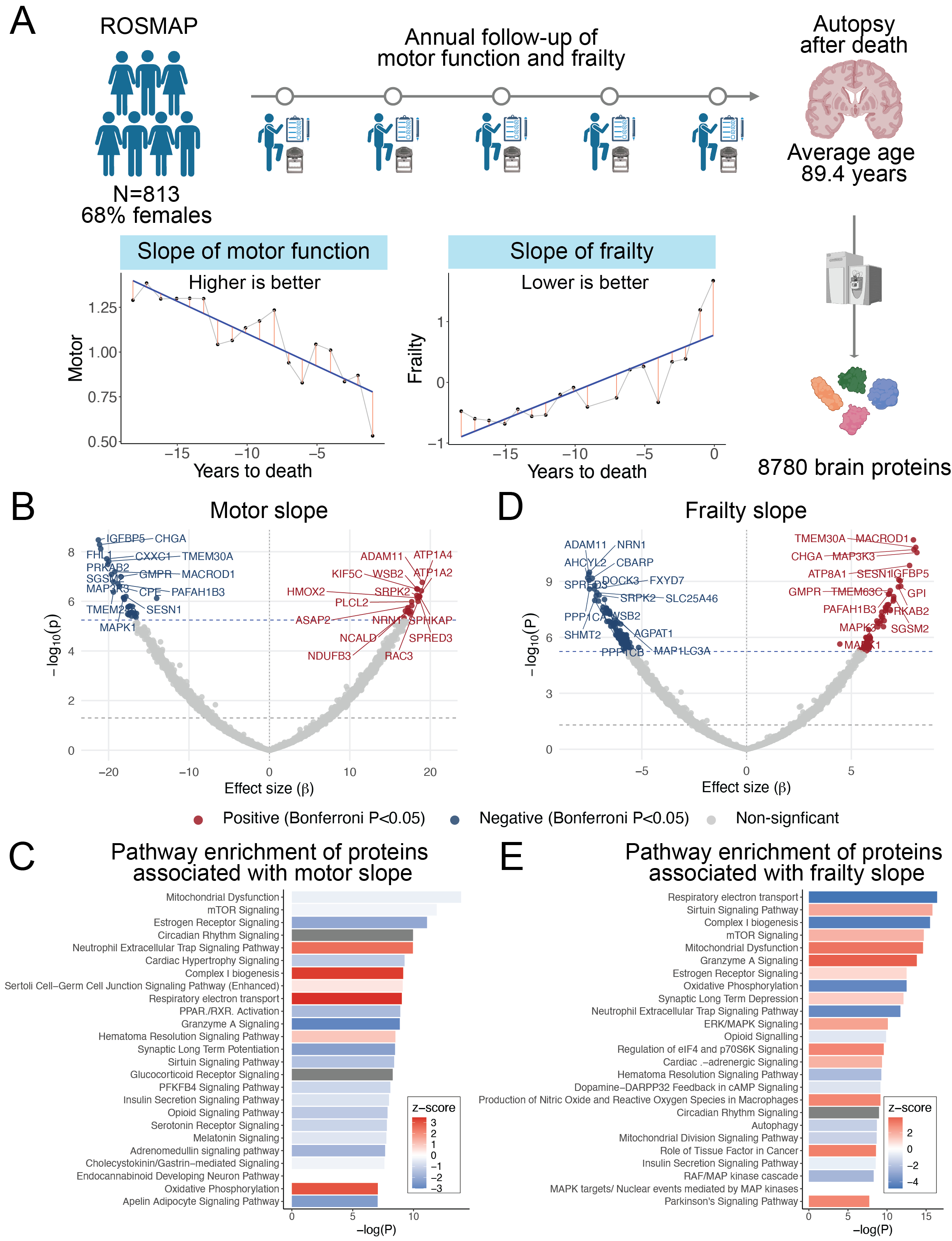
Abstract Body: Introduction Motor function decline and increase in frailty accelerate with aging and are associated shorter lifespan. These functional changes have been associated with age-related changes in brain activity, but the precise molecular pathways involved remain unclear. Hypothesis Motor function and frailty trajectories are associated with specific brain proteins in older adults. Methods Our study included 813 adults from the Religious Orders Study and the Rush Memory and Aging Project (mean age=80.7 yr at baseline and 89.4 yr at death). Antemortem global motor function was assessed objectively by 10 performances, and frailty was assessed based on BMI, fatigue, gait, grip strength, and physical activity, with up to 26 repeated annual assessments (Fig. A). Slopes of changes in motor function and frailty were estimated using linear mixed-effects models. Proteomic profiling of dorsolateral prefrontal cortex tissues was conducted using isobaric tandem mass tag (TMT) peptide labeling coupled with LC-MS. Diet was assessed annually using a food frequency questionnaire. Linear regression was used to assess associations between diet, brain proteins, and motor function and frailty slopes. Results Of the 8780 brain proteins measured, multivariable analysis identified 53 associated with motor function decline (P-adjusted<0.05; Fig. B). These proteins are enriched in pathways such as mitochondrial dysfunction, mTOR signaling, and estrogen receptor signaling for motor-associated proteins, leading by proteins including PRKAB2, MAPK1, and NDUFB3 (Fig. B-C). In addition, frailty progression was associated with 176 brain proteins (P-adjusted<0.05; Fig. D), leading by NRN1, MACROD1, and PPP1CB, with pathway enrichment in respiratory electron transport, sirtuin signaling, and mitochondrial dysfunction (Fig. D-E). Furthermore, higher consumptions of fish and EPA+DPA were inversely associated with frailty slope (P<0.05). Among frailty-associated brain proteins, fish and DPA intake were associated with Paralemmin-3 (FDR=0.03). Conclusions Motor function decline and increase in frailty are associated with alterations of brain proteins enriched in mitochondrial, mTOR, and energy metabolism-related signaling pathways. Fish intake, which is related to less frailty, is associated with Paralemmin-3 (involved in brain mitochondrial function).
Mei, Zhendong
(
Brigham and Women's Hospital
, Boston , Massachusetts , United States )
Tessier, Anne-julie
(
Harvard T.H. Chan School of Public
, Boston , Massachusetts , United States )
Wang, Xingyan
(
Harvard T.H. Chan School of Public
, Boston , Massachusetts , United States )
Liang, Liming
(
Harvard University
, Boston , Massachusetts , United States )
Bennett, David
(
Rush University Medical Center
, Chicago , Illinois , United States )
Arvanitakis, Zoe
(
Rush University Medical Center
, Chicago , Illinois , United States )
Grodstein, Francine
(
Rush University Medical Center
, Chicago , Illinois , United States )
Capuano, Ana
(
Rush University
, Chicago , Illinois , United States )
Li, Jun
(
Harvard Medical School, BWH
, Boston , Massachusetts , United States )
Yun Huan, Clish Clary, Willett Walter, Manson Joann, Hu Frank, Liang Liming, Li Jun, Hu Jie, Wang Xingyan, Sevilla-gonzalez Magdalena, Mei Zhendong, Tessier Anne-julie, Tobias Deirdre, Zeleznik Oana, Eliassen A