Associations Between Rurality and Early Pregnancy Cardiovascular Health Behaviors in a Central Appalachian Cohort
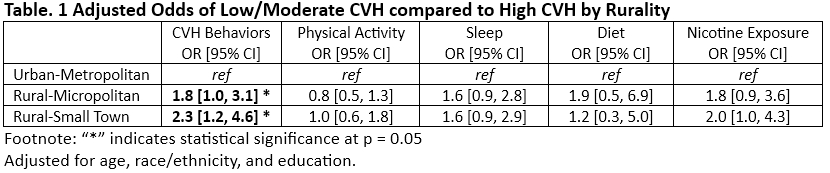
Abstract Body: Introduction: Ideal cardiovascular health behaviors are associated with lower rates of cardiovascular and other pregnancy complications. Since such complications are more prominent in rural areas compared to urban areas, this study aimed to evaluate whether rurality is associated with first trimester Life’s Essential 8 (LE8) CVH behaviors, including physical activity, sleep, diet, and avoidance of nicotine. Hypothesis: Those living in rural areas would have worse CVH behaviors in early pregnancy than their urban counterparts. Methods: This study presents a secondary analysis of the Mountain Mama and Baby Study cohort (n=417) from the first trimester of pregnancy. Participant’s physical addresses were translated into the United States Department of Agriculture’s 2020 Primary Rural-Urban Commuting Area (RUCA) Codes and classified into three categories: 1) Urban-Metropolitan (1-3), 2) Rural-Micropolitan (4-6), and 3) Rural-Small Town (7-10). CVH behavior scores were assessed using the LE8 framework, calculated from self-report instruments for physical activity (Pregnancy Physical Activity Questionnaire), sleep duration (Pittsburgh Sleep Quality Index), diet (Mediterranean Eating Pattern for Americans), and past/current nicotine exposure. Each CVH behavior was scored from 0 (least healthy) to 100 (most healthy) and an overall mean score was calculated by adding the scores for each measure and dividing by 4. The overall score and each component were classified into two CVH categories: 1) high (≥80) and 2) low-to-moderate (≤79). Adjusted logistic regression models evaluated the associations between rurality and overall CVH behaviors and each component, adjusting for age, race/ethnicity, and education. Results: In the adjusted analysis, living in rural-micropolitan areas and rural-small towns in central Appalachia were associated with significantly higher odds of low-to-moderate CVH behavior in early pregnancy compared to living in urban-metropolitan areas (rural-micropolitan: OR = 1.8, 95% CI: 1.0, 3.1; rural-small towns: OR = 2.3, 95% CI: 1.2, 4.6). However, no statistically significant associations were found between rurality and having low-to-moderate individual CVH behaviors, including physical activity, sleep, diet, or nicotine exposure (See Table 1). Conclusion: Poorer CVH behaviors in pregnancy may contribute to disparities but also provide an intervention strategy to reduce pregnancy-related morbidity and mortality among rural populations.
Marshall, Elly
(
West Virginia University
, Morgantown , West Virginia , United States )
Umer, Amna
(
WEST VIRGINIA UNIVERSITY
, Morgantown , West Virginia , United States )
Whitaker, Kara
(
UNIVERSITY OF IOWA
, Iowa City , Iowa , United States )
Rowan, Shon
(
WEST VIRGINIA UNIVERSITY
, Morgantown , West Virginia , United States )
Olfert, Ivan
(
WEST VIRGINIA UNIVERSITY
, Morgantown , West Virginia , United States )
Lilly, Christa
(
WEST VIRGINIA UNIVERSITY
, Morgantown , West Virginia , United States )
Barone Gibbs, Bethany
(
West Virginia University
, Morgantown , West Virginia , United States )