
Logo

American Heart Association

  2
  0


Final ID: WE534

Seven-Day Accelerometer Data Provide a Reasonable Proxy for Longitudinal Exercise Patterns

Abstract Body: Introduction: The incorporation of accelerometer data into population biobanks has catalyzed a new wave or research into physical activity. The most common study design uses 7 days of data to define exercise patterns.

Hypothesis: Exercise patterns defined using 7-day accelerometer data are consistent with those defined using 90-day data.

Methods: We analyzed participants from the All of Us Research Program with accelerometer (FitBit) data prior to enrollment. We defined a subset of dedicated users with sufficient data (>88% of days with ≥12 hours of wear-time) over the 90 day period prior to enrollment, including the 7 days immediately prior to enrollment. FitBit-defined “very active” and “fairly active” minutes were used to estimate vigorous intensity and moderate intensity exercise minutes respectively. Race, ethnicity, gender, and sex at birth were self-reported. Pearson’s correlation coefficients were used to compare the average weekly activity minutes using 7-day versus 90-day data. Meeting guidelines was defined as ≥75 minutes of vigorous intensity and/or ≥150 minutes of moderate intensity exercise per week.

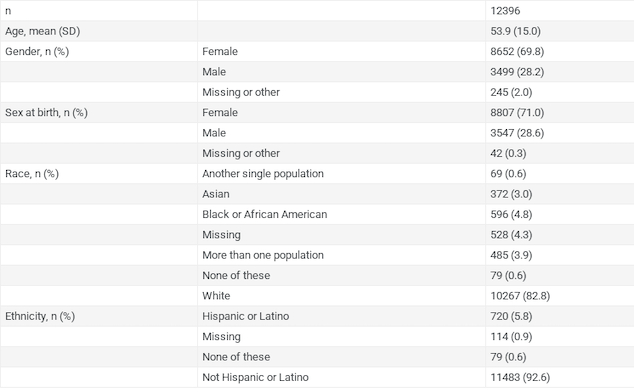
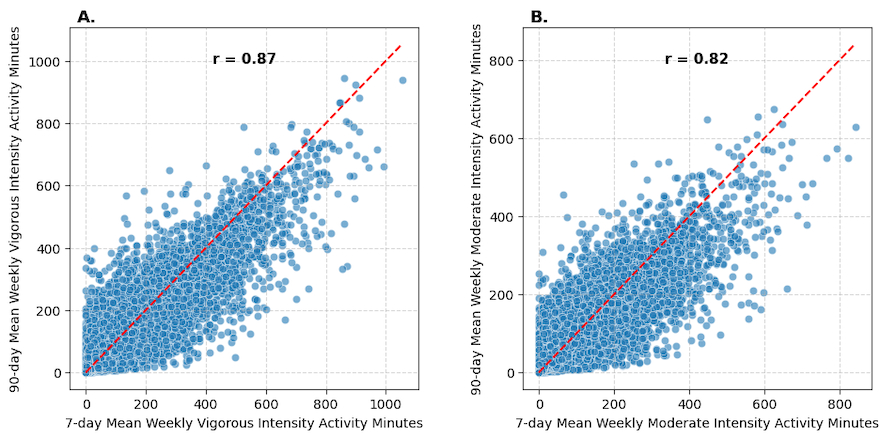
Results: The cohort consisted of 12,396 participants. Demographics are reported in the Table. Mean weekly activity minutes over 7-day and 90-day periods were positively correlated for both moderate and vigorous intensity exercise (Figure). The average difference in estimates from 7-day and 90-day data was 7.6 (SD 73.6) minutes/week for vigorous and 3.8 (SD 61.2) minutes/week for moderate intensity exercise. Among the 7,213 individuals who met guidelines based on 7-day data, 983 (14%) did not meet guidelines when considering 90-day data. Of the 5,183 individuals who did not meet guidelines based on 7-day data, 1,007 (19%) did meet guidelines when considering 90-day data. When identifying individuals who achieve recommended weekly exercise, the overall agreement between 7-day and 90-day data was 83.9% with Kappa .670 (95% CI [0.656, 0.682]), reflecting good agreement.

Conclusions: In conclusion, exercise patterns derived from 7-day accelerometer data show good agreement with those derived from 90-day data. Though, some individuals may be misclassified. Overall, our findings support the use of 7-day data for studies of exercise patterns in large populations, but the potential impacts of modest misclassification should be considered.
  • Scharfstein, Eliza  ( Albert Einstein College of Medicine , Bronx , New York , United States )
  • Clarke, Shoa  ( Stanford University , Palo Alto , California , United States )
  • Author Disclosures:
Meeting Info:

EPI-Lifestyle Scientific Sessions 2026

2026

Boston, Massachusetts

Session Info:

Poster Session 2

Wednesday, 03/18/2026 , 05:00PM - 07:00PM

Poster Session

More abstracts on this topic:
AI-Based ECG Denoising Improves Smartwatch ECG Interpretation

Liao Shun, Di Achille Paolo, Vakharia Tanay, Faranesh Tony, Shreibati Jacqueline, Poh Ming-zher

Apparent Resistant Hypertension in US Adults: Temporal Trends, Renal Denervation Eligibility, and the Impact of Isolated Systolic Hypertension

Ateh Stanislas Ketum, Metlock Faith, Ogungbe Bunmi, Cingolani Oscar, Commodore-mensah Yvonne

More abstracts from these authors:
You have to be authorized to contact abstract author. Please, Login
Not Available