Prospective Associations of PFAS with Cardiovascular Disease in Prediabetes: Diabetes Prevention Program
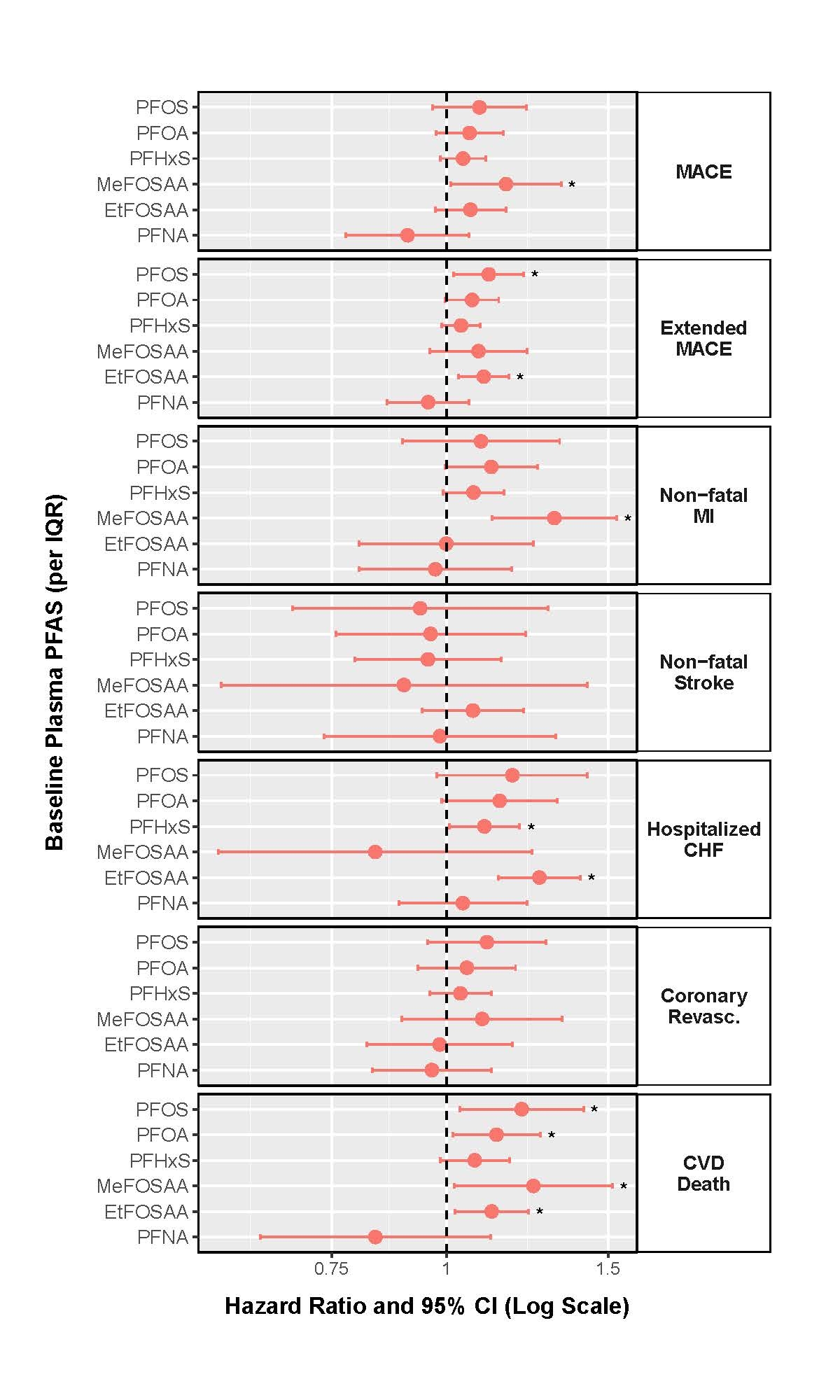
Abstract Body: Background: Per- and polyfluoroalkyl substances (PFAS) are persistent environmental contaminants linked to cardiometabolic dysfunction, yet their prospective association with cardiovascular disease (CVD) in high-risk populations remains unclear. We evaluated whether baseline plasma PFAS concentrations predict incident CVD in adults with prediabetes in the Diabetes Prevention Program Outcomes Study (DPPOS). Methods: In 1,382 DPPOS participants, we measured baseline plasma concentrations of six PFAS (PFHxS, PFOS, PFOA, PFNA, MeFOSAA, EtFOSAA). Notably, MeFOSAA and EtFOSAA eventually metabolize to PFOS. We followed participants for a median of 21 years. Cox proportional hazards models estimated risks for CVD per interquartile range (IQR) increase in PFAS. We assessed PFAS mixture effects using a burden score and quantile g-computation and explored effect modification by age, sex/menopause, diet, and physical activity. Data provided by NIDDK CR, a program of the National Institute of Diabetes and Digestive and Kidney Diseases. Results: At baseline (1996-1999, mean [SD] age 52.1 [10.3] years), median PFAS concentrations were comparable to U.S. reference values (e.g., PFOS: 27.9 ng/mL; PFOA: 4.77 ng/mL). Incidence of major adverse cardiovascular events (MACE) was 9.6%; CVD death was 3.9%. Each IQR (1.1 ng/mL) increase in MeFOSAA was associated with a 16% higher risk of MACE (95% CI: 1.01–1.33) and 24% higher CVD death risk (95% CI: 1.02–1.52). PFHxS, PFOS, EtFOSAA, and PFOA were linked to elevated risks of non-fatal myocardial infarction, hospitalized congestive heart failure, and CVD death. Mixture and total PFAS burden analyses showed no significant associations. No consistent effect modification was observed by age, sex, diet, or physical activity. Sensitivity analyses accounting for additional covariates, including educational attainment, martial status, alcohol intake, physical activity, BMI, and fish intake, showed consistent results. Conclusion: Higher plasma concentrations of select PFAS, particularly MeFOSAA, were associated with increased CVD risk in adults with prediabetes, independent of lifestyle factors. These findings highlight PFAS as potential environmental contributors to CVD in metabolically vulnerable populations, warranting further investigation and clinical consideration.
Lin, Pi-i
(
Harvard Medical School and Harvard Pilgrim Health Care Institute
, Boston , Massachusetts , United States )
Cardenas, Andres
(
Stanford University
, Stanford , California , United States )
Temprosa, Marinella
(
Milken Institute School of Public Health, the George Washington University
, Washington, DC , District of Columbia , United States )
Botelho, Julianne
(
Centers for Disease Control and Prevention
, Atlanta , Georgia , United States )
Calafat, Antonia
(
Centers for Disease Control and Prevention
, Atlanta , Georgia , United States )
Gold, Diane
(
Harvard T.H. Chan School of Public Health
, Boston , Massachusetts , United States )
Oken, Emily
(
Harvard Medical School and Harvard Pilgrim Health Care Institute
, Boston , Massachusetts , United States )
Fleisch, Abby
(
MaineHealth Institute for Research
, Westbrook , Maine , United States )
Ahmad Husnain, Khan Muhammad, Sharif Aleena, Hossain Mohammad, Eltawansy Sherif, Faizan Muhammad, Ali Muhammad Faizan, Ahmed Ashraf, Abdul Malik Mohammad Hamza Bin, Pahwani Ritesh, Patel Rahul, Mehdi Hassan