Lactation and Maternal Serum Metabolomic Profiles in Relation to Cardiometabolic Disease: Results from the Hispanic Community Health Study/Study of Latinos (HCHS/SOL)
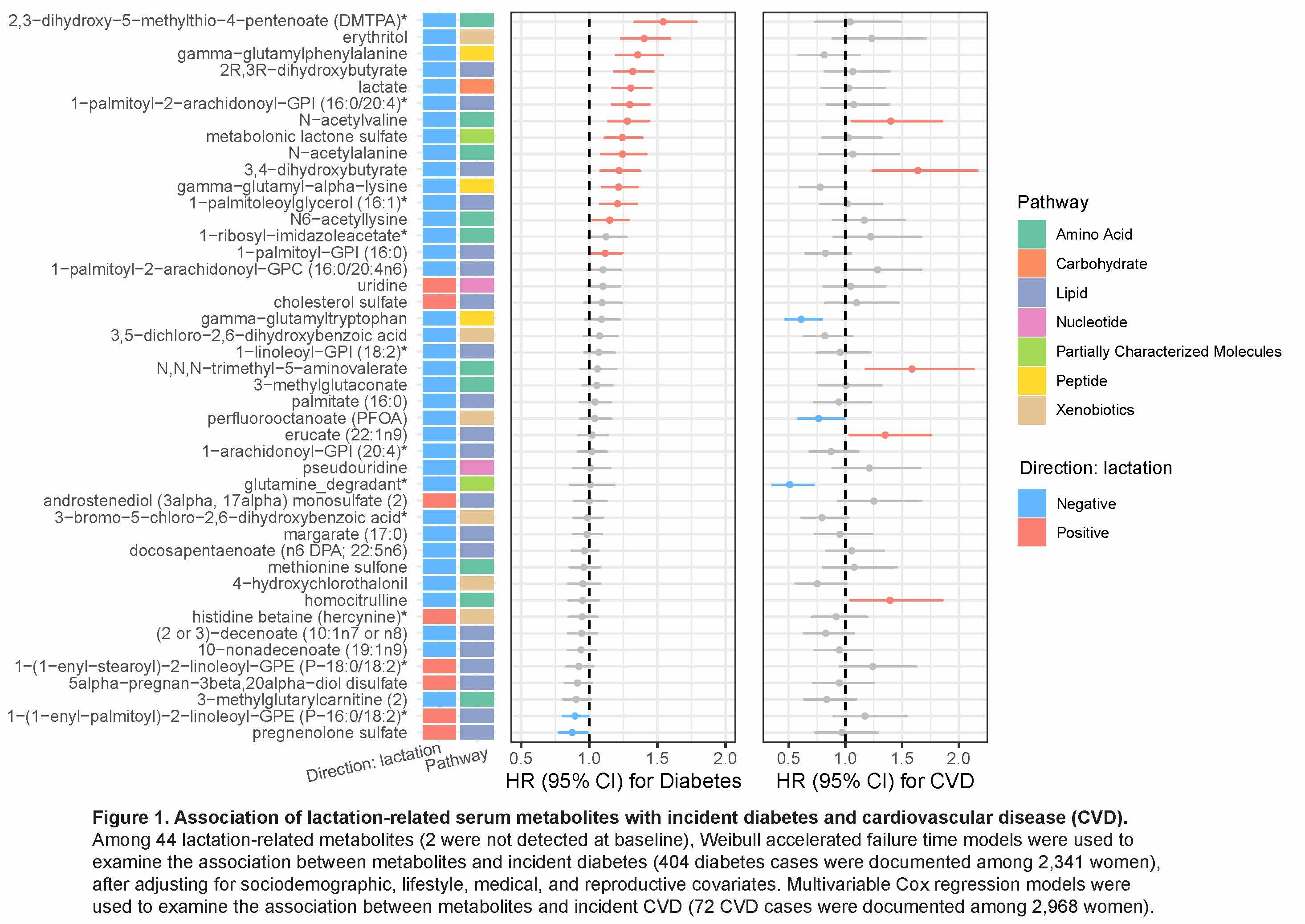
Abstract Body: Introduction: Lactation has been associated with improved long-term cardiometabolic health in women, but the underlying mechanisms remain unclear. Methods: We studied 194 parous women (mean age: 32.8 years) from the HCHS/SOL with singleton births and self-reported lactation information. A total of 694 serum metabolites were profiled a median of 3 years (IQR: 1-4) after delivery. Lactation duration was categorized as <6 months or ≥6 months. Lactation-related metabolites were identified by metabolome-wide association analyses with an Empirical Bayes method and adjusting for sociodemographic and reproductive factors (|fold change|>1.2 and FDR-adjusted p<0.05). We examined the correlations between selected metabolites and cardiometabolic traits. We further examined the prospective associations of selected metabolites with incident diabetes (without baseline diabetes, n=2,341) and CVD (without baseline CVD, n=2,968) over 12 years of follow-up among parous women in the HCHS/SOL. Results: In this study, 26 (13.4%) women reported no lactation for this birth, 100 (51.5%) lactated <6 months, and 68 (35.1%) lactated ≥6 months. Compared with <6 months (n=126), lactation for ≥6 months (n=68) was associated with 46 metabolites, including lower levels of 37 metabolites (e.g., amino acid derivatives [involved in energy balance and methylation process] and glycerophospholipids [key membrane and lipoprotein components linked to dyslipidemia]), and higher levels of 9 metabolites (e.g. certain plasmalogens [antioxidant phospholipids] and sulfated steroids [involved in hormonal and metabolic regulation]). Most lactation-increased metabolites were positively correlated with triglycerides and LDL cholesterol, while many lactation-decreased metabolites were positively correlated with HDL cholesterol. Furthermore, 17 metabolites (e.g., N-acetylvaline and 3,4-dihydroxybutyrate) that were higher in women with <6 months lactation, were associated with increased risk of incident diabetes or CVD (HRs per SD range:1.12-1.64, p<0.05); while 2 metabolites (pregnenolone sulfate and a plasmalogen), higher in women with ≥6 months lactation, were inversely associated with incident diabetes (HRs per SD: 0.88 and 0.90, p<0.05) (Figure 1). Conclusion: Longer lactation duration was associated with a favorable maternal serum metabolomic profile 1-4 years after delivery, which may partly explain the protective effects of sustained lactation on diabetes and CVD risk among Hispanic/Latino women.
Wang, Yi
(
Albert Einstein College of Medicine
, Bronx , New York , United States )
Isasi, Carmen
(
ALBERT EINSTEIN COLLEGE MEDICINE
, Bronx , New York , United States )
Stuebe, Alison
(
University of North Carolina
, Chapel Hill , North Carolina , United States )
Hu, Jie
(
Massachusetts General Hospital
, Boston , Massachusetts , United States )
Daviglus, Martha
(
UNIVERSITY ILLINOIS CHICAGO
, Chicago , Illinois , United States )
Boerwinkle, Eric
(
UTHealth
, Houston , Texas , United States )
Burk, Robert
(
Albert Einstein College of Medicine
, Bronx , New York , United States )
Kaplan, Robert
(
ALBERT EINSTEIN COLLEGE OF MEDICINE
, Seattle , Washington , United States )
Qi, Qibin
(
ALBERT EINSTEIN COLLEGE OF MEDICINE
, Bronx , New York , United States )
Peters-samuelson, Brandilyn
(
Albert Einstein College of Medicine
, Bronx , New York , United States )
Louis-jacques, Adetola
(
University of Florida
, Gainesville , Florida , United States )