Educational Attainment and Systolic Blood Pressure Trajectories Among Midlife Women in the Study of Women’s Health Across the Nation
Abstract Body: Introduction: Hypertension is a leading risk factor for cardiovascular disease. Compared to men, women often experience a larger rise in systolic blood pressure (SBP) throughout life and an increased cardiovascular risk at lower SBP. Social factors are associated with blood pressure, but how educational attainment (EA) influences SBP remains unclear. We aimed to examine the association between EA and SBP trajectories in midlife women.
Methods: We utilized data from the Study of Women’s Health Across the Nation, an ongoing cohort study with up to 27 years of follow-up. We used locally estimated scatterplot smoothing to plot SBP trajectories, according to levels of EA (≤ high school, > high school and < college degree, and ≥ college degree). We compared baseline SBP and changes in SBP by EA over time using linear mixed models adjusted for baseline age, race/ethnicity, and study site. We assessed the statistical interaction between EA and follow-up time using likelihood ratio tests. Finally, we conducted mediation analyses to evaluate pathways through which EA might influence SBP.
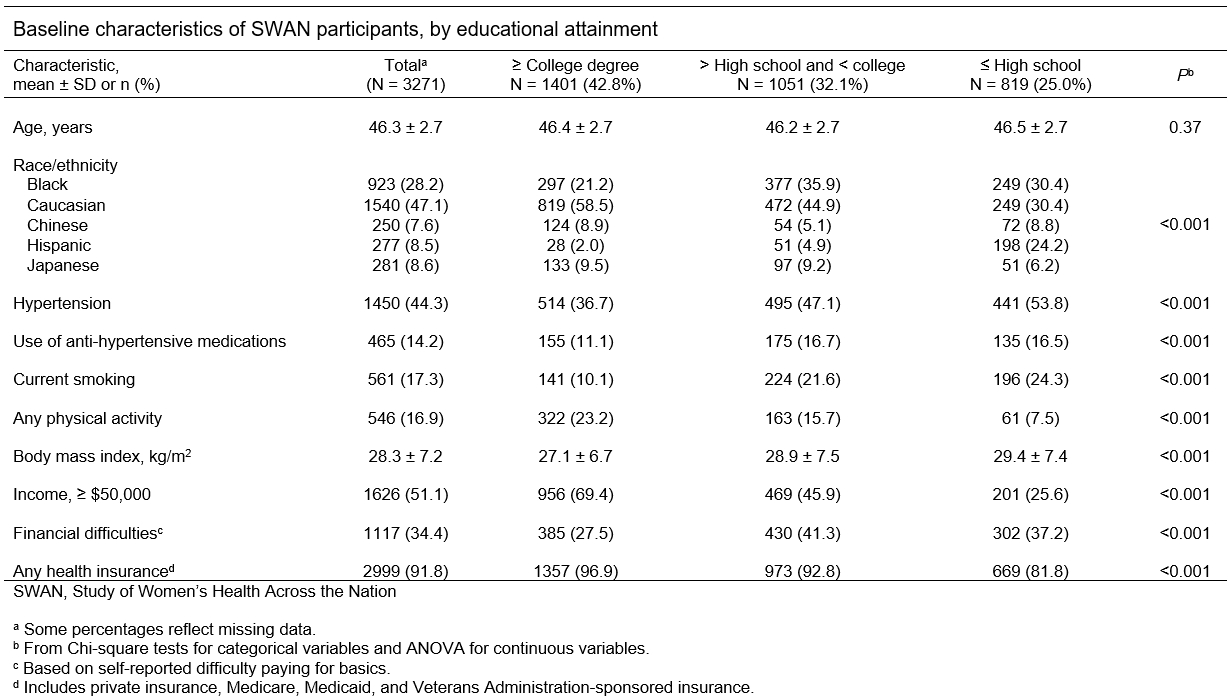
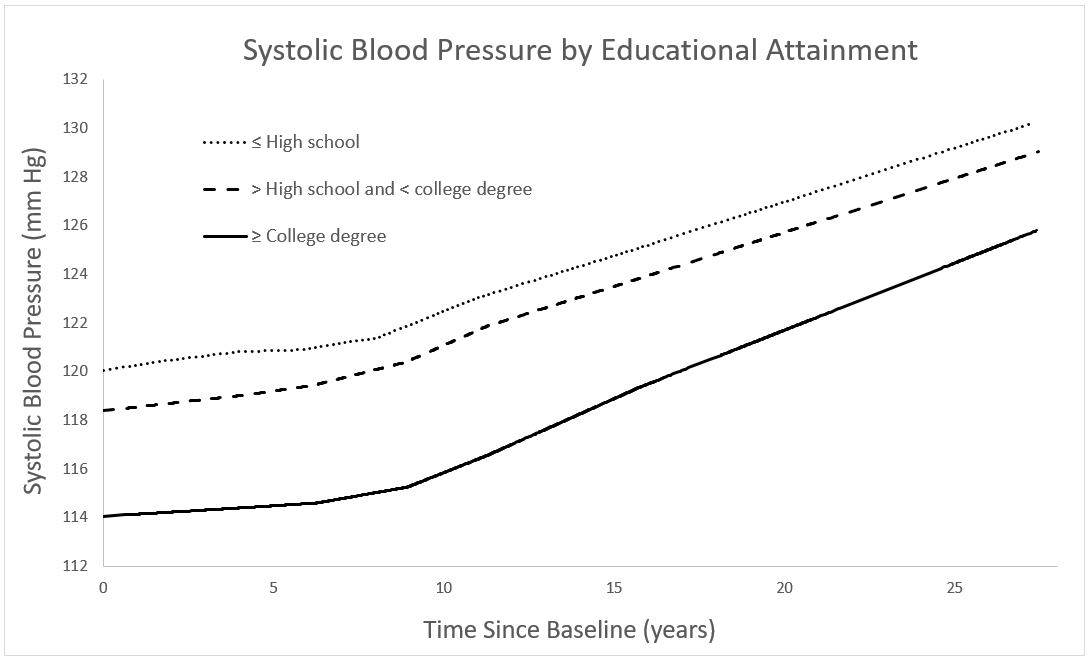
Results: We included 3,271 participants with a mean ± SD age of 46.3 ± 2.7 years at baseline; 47.1% were White race, and 42.8% had ≥ college degree (Table). EA was inversely related to baseline SBP, and these differences were preserved throughout follow-up (Figure). Compared to individuals with ≥ college degree, baseline SBP was 3.7 mm Hg higher [95% CI: (2.6, 4.9), P<0.001] for those with > high school and < college degree, and 4.0 mm Hg higher [95% CI: (2.7, 5.3), P<0.001] for those with ≤ high school degree in adjusted models. Overall, SBP increased by 5.8 mm Hg per 10 years [95% CI: (5.5, 6.1), P<0.001]; however, interaction analysis demonstrated a similar rate of change in SBP across EA groups (P=0.50). In separate mediation models, income accounted for 15.1% of the association between EA and baseline SBP [95% CI: (3.0, 27.2), P=0.01], BMI 27.2% [95% CI: (11.1, 43.4), P=0.001], and physical activity 8.6% [95% CI: (2.0, 15.3), P=0.01].
Conclusion: In this longitudinal analysis of midlife women, EA was inversely associated with baseline SBP – partly through income, BMI, and physical activity -- but the rate of change was similar over time. These results suggest that the contribution of EA to SBP manifests early in life and persists throughout midlife. Interventions to control blood pressure in early adulthood are essential to reduce disparities in hypertension by EA.
Garfein, Joshua
(
University of Pittsburgh
, Pittsburgh , Pennsylvania , United States )
Brooks, Maria
(
University of Pittsburgh
, Pittsburgh , Pennsylvania , United States )
El Khoudary, Samar
(
University of Pittsburgh
, Pittsburgh , Pennsylvania , United States )
Sekikawa, Akira
(
University of Pittsburgh
, Pittsburgh , Pennsylvania , United States )
Fabio, Anthony
(
University of Pittsburgh
, Pittsburgh , Pennsylvania , United States )
Magnani, Jared
(
University of Pittsburgh
, Pittsburgh , Pennsylvania , United States )