
Metabolomic Pathway Alterations in Serum of Postmenopausal Women with Stroke
Abstract Body: Background: Among postmenopausal women, stroke is a major contributor to death and disability, yet the biological pathways influencing risk and outcomes remain largely unknown.
Objective: This pilot study aims to: (1) compare metabolomic profiles between postmenopausal women with acute stroke and controls; and (2) assess longitudinal metabolic changes in stroke patients from the acute phase (24–72 hours post-stroke) to follow-up (~six months post-stroke).
Methods: We conducted a pilot, case-control study comparing postmenopausal women with acute ischemic stroke (cases) to healthy women (controls), all recruited from a single healthcare system. Using high resolution liquid chromatography–mass spectrometry (LC-HRMS), we conducted untargeted metabolomics analysis on 20 serum samples at baseline (drawn 24-72 hours post-stroke) and at the time of enrollment for 25 healthy controls. Thirteen cases had a second specimen drawn at approximately 6 months post-stroke. The resulting metabolite feature tables were analyzed using principal component analysis, followed by multivariable linear regression to compare cases with controls and mixed-effects models for longitudinal comparisons. Pathway enrichment analysis was performed with MetaboAnalyst using the Mummichog algorithm. Models were adjusted for age at enrollment, history of hypertension, history of diabetes, history of coronary artery disease, body mass index, age at menopause, and smoking status.
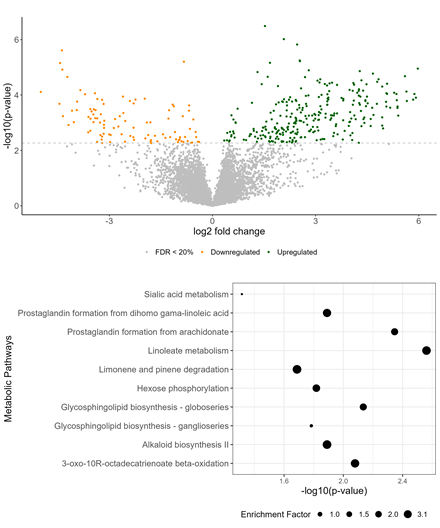
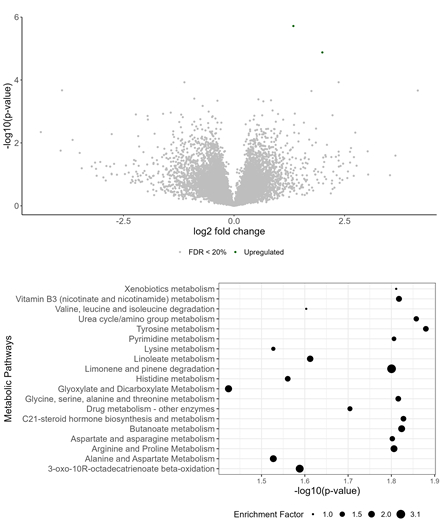
Results: Of the 384 metabolites, 285 were upregulated and 99 downregulated, with their patterns differing significantly (FDR<20%) between cases and controls at baseline. Pathway enrichment analysis identified 10 altered metabolic pathways (Figure 1), mainly related to lipid metabolism and carbohydrate processing. In contrast, 19 pathways were enriched after stroke (Figure 2), including amino acid metabolism, steroid hormone biosynthesis, vitamin B3 metabolism, nucleotide metabolism, and xenobiotic detoxification.
Conclusions: This pilot study identifies pronounced metabolic alterations in postmenopausal women with stroke. Baseline differences between cases and controls were largely associated with lipid metabolism and inflammatory pathways, while post-stroke changes involved amino acid metabolism and steroid hormone biosynthesis. These findings may inform the development of biomarkers for stroke risk and recovery monitoring.
El Azzouzi, Fatima
( University of Vermont Larner College of Medicine
, Burlington
, Vermont
, United States
)
Madsen, Tracy
( University of Vermont Larner College of Medicine
, Burlington
, Vermont
, United States
)
Klein, Rachel
( University of Michigan
, Ann Arbor
, Michigan
, United States
)
Manz, Katherine
( University of Michigan
, Ann Arbor
, Michigan
, United States
)
Pennell, Kurt
( Brown University
, Providence
, Rhode Island
, United States
)
Bourjeily, Ghada
( Brown University
, Providence
, Rhode Island
, United States
)
Clark Donat, Lindsay
( Brown University
, Providence
, Rhode Island
, United States
)
Burton, Tina
( Brown University
, Providence
, Rhode Island
, United States
)
Furie, Karen
( Brown University
, Providence
, Rhode Island
, United States
)
Liu, Simin
( University of California Irvine
, Irvine
, California
, United States
)
Zhang Xinge, Neuhouser Marian, Reiner Alex, Wong Nathan, Liu Simin, Yang Bo, Boden-albala Bernadette, Anton-culver Hoda, Allison Matthew, Van Horn Linda, Madsen Tracy, Malik Shaista, Manson Joann
4406301_File000001.jpg
4406301_File000002.jpg
You have to be authorized to contact abstract author. Please, Login