Associations of total and types of fish intake with cardiometabolic diseases: cross-sectional findings from the South Asia Biobank
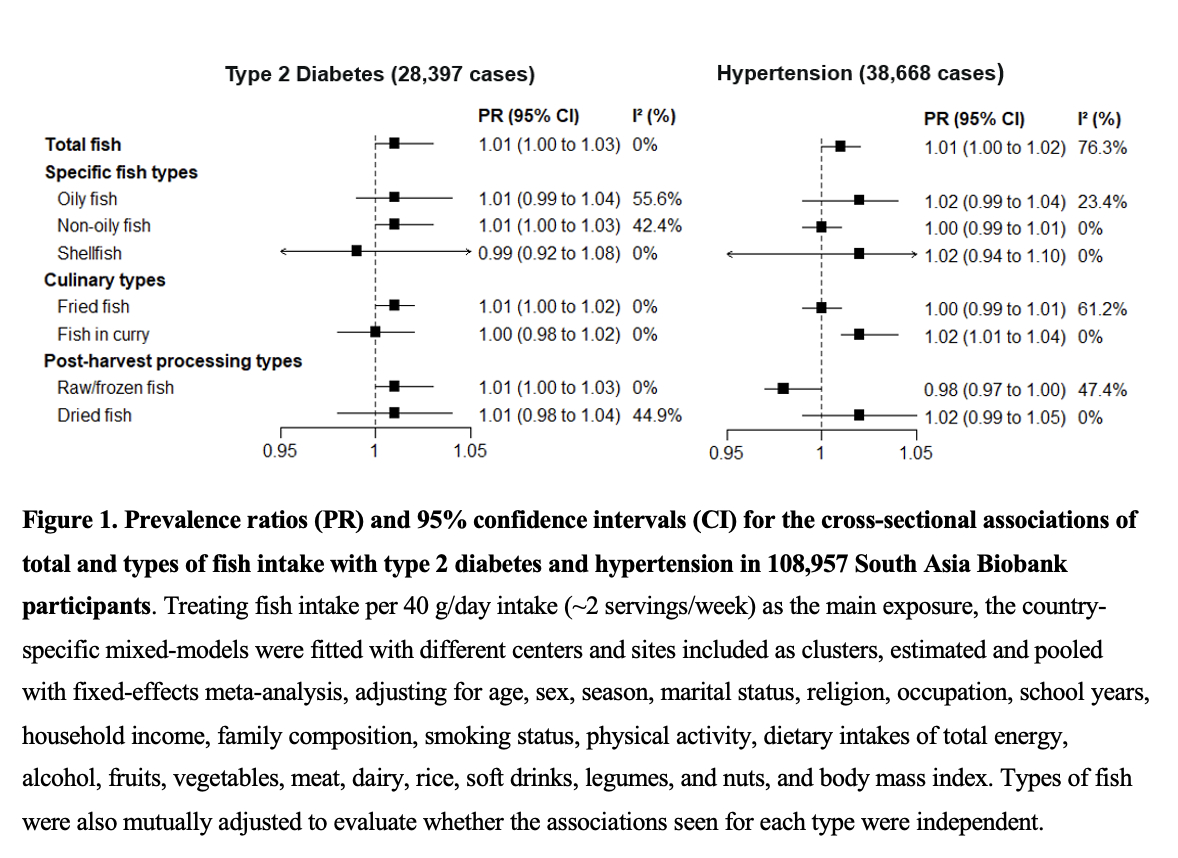
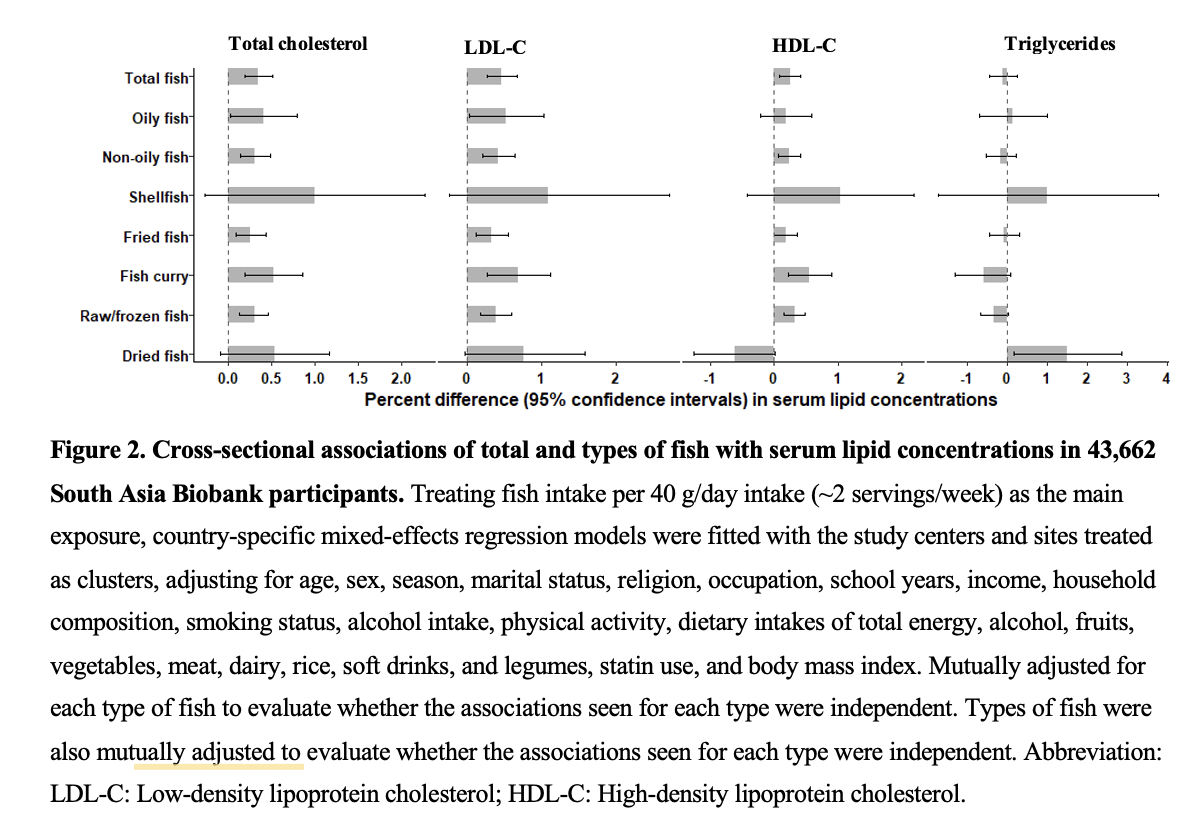
Abstract Body: Introduction Epidemiological evidence linking fish intake with cardiometabolic health remains mixed and inconsistent, with a paucity of data from South Asia. Hypothesis. We hypothesized that the association between fish intake and cardiometabolic health outcomes would vary by types of fish and preparation methods. Methods. We evaluated 108,957 participants (mean age 46.9y, 63% women) from Bangladesh, India, Pakistan, and Sri Lanka in South Asia Biobank (2018-24). Diet was assessed with interviewer-led digital 24 hour dietary recalls and health outcomes were defined from self-reports and objective measures. Multivariable-adjusted mixed-effect Poisson or linear regression was modelled to examine the cross-sectional associations of fish intake classified by type and preparation methods with prevalent type 2 diabetes (T2D), prevalent hypertension and serum lipid levels. Analyses were conducted by country and pooled using fixed-effect meta-analysis. Results. Proportion of participants reporting fish consumption varied by country: Sri Lanka, 65%; Bangladesh, 51%; India, 11%; and Pakistan, 2%. The overall prevalence of T2D was 26.1%, hypertension, 35.5% and dyslipidemia, 87.9%. In the pooled analysis, higher total fish intake (40 g/day ≈ 2 servings/week) was positively associated with prevalent T2D, hypertension (Figure 1), and cholesterol levels (total cholesterol, LDL-C, and HDL-C) (Figure 2). The results for hypertension prevalence were heterogeneous by country (I^2 > 75%). Among types of fish, non-oily fish was positively associated with prevalent T2D and levels of total cholesterol, LDL-C and HDL-C, and oily fish was positively associated with total cholesterol and LDL-C. For preparation methods, fried fish was positively associated with prevalent T2D and cholesterol levels, while fish curry was positively associated with prevalent hypertension and cholesterol levels. Fish sourced as raw/frozen fish was positively associated with prevalent T2D and cholesterol levels but inversely associated with prevalent hypertension. Dried fish was positively associated with triglycerides. Conclusions. In four South Asian countries, higher total fish intake was weakly positively associated with prevalent T2D, hypertension and cholesterol levels, but heterogeneous by type of fish and by countries. These cross-sectional findings will guide prospective studies to compare findings, explore causality, and inform country-specific dietary guidelines for South Asian populations.
Sarwar, Nazmul
(
University of Cambridge School of Clinical Medicine
, Cambridge , United Kingdom )
Imamura, Fumiaki
(
University of Cambridge School of Clinical Medicine
, Cambridge , United Kingdom )
Kasturiratne, Anuradhani
(
University of Kelaniya
, Ragama , Sri Lanka )
Jha, Vinitaa
(
Max Super Speciality Hospital, Devki Devi Foundation
, Delhi , India )
Katulanda, Prasad
(
University of Colombo
, Colombo , Sri Lanka )
Khawaja, Khadija
(
Services Institute of Medical Sciences, Services Hospital
, Lahore , Pakistan )
Anjana, Ranjit Mohan
(
The Madras Diabetes Research Foundation and Dr Mohan’s Diabetes Specialities Centre
, Chennai , India )
Mridha, Malay
(
BRAC James P Grant School of Public Health
, Dhaka , Bangladesh )
Chambers, John
(
Nanyang Technological University
, Nanyang , Singapore )
Forouhi, Nita
(
University of Cambridge School of Clinical Medicine
, Cambridge , United Kingdom )