Ultra-Processed Food Intake and Cardiometabolic Outcomes: A Cross-Sectional Analysis in a Multi-Ethnic Asian Population in Singapore
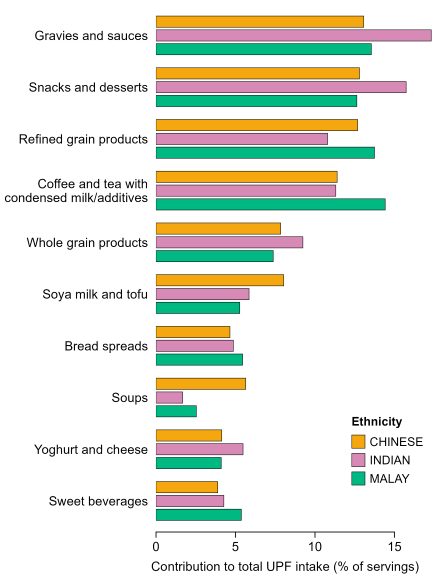
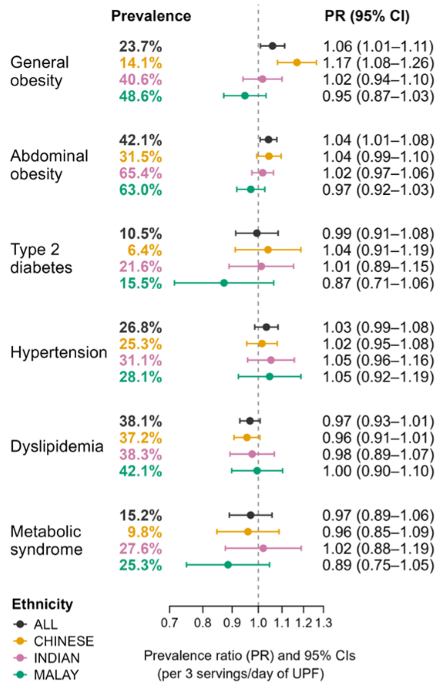
Abstract Body: Background: Ultra-processed food (UPF) intake has been linked to adverse cardiometabolic outcomes, but there is limited evidence from Asia, a region with a unique food environment and diverse populations with varying rates of cardiometabolic disease. Objective: To examine the association of UPF intake with prevalent cardiometabolic outcomes in multiple Asian ethnic groups. Methods: Cross-sectional data of 5515 Chinese, 1553 Indian, and 1067 Malay individuals aged 30–84 years from the Health for Life in Singapore Study (2018–2022) were analyzed. UPF intake was defined by applying the Nova classification for food processing to the 163-item Singaporean food frequency questionnaire. The associations of total UPF intake with the prevalence of general obesity (BMI≥27.5kg/m2), abdominal obesity (waist circumference ≥90cm for men, ≥80cm for women), metabolic syndrome (Asian definition), type 2 diabetes, hypertension, and dyslipidemia were examined using multivariable Poisson regression adjusted for sociodemographic and behavioral factors, family cardiometabolic history, total energy intake, and BMI (except for general obesity). Results: The mean intake of total UPF was the highest in Malays (6.1±3.6 servings/day), followed by Chinese (5.3±3.2) and Indians (5.2±3.2). The top food groups contributing to total UPF intake by servings were gravies and sauces, snacks and desserts, refined grain products, and coffee and tea with condensed milk/additives (Figure 1). Cardiometabolic conditions were more prevalent in Indians and Malays compared to the Chinese (Figure 2). Total UPF intake was significantly associated with general obesity (prevalence ratio and 95% CI for 3 servings/day: 1.06, 1.01–1.11) and abdominal obesity post-BMI adjustment (1.04, 1.01–1.08) but not the other assessed outcomes (Figure 2). There was a significant interaction of total UPF intake with ethnicity for obesity (P=0.0001), with the association being more pronounced among Chinese. In leave-one-out analyses of UPF subtypes, the associations with adiposity were attenuated when coffee and tea with condensed milk/additives, gravies and sauces, or sweet beverages were excluded from total UPF. Conclusions: In this multi-ethnic Singaporean population, UPF intake was positively associated with general and abdominal obesity, with ethnic variation in general obesity. The heterogeneity and details of the types of UPFs consumed across ethnic groups require further investigation in prospective analyses.
Lee, Jia Yi
(
University of Cambridge
, Cambridge , United Kingdom )