Logo

American Heart Association

  1
  0


Final ID: TU132

Health Behaviors of Middle School Children by Community Type: Metropolitan, Micropolitan, and Rural

Abstract Body: Background: Previous research examining differences in health behaviors between urban and rural children has yielded inconsistent results. This study aims to enhance understanding of these potential disparities by investigating whether health behaviors differ across community types, specifically utilizing Core Based Statistical Areas (CBSAs) for classification. CBSAs provide more granularity in community type definitions by using county data to identify areas that have economic and cultural connections to population centers, and may therefore have more access to resources (e.g., health care, employment opportunities, public transport).
Methods: Using baseline data collected from the Michigan Project Healthy Schools (PHS) school-based wellness program from 2004-present, we analyzed dietary habits, physical activity levels, and screen time among 5th-7th grade children from 3 CBSA-defined community types, utilizing Wilcoxon rank-sum tests: metropolitan (include a population center with more than 50,000 people), micropolitan (have a center with 10,000-49,999 people), and rural (all population centers have less than 10,000 people). Due to the large cohort size, effect size was reported to reflect the magnitude of differences between groups. No adjustments were made for multiple pairwise comparisons.
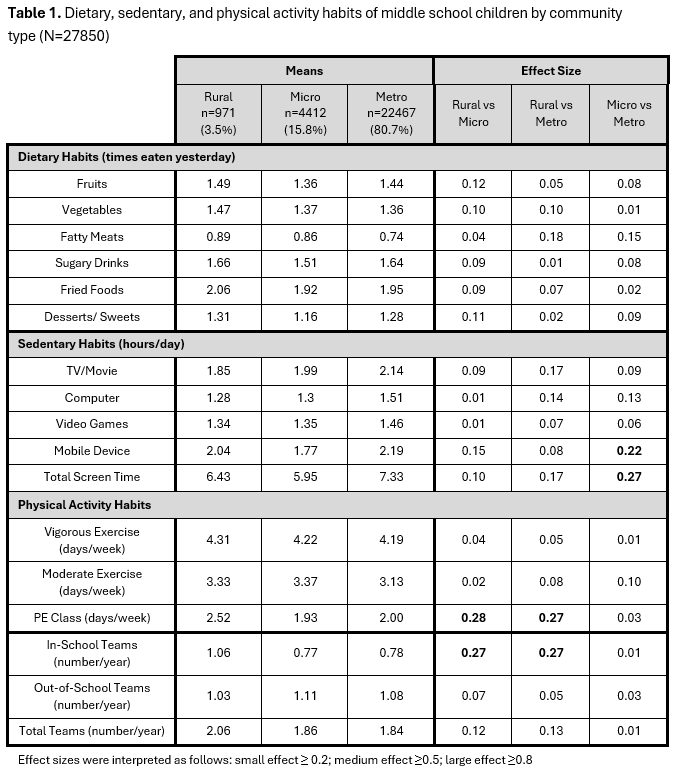
Results: Of 27850 children, 80.7% were from metropolitan communities, 15.8% micropolitan, and 3.5% rural. No differences were seen in dietary patterns across community types. Compared with metropolitan and micropolitan students, rural students participated more frequently in PE classes and school sports teams. Additionally, when the metro- and micro-politan groups were combined, rural students reported more days of vigorous and moderate exercise. No differences were seen in sedentary habits between rural students and those from other community types. Children from micropolitan areas reported less total screen time and time on mobile devices compared to their metropolitan counterparts.
Conclusions: Despite previously documented rural health challenges, results from this study highlight better physical activity habits among rural students, when compared to other community types. School-based wellness programs like PHS are warranted to target primordial health within diverse populations, including rural locations with more limited access to health care resources.
  • Smith, Emma  ( Michigan Medicine , Ann Arbor , Michigan , United States )
  • Krallman, Rachel  ( Michigan Medicine , Ann Arbor , Michigan , United States )
  • Pai, Chih Wen  ( University of Michigan , Ann Arbor , Michigan , United States )
  • Newman, Brad  ( University of Michigan , Canton , Michigan , United States )
  • Eagle, Kim  ( UNIVERSITY MICHIGAN , Ann Arbor , Michigan , United States )
  • Jackson, Elizabeth  ( University of Alabama at Birmingham , Birmingham , Alabama , United States )
  • Author Disclosures:
Meeting Info:

EPI-Lifestyle Scientific Sessions 2026

2026

Boston, Massachusetts

Session Info:

Poster Session 1

Tuesday, 03/17/2026 , 05:00PM - 07:00PM

Poster Session

More abstracts on this topic:
Adaptation of the AHA Heart Health Promotion Model for Black Americans with Among the Highest Community Rates of Hypertension Morbidity and Mortality

Oakley Linda, Kunkul Fatih, Omuya Helen, Jonaitis Erin, Miller Megan, Leclair Jessica, Heitman Cierra, Luo Dian, Voland Rick

A New Neurological Assessment Focused on Consciousness and Quantitative Motor Function in a Rat Model of Subarachnoid Hemorrhage

Kanamaru Hideki, Zhu Shiyi, Han Mingyang, Huang Lei, Sherchan Prativa, Suzuki Hidenori, Tang Jiping, Zhang John

More abstracts from these authors:
You have to be authorized to contact abstract author. Please, Login
Not Available