Sex-Specific Lipidomic Signatures Associated With Obstructive Sleep Apnea Severity
Abstract Body: Background Obstructive sleep apnea (OSA) is a prevalent cardiometabolic disorder with known sex differences in presentation and diagnosis. The apnea–hypopnea index (AHI) often underrepresents disease severity in females. Although lipidomic alterations have been reported, few studies have systematically stratified these associations by sex or BMI.
Hypothesis We hypothesized that AHI and related OSA traits are associated with distinct circulating lipid profiles, and that these associations differ by sex.
Methods: We analyzed data from the Human Phenotype Project, which includes home sleep apnea testing and targeted lipidomic profiling. A total of 143 lipid species were analyzed.Multivariable regression models were adjusted for age, sex, and BMI, with additional sex-stratified and interaction analyses performed. Statistical significance was defined as a false discovery rate <0.05. OSA was defined as an AHI ≥15 events/hour.
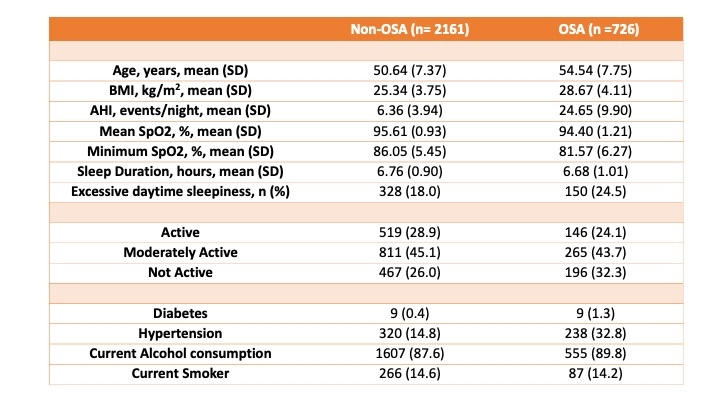
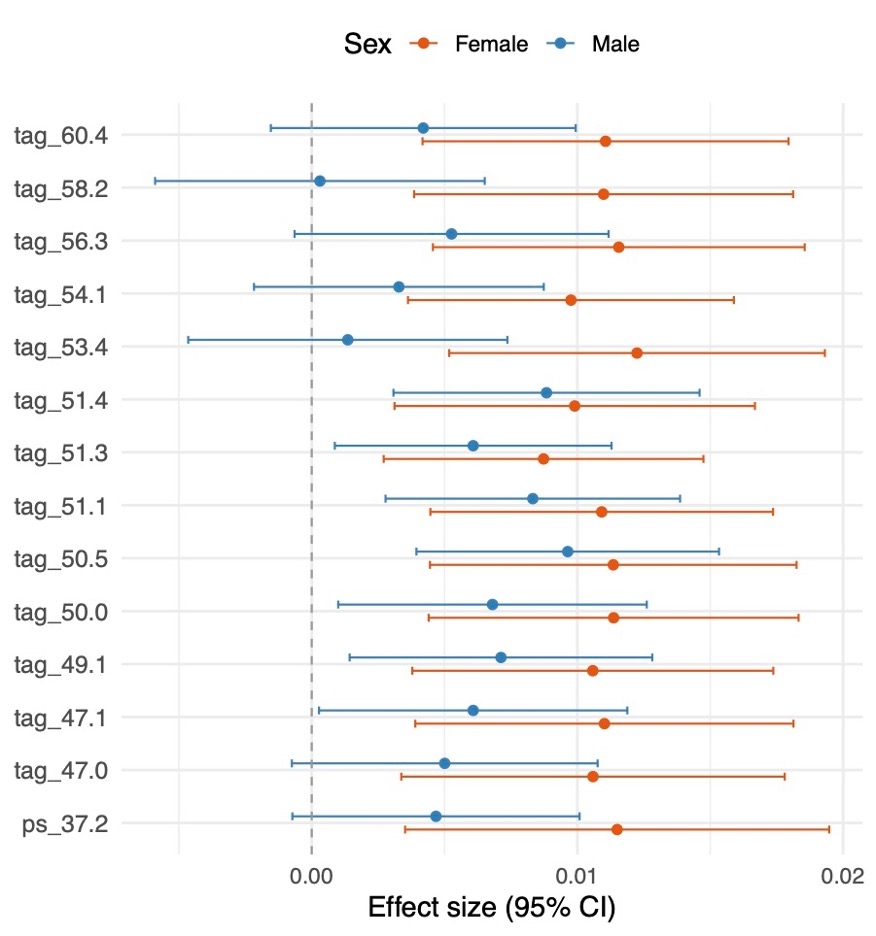
Results Among 2887 adults (51.6 % female), 25.1% had OSA. In this subgroup, the mean age was 54.54 ± 7.75 years, mean BMI was 28.67 ± 4.11 kg/m2, mean AHI was 24.65 ± 9.90 events/hour. Among these participants, 32.8% had hypertension, 1.3% had diabetes, and 24.5 % reported excessive daytime sleepiness. (Table 1). In BMI-adjusted models, higher AHI was associated with elevated triacylglycerols (TAGs). For example, TAG (47.0) showed β = 0.007 (95% CI 0.002 - 0.011, FDR = 0.014), and TAG (51.1) showed β = 0.009 (95% CI 0.005–0.013, FDR = 0.001). Sex- stratified analysis identified 14 statistically significant lipids in female – 13 TAGs (TAG 47.0, 47.1, 49.1, 50.0, 50.5, 51.1, 51.3, 51.4, 53.4, 54.1, 56.3, 58.2, 60.4) and one Phosphatidylserines (PS_37.2) that remained significant after BMI adjustment. No significant associations were found in males (Figure 1). Excessive daytime sleepiness was inversely associated with ceramides such as Cer d18:1/24:1 (β = –0.120, 95% CI –0.188 to –0.052, FDR = 0.031). Interaction testing confirmed pronounced sex differences in BMI-adjusted analysis, with all statistically significant associations having sex interaction p-value<0.05.
Conclusions OSA traits, particularly AHI, are linked to distinct lipidomic signatures in females. A consistent set of 14 female-driven lipids—predominantly TAGs—persisted after BMI adjustment, suggesting BMI-independent pathways. These robust, female-specific TAG signals may represent reliable biomarkers of cardiometabolic risk in women with OSA.
Ou, Yi Hui
(
Harvard Medical School
, Boston , Massachusetts , United States )
Zhang, Yu
(
Beth isreal Deaconess Medical Center
, Boston , Massachusetts , United States )
Sofer, Tamar
(
Beth Israel Deaconess Medical Cente
, Boston , Massachusetts , United States )
Ou Yi Hui, Chan Yan Yee Mark, Richards A, Cistulli Peter, Lee Ronald, Colpani Juliana, Cheong Crystal, Loke Wei Qiang, Thant As Tar, Shih E Ching, Chan Siew-pang, Chin Calvin, Kojodjojo Pipin