Logo

American Heart Association

  128
  0


Final ID: Sa1070

A Novel Missense Mutation in TNNT2 Gene in a Lebanese Pedigree With Ebstein Anomaly And Wolf-Parkinson-White Syndrome: A Case Report

Abstract Body (Do not enter title and authors here): Background: Ebstein anomaly (EA) is a rare congenital heart defect occurring in 1.2 to 5 in 100,000 live births, characterized by a downward displacement of the tricuspid valve, thin-walled right ventricle, and tricuspid valve regurgitation. It can present variably from asymptomatic cases to severe symptoms like arrhythmias and right-sided heart failure. EA is often associated with other anomalies such as interatrial communication and mitral valve prolapse. The condition can lead to accessory atrioventricular pathways, frequently resulting in Wolff-Parkinson-White syndrome (WPW), which involves abnormal heart electrical activity and increases the risk of sudden cardiac death. While the genetic basis of EA is not fully understood, it appears to involve multiple genes like FLNA and NKX2-5, MYH6, MYH7 suggesting a complex polygenic inheritance pattern. TNNT2 is known to be associated with Cardiomyopathy but has not been previously associated with EA and WPW.
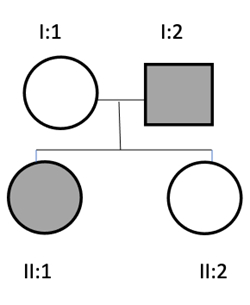
Case: In this report, we present findings from a lebanese family with EA, comprising 2 affected individuals. Whole exome sequencing in the affected individuals identified a pathogenic variant in the TNNT2 gene at coding strain position 260 (a missense mutation: C to T), resulting in the substitution of Proline with Leucine at position 87 in affected individuals (Figure 1). No variants were detected in any other candidate gene examined. Individuals I:1 and II:2 were found to be normal, with no EA findings on echocardiography.
Methods: Whole exome sequencing in the patients involved collecting blood samples after obtaining consent. These samples were sent to Centogene lab, where genomic DNA is enzymatically fragmented. The regions of interest are then enriched using DNA capture probes, facilitating detailed genetic analysis.
Results: The whole exome sequencing identified a heterozygous missense mutation in both the father and his daughter. This nonsynonymous variant is located on chromosome 1 (GRCh37) in the TNNT2 gene region. The specific variant, NM_001276345.1:c.260C>T p.(Pro87Leu), was found in both individuals.
Conclusion: In conclusion, the genetic basis of EA is rather complex and remains poorly understood. It is established that mutations in the TNNT2 gene are linked to several cardiomyopathies, none of them overlap with the described phenotype of our patients. In this report, we therefore confirm the potential role of TNNT2 gene mutation in the genetic basis of familial EA with WPW.
  • Atasi, Montaser  ( AMERICAN UNIVERSITY OF BEIRUT , Beirut , Lebanon )
  • Dankar, Razan  ( AMERICAN UNIVERSITY OF BEIRUT , Beirut , Lebanon )
  • Barakat, Salim  ( Staten Island University Hospital , Staten Island , New York , United States )
  • Wehbi, Jad  ( AMERICAN UNIVERSITY OF BEIRUT , Beirut , Lebanon )
  • Refaat, Marwan  ( AMERICAN UNIVERSITY OF BEIRUT , Beirut , Lebanon )
  • Author Disclosures:
    Montaser Atasi: DO NOT have relevant financial relationships | Razan Dankar: No Answer | Salim Barakat: DO NOT have relevant financial relationships | Jad Wehbi: No Answer | Marwan Refaat: DO NOT have relevant financial relationships
Meeting Info:

Scientific Sessions 2024

2024

Chicago, Illinois

Session Info:

Clinical Cardiovascular Genetics

Saturday, 11/16/2024 , 10:30AM - 11:30AM

Abstract Poster Session

More abstracts on this topic:
Age-stratified Monogenic and Polygenic Contributions for Atrial Fibrillation in the All of Us Research Program

Chen Zhanlin, Gordon Adam, Webster Gregory

Adding a polygenic risk score to the PREVENT clinical risk tool significantly improves cardiovascular risk prediction

Euesden Jack, Absher Devin, Iribarren Carlos, Riveros-mckay Fernando, Rana Jamal, Rowell Sarah, Neogi Arpita, Harrison Seamus, Weale Michael, Donnelly Peter

More abstracts from these authors:
Combination Therapy with ACEIs/ARBs and β-Blockers Reduces Basal Inflammation in Heart Failure Patients: A Cross-Sectional Observational Study

Kataya Rayan, Zouein Fouad, Ziade Joanna, Amin Ghadir, Mansour Sara, Elbejjani Martine, Fares Souha, Mudawwar Walid, Refaat Marwan, Mericskay Mathias

You have to be authorized to contact abstract author. Please, Login
Not Available