Patient characteristics associated with 90-day referral to a home-based cardiac rehabilitation program in Kaiser Permanente Southern California
Abstract Body: Background: Cardiac rehabilitation (CR) is a guideline-recommended exercise and lifestyle management program to support individuals recovering from a cardiovascular event or procedure. It is effective in reducing subsequent morbidity and mortality among high-risk patients. Given the historic under-referral to CR, we aimed to identify patient factors associated with referral to an 8-week home-based CR (HBCR) program within Kaiser Permanente Southern California (KPSC).
Methods: We identified 44,468 KPSC adults ≥18 years of age with an HBCR-eligible event or procedure between 1/1/2021 and 9/30/2024; the first event per patient was selected. We identified all HBCR referrals occurring within 90 days of the event or procedure date. Using Poisson regression with a robust error variance, we calculated multivariable-adjusted prevalence ratios (PR) for the association of baseline sociodemographic and clinical characteristics with 90-day referral to HBCR.
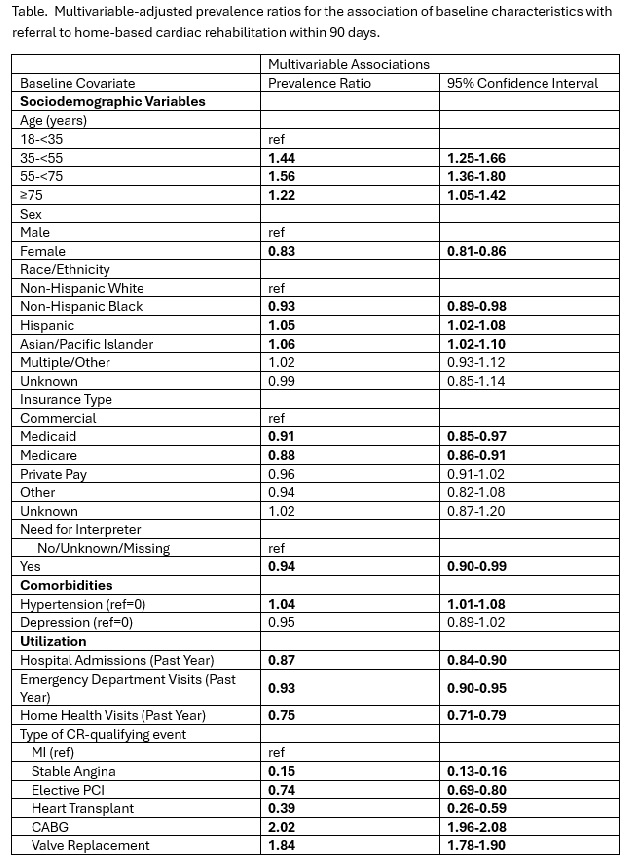
Results: Overall, 13,164 individuals (29.6%) had a HBCR referral within 90 days of the qualifying event. A higher proportion of adults having vs not having a 90-day referral were male (71.4% vs 59.5%), Asian/Pacific Islander ([API];13.3% vs 10.8%), and had a myocardial infarction (MI) as their qualifying event (52.7% vs 35.6%); all p-values were <0.001. After multivariable adjustment, those having a higher likelihood of referral were older (PR 1.44, 95% CI 1.25-1.66; PR 1.56, 95% CI 1.36, 1.80; PR 1.22, 95% CI 1.05, 1.42 for ages 35-54, 55-75, and ≥75 vs 18-34 years, respectively) and Hispanic and Asian/Pacific Islander compared to white (PR 1.05, 95% CI 1.02-1.08 and PR 1.06, 95% CI 1.02, 1.10, respectively). Those having a lower likelihood of referral were female (PR 0.83, 95% CI 0.81, 0.86), non-Hispanic black compared to white (PR 0.93, 95% CI 0.89, 0.98), those with Medicaid or Medicare insurance (PR 0.91, 95% CI 0.85, 0.97 and PR 0.88, 95% CI 0.86, 0.91, respectively), those needing an interpreter (PR 0.94, 95% CI 0.90, 0.99), and patients having any hospitalizations (PR 0.87, 95% CI 0.84, 0.90), emergency department visits (PR 0.93, 95% CI 0.90, 0.95), or home health visits (PR 0.75, 95% CI 0.71, 0.79) in the year prior to their event. (Table)
Conclusion: Approximately 30% of eligible patients were referred to HBCR within 90-days leaving much room for improvement. Focusing on patient populations at high risk of non-referral and understanding provider barriers to referrals are important to improve uptake.
Mefford, Matthew
(
Kaiser Permanente
, Pasadena , California , United States )
Zhou, Mengnan
(
KAISER PERMANENTE SOUTHERN CA
, Pasadena , California , United States )
Zhou, Hui
(
KAISER PERMANENTE SOUTHERN CA
, Pasadena , California , United States )
Silliman, Miriam
(
KAISER PERMANENTE SOUTHERN CA
, Pasadena , California , United States )
Shin, Erica
(
Kaiser Permanente Southern Californ
, Pasadena , California , United States )
Harrison, Teresa
(
KAISER PERMANENTE SOUTHERN CA
, Pasadena , California , United States )
Batiste, Columbus
(
Kaiser Permanente SCPMG
, Pasadena , California , United States )
Funahashi, Tad
(
Kaiser Permanente SCPMG
, Pasadena , California , United States )
Lahti, Debora
(
Kaiser Permanente SCPMG
, Pasadena , California , United States )
Nkonde-price, Chileshe
(
Kaiser Permanente School of Medicin
, Monrovia , California , United States )
Elkoustaf, Rachid
(
Kaiser Permanente SCPMG
, Pasadena , California , United States )
Reynolds, Kristi
(
KAISER PERMANENTE SOUTHERN CA
, Pasadena , California , United States )
Au Michael, Shah Nilay, Reynolds Kristi, An Jaejin, Zhang Yiyi, Zhou Mengnan, Choi Soonie, Zhou Hui, Harrison Teresa, Mefford Matthew, Lee Mingsum, Yang Eugene