Logo

American Heart Association

  111
  0


Final ID: MP07

Derivations of Supine and Standing Blood Pressure and Their Associations with Adverse Cardiovascular and Hypotension-Related Events

Abstract Body: Background: Postural drops in systolic blood pressure (SBP) are associated with cardiovascular and hypotension-related adverse events (falls, syncope). These associations are traditionally thought to be secondary to low standing blood pressure; however, the role of both high and low SBP in supine and standing positions has not been thoroughly characterized.

Objectives: To compare traditional and alternative derivations of supine and standing SBP with adverse cardiovascular and hypotension-related outcomes.

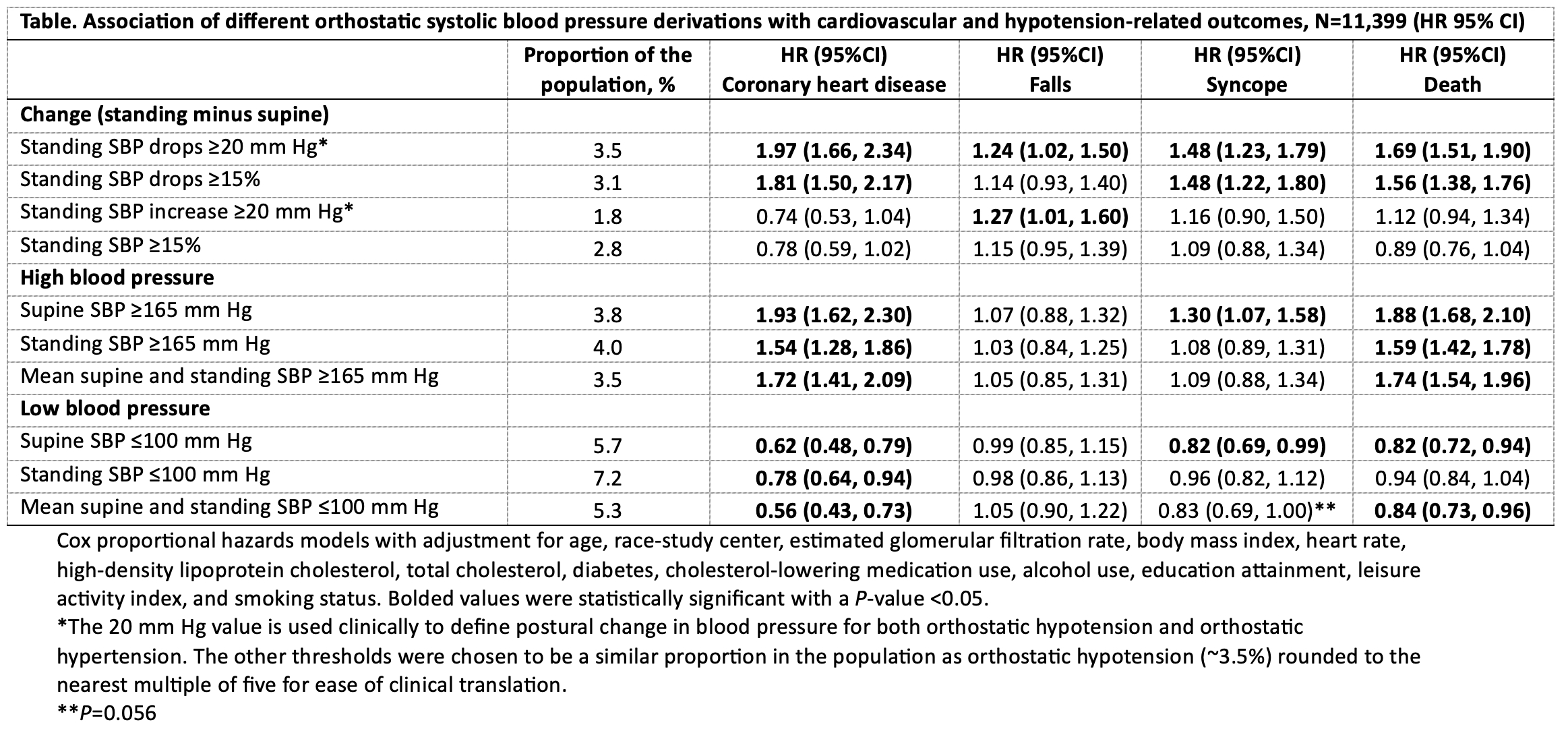
Methods: The Atherosclerosis Risk in Communities (ARIC) study measured supine and standing SBP in adult participants aged 45-64 between 1987–1989 and followed them for over 30 years. We examined low and high values (see Table) of supine SBP, standing SBP, absolute and relative differences in SBP after standing, and mean SBP between both positions in relation to adjudicated coronary heart disease (CHD) or all-cause mortality events as well as medical claims-based falls and syncope. We used Cox regression with adjustment for CVD risk factors. Cutpoints were chosen to match a population percentile approximating a 20 mm Hg difference between supine and standing SBP (the traditional definition for orthostatic hypotension).

Results: Among 11,399 participants (mean age 54 yr [SD, 5.7]; 56% female; 25% Black adults), relative or absolute drops in SBP were associated with CHD and mortality. Higher mean supine and standing BP was also associated with CHD (HR 1.72; 1.41, 2.09) and all-cause mortality (HR 1.74; 1.54, 1.96). An absolute decrease (HR 1.24; 1.02, 1.50) or increase (HR 1.27; 1.01, 1.60) in SBP was associated with falls. An absolute or relative decrease (both HRs 1.48) and higher supine SBP (HR 1.30; 1.07, 1.58) were associated with syncope. Lower supine SBP was inversely associated with CHD (HR 0.62) and all-cause mortality (HR 0.82). Lower standing SBP was also inversely associated with CHD (HR 0.78; 0.64, 0.94) but not with falls or syncope.

Conclusion: While both cardiovascular and hypotension-related outcomes were associated with postural drops in SBP, these outcomes were not consistently associated with low standing SBP. Rather, high supine SBP was associated with a greater risk of CHD, syncope, and death. Moreover, a rise in SBP with standing was associated with falls. These findings call attention to high SBP as a risk factor for both cardiovascular and hypotension-related outcomes and may have implications for treatment strategies if replicated.
  • Mate-kole, Manfred  ( Beth Israel Deaconess Medical Ctr , Brookline , Massachusetts , United States )
  • Lutsey, Pamela  ( University of Minnesota , Minneapolis , Minnesota , United States )
  • Juraschek, Stephen  ( BIDMC-Harvard Medical School , Boston , Massachusetts , United States )
  • Turkson-ocran, Ruth-alma  ( Beth Israel Deaconess Medical Ctr , Boston , Massachusetts , United States )
  • Larbi, Fredrick  ( Beth Israel Deaconess Medical Ctr , Boston , Massachusetts , United States )
  • Col, Hannah  ( Beth Israel Deaconess Medical Ctr , Boston , Massachusetts , United States )
  • Khan, Md Marufuzzaman  ( Beth Israel Deaconess Medical Ctr , Boston , Massachusetts , United States )
  • Ngo, Long  ( Harvard Medical School , Boston , Massachusetts , United States )
  • Wagenknecht, Lynne  ( WAKE FOREST UNIV , Winston Salem , North Carolina , United States )
  • Windham, B Gwen  ( UMMC, The MIND Center , Jackson , Mississippi , United States )
  • Selvin, Elizabeth  ( JOHNS HOPKINS UNIVERSITY , Baltimore , Maryland , United States )
  • Author Disclosures:
    Manfred Mate-Kole: DO NOT have relevant financial relationships | Pamela Lutsey: DO NOT have relevant financial relationships | Stephen Juraschek: No Answer | Ruth-Alma Turkson-Ocran: DO NOT have relevant financial relationships | Fredrick Larbi: No Answer | Hannah Col: No Answer | Md Marufuzzaman Khan: DO NOT have relevant financial relationships | Long Ngo: No Answer | Lynne Wagenknecht: DO NOT have relevant financial relationships | B Gwen Windham: DO NOT have relevant financial relationships | Elizabeth Selvin: DO NOT have relevant financial relationships
Meeting Info:
Session Info:

MP02. Hypertension

Thursday, 03/06/2025 , 05:00PM - 07:00PM

Moderated Poster Session

More abstracts on this topic:
A Novel Machine Learning-based Adverse Cardiovascular Events Risk Algorithm For Cancer Patients Treated With Tyrosine Kinase Inhibitors

Wahi Shawn, Cross James, Mora Ruben, Im Yunju, Kwan Jennifer

A major effect of aprocitentan on albuminuria in patients with resistant hypertension

Schlaich Markus, Bakris George, Flack John, Gimona Alberto, Narkiewicz Krzysztof, Sassi-sayadi Mouna, Wang Jiguang, Weber Michael

More abstracts from these authors:
Characteristics and Temporal Usage Patterns of Omron Home Blood Pressure Device Users in the United States

Khan Md Marufuzzaman, Col Hannah, Larbi Fredrick, Zhang Mingyu, Turkson-ocran Ruth-alma, Ngo Long, Juraschek Stephen

Sex-Specific Blood Pressure Thresholds in Middle-Aged Adults: Results from the Atherosclerosis Risk in Communities (ARIC) Study

Williams Katherine, Selvin Elizabeth, Wagenknecht Lynne, Windham B Gwen, Juraschek Stephen, Col Hannah, Larbi Fredrick, Zhang Mingyu, Turkson-ocran Ruth-alma, Ngo Long, Grams Morgan, Coresh Josef, Lutsey Pamela

You have to be authorized to contact abstract author. Please, Login
Not Available