
Logo

American Heart Association

  100
  0


Final ID: 024

Should Women Have Lower Blood pressure Goals Than Men? Sex Differences in Blood Pressure and Cardiovascular Disease in the UK Biobank

Abstract Body: Background: Recent studies show that the risk of cardiovascular disease (CVD) increases from a lower level of systolic blood pressure (SBP) in women than men, and increases at a steeper rate. This has led to a suggestion for sex-based SBP thresholds for hypertension diagnosis.
Aims: To investigate sex differences in the association of SBP and incident CVD.
Methods: The UK Biobank recruited over 500,000 participants aged 40-70 years between 2006 and 2010, with follow up until May-October 2022. The present study included 420,649 participants with no prior history of CVD. The primary outcome was incident CVD, defined as a first diagnosis of fatal or non-fatal coronary heart disease (CHD) or stroke. Age-adjusted sex-specific risks, relative risks and risk differences relating SBP to CVD were estimated using Poisson and Cox regression.
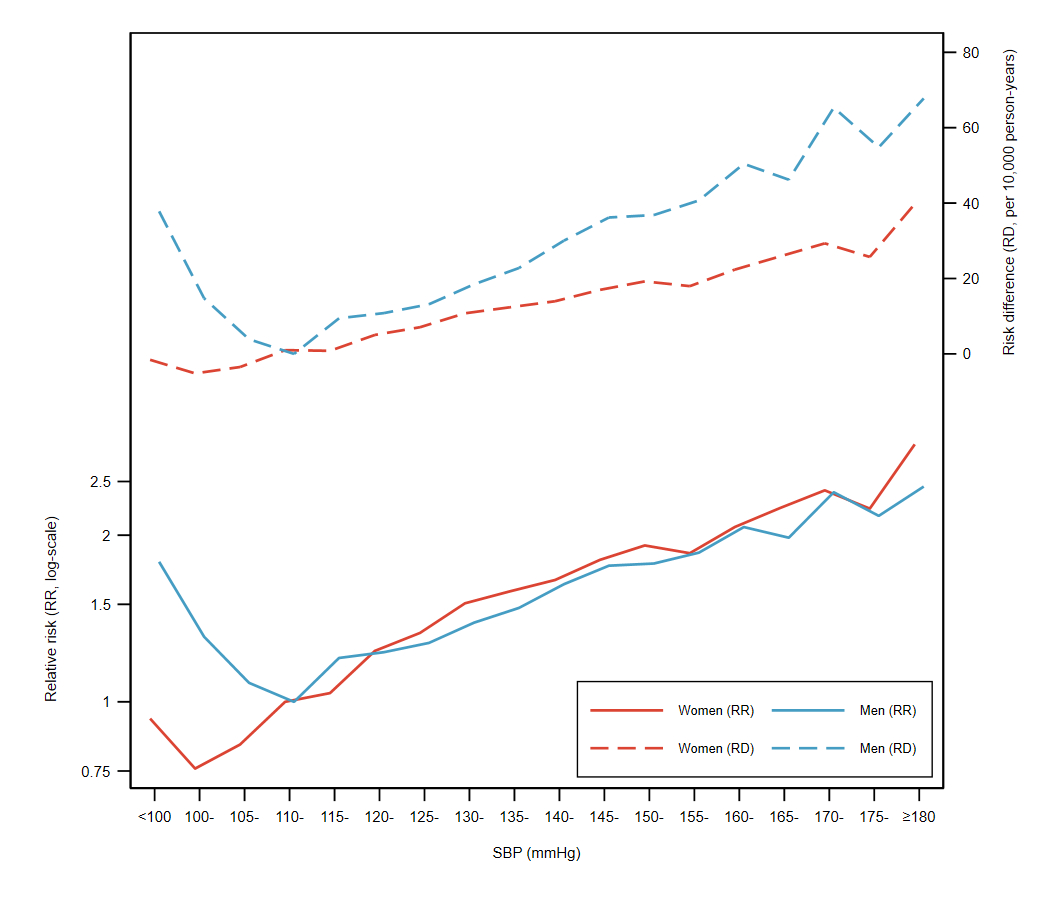
Results: The mean (SD) age among 235,556 (56.0%) women was 56.1 (8.0) years and among 185,093 men was 56.1 (8.2) years. Over a mean follow-up of 13.2 years, there were 28,628 CVD events. CVD risks across SBP levels showed a “J-shape”, and were higher in men than women at all BP levels. The lowest risk for CVD among women was at SBP 100-<105 mmHg (15.6 [95% CI 11.8-23.1] events per 10,000 person-years) and SBP 110-<115 among men (47.2 [95% CI 41.8-53.0]). Compared with SBP 100-<110 mmHg, sex-specific relative risks at SBP above 120 mmHg were higher in women than men, but risk differences were higher in men than women at all levels of SBP. Furthermore, compared to men at SBP100-<110 mmHg (i.e. the men with least risk), risks in women were lower at all levels of SBP below 170 mmHg, and the relative risk at the highest SBP (≥180 mmHg) in women (1.3 [95% CI 1.1-1.5]) remained lower than men (2.4 [95% CI 2.0-2.7]) at the same SBP level.
Conclusions: Consideration of the risks and sex-combined analyses do not support that women should have lower BP thresholds than men.
  • Kelly, Rebecca K  ( The George Institute for Global Health , West Hobart , Tasmania , Australia )
  • Harris, Katie  ( The George Institute for Global Health , West Hobart , Tasmania , Australia )
  • Carcel, Cheryl  ( The George Institute for Global Health , West Hobart , Tasmania , Australia )
  • Muntner, Paul  ( University of Alabama at Birmingham , Birmingham , Alabama , United States )
  • Woodward, Mark  ( The George Institute for Global Health , West Hobart , Tasmania , Australia )
  • Author Disclosures:
    Rebecca K Kelly: DO NOT have relevant financial relationships | Katie Harris: No Answer | Cheryl Carcel: No Answer | Paul Muntner: No Answer | Mark Woodward: DO NOT have relevant financial relationships
Meeting Info:
Session Info:

04.B Hypertension

Friday, 03/07/2025 , 03:30PM - 05:00PM

Oral Abstract Session

More abstracts on this topic:
A pilot study of an intervention for self-management of blood pressure among refugees fleeing war and resettled in the United States

Behnam Rawnaq, Godino Job, Celis Deisy, Anderson Cheryl, Al-rousan Tala

A Study Using Team Based Hypertension Care Focused on Black Patients to Inform a Future Randomized Trial

Manandhar Srista, Taylor Yhenneko, Bosworth Hayden, Pokharel Yashashwi, Chhetri Sunit, Sutton Danielle, Saha Animita, Kaur Suneet, Brown Josh, Moore Justin, Callahan Kate, Williamson Jeff

More abstracts from these authors:
Associations of Predicted CVD risk by the PREVENT Equation with AI-analyzed Coronary Atherosclerotic Plaque Characteristics

Gurevitz Chen, Fisher Rebecca, Muntner Paul, Fisher Edward, Rosenson Robert

Excess Cardiovascular Events and Healthcare Resource Utilization with Lack of Lipid Lowering Therapy in US Adults with or at Risk of ASCVD

Muntner Paul, Ke Xuehua, Bash Lori, Wilson Michelle, Yang Xinyu, Coderch Lanau Rafael, Were Jay, Molnar Nicole, Kohli Payal

You have to be authorized to contact abstract author. Please, Login
Not Available