
Logo

American Heart Association

  186
  0


Final ID: P3089

Predicting Reductions In Hemoglobin A1c From Large Dietary Datasets Using Artificial Intelligence Pipeline With Interpretable Encoder-Decoder Deep Neural Networks

Abstract Body:
Introduction: Artificial intelligence algorithms can help understand and predict the complex interactions between dietary intake and health outcomes, especially from large datasets. Precision nutrition leverages machine learning techniques to analyze such patterns, but the methods and uses need deeper examination.

Objective: Demonstrate the viability of fully unsupervised training of a β-Variational Autoencoder (β-VAE, a fully unsupervised and robust framework for capturing latent features from high-dimensional data) to predict improved hemoglobin A1c from complex population-level dietary data.

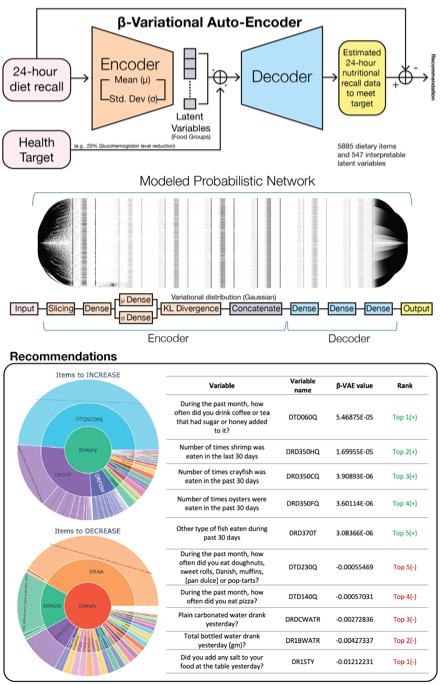
Methods: Our β-VAE neural network architecture (Figure 1) was trained using 10 cycles of cross-sectional datasets from the US National Health and Nutrition Examination Survey from 1999 to 2018. Dietary data were collected with 24-hour recalls. A cumulative 102,957 participants and 5885 food/nutrient items were aggregated into 547 interpretable latent variables.

Results: The trained network performance was evaluated through an aggregated multi-participant study case (n=1000) that explored the relationship between the target hemoglobin A1c change percentage and associated potential changes in participants' diet. Among the top five dietary changes required to achieve a 20% reduction in the latent space value corresponding to hemoglobin A1c were increasing coffee/tea and seafood intake and decreasing sweets, pizza, and salt intake (Figure 1).

Conclusion: The prediction model showed a reasonable alignment with dietary recommendations despite being trained in a fully unsupervised way. β-VAE may be a first-in-class, efficient, and interpretable framework to analyze complex population-level dietary data for precision nutrition research.
  • Tamez, Martha  ( Harvard T.H. Chan School of Public Health , New York , New York , United States )
  • Soenksen, Luis  ( Johns Hopkins University , Baltimore , Maryland , United States )
  • Boussioux, Leonard  ( University of Washington , Seattle , Washington , United States )
  • Mattei, Josiemer  ( Harvard T.H. Chan School of Public Health , New York , New York , United States )
  • Author Disclosures:
    Martha Tamez: DO NOT have relevant financial relationships | Luis Soenksen: No Answer | Leonard Boussioux: No Answer | Josiemer Mattei: DO NOT have relevant financial relationships
Meeting Info:
Session Info:

PS03.07 Methodology and Data Science

Saturday, 03/08/2025 , 05:00PM - 07:00PM

Poster Session

More abstracts on this topic:
A Cross-scale Causal Machine Learning Framework Pinpoints Mgl2+ Macrophage Orchestrators of Balanced Arterial Growth

Han Jonghyeuk, Kong Dasom, Schwarz Erica, Takaesu Felipe, Humphrey Jay, Park Hyun-ji, Davis Michael E

Assessment of Dietary Recall Plausibility Using an Updated Formula that Considers Energy Intake Measured by Doubly-Labeled Water

Santos Baez Leinys, Ravelli Michele N., Diaz-rizzolo Diana A., Popp Collin, Cheng Bin, Gallagher Dympna, Schoeller Dale, Laferrere Blandine

More abstracts from these authors:
Association Between Diet Quality, Hypertension, And Hypertension Awareness Among Adults In Puerto Rico

Tamez Martha, Kaplan Robert, Rodriguez-orengo Jose F, Tucker Katherine, Mattei Josiemer

The Association of Psychosocial Factors with Diet Quality in a Puerto Rican Adults

Porter Anna, Tamez Martha, Spiegelman Donna, Mattei Josiemer

You have to be authorized to contact abstract author. Please, Login
Not Available