Estimated Health Benefits, Costs, and Cost-Effectiveness of Eliminating Dietary Industrial Trans-fatty Acids in China
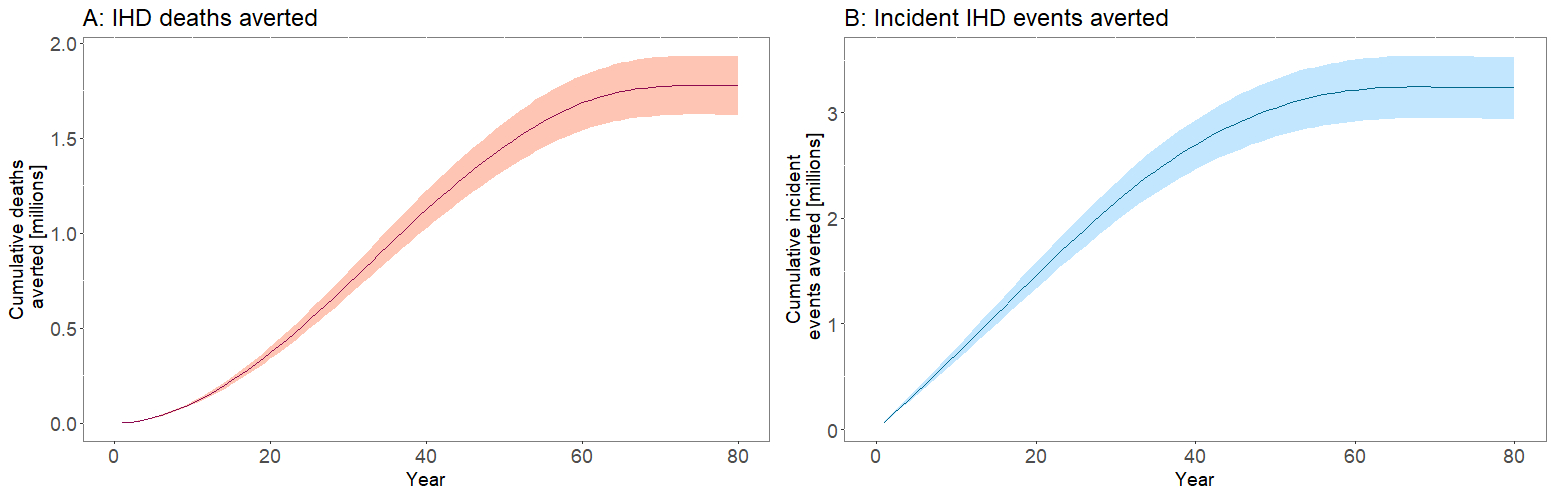
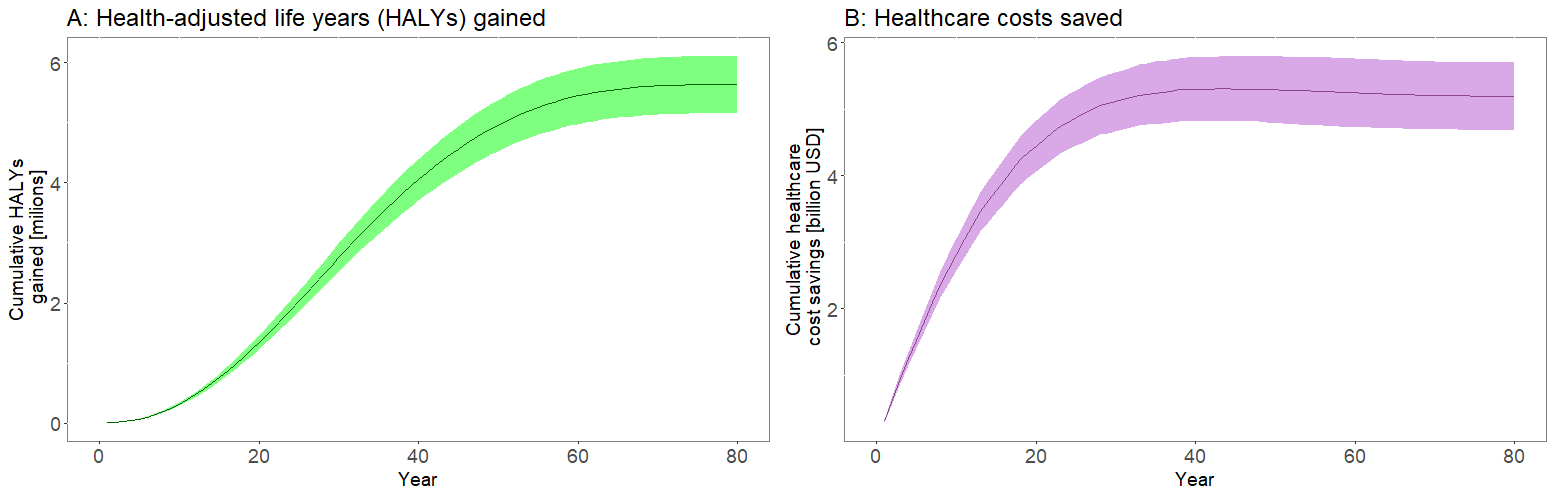
Abstract Body: Objectives: To estimate the potential health benefits, costs, and cost-effectiveness of mandating a limit on industrial trans-fatty acids (iTFA) in all foods, fats, and oils in China. Methods: A multiple cohort proportional multistate life table model was used to project the impact of eliminating dietary iTFA on ischemic heart disease (IHD) burden and costs over different time horizons (5 years, 10 years, and population lifetime). Nationally representative data on iTFA intake were derived from the 2015-2018 China Total Diet Study and China National Health and Nutrition Survey 2011. The health benefits were modelled as averted IHD deaths, events, and health-adjusted life years (HALYs) gained. Net costs were estimated by combining healthcare costs and policy implementation costs, which included government monitoring and industry reformulation costs. Cost-effectiveness was assessed through incremental cost-effectiveness ratios, with both costs and HALYs discounted at 3%. Results: Over 10 years, the mandatory iTFA limit was estimated to prevent approximately 111K IHD deaths (95% uncertainty interval [UI]: 101K-120K), 744K IHD events (95% UI: 678K-807K), 330K HALYs (95% UI: 301K-357K), resulting in a healthcare cost saving of around 2.8 billion USD (95% UI: 2.5-3.0). Over the population lifetime, the intervention was projected to avert 1.9 million (95% UI: 1.7-2.0) IHD deaths, 3.4 million (95% UI: 3.0-3.7) IHD events, and 5.9 million (95% UI: 5.4-6.4) HALYs, saving approximately 5.1 billion USD (95% UI: 4.6-5.7) Policy implementation costs were estimated at 165 million USD (95% UI: 132-198) over the first 10 years and 295 million USD (95% UI: 261-329) over the population lifetime (Figures 1-2). The intervention was estimated to be cost-saving regardless of the time horizon, with robust findings across sensitivity analyses. Conclusions These findings suggest that legislating a mandatory limit on iTFAs could be a cost-saving strategy to prevent a substantial number of IHD events and deaths in China.
Huang, Liping
( The George Institute for Global Health
, Sydney
, New South Wales
, Australia
)
Aminde, Leopold
( Griffith University
, Gold Coast
, Queensland
, Australia
)
Trieu, Kathy
( The George Institute for Global Health
, Sydney
, New South Wales
, Australia
)
Ge, Zeng
( Resolve To Save Lives
, Beijing
, China
)
Drummond, Liz
( Resolve to Save Lives
, New York
, New York
, United States
)
Cobb, Laura
( Resolve to Save Lives
, New York
, New York
, United States
)
Wu, Jason
( The George Institute for Global Health
, Sydney
, New South Wales
, Australia
)
Veerman, J. Lennert
( Griffith University
, Gold Coast
, Queensland
, Australia
)
Marklund, Matti
( Johns Hopkins Bloomberg School of Public Health
, Silver Spring
, Maryland
, United States
)
Author Disclosures:
Liping Huang:No Answer
| Leopold Aminde:No Answer
| Kathy Trieu:DO NOT have relevant financial relationships
| Zeng Ge:No Answer
| Liz Drummond:DO NOT have relevant financial relationships
| Laura Cobb:No Answer
| Jason Wu:DO NOT have relevant financial relationships
| J. Lennert Veerman:DO NOT have relevant financial relationships
| Matti Marklund:DO NOT have relevant financial relationships