
Effects of Dietary Patterns and Sodium Intake on Blood Pressure Variability: Results from the DASH and DASH-Sodium Trials
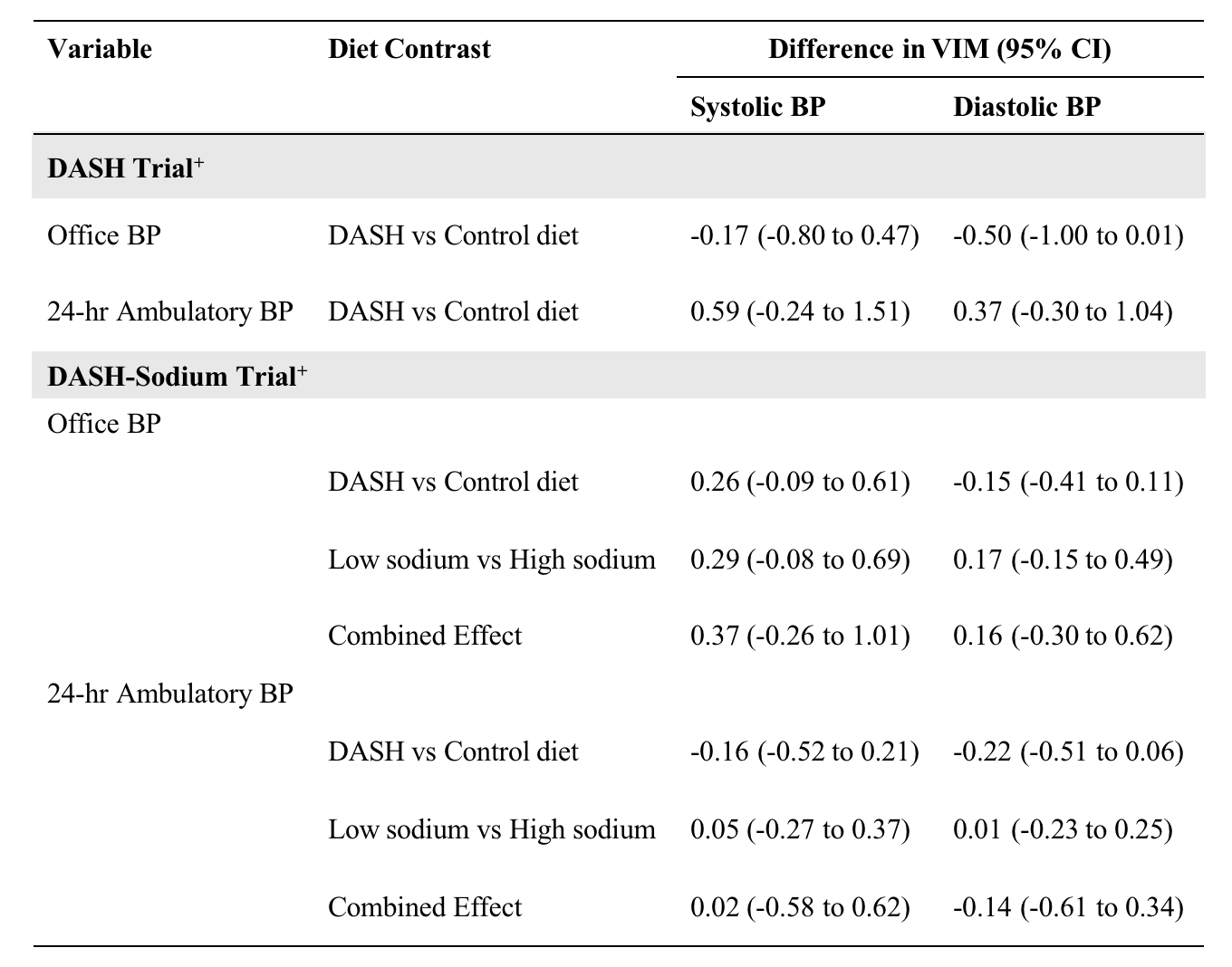
Abstract Body: Background Increased blood pressure (BP) variability is associated with adverse cardiovascular disease outcomes. The Dietary Approaches to Stop Hypertension (DASH) diet and sodium reduction lower BP and cardiovascular risk, but their effects on office and ambulatory BP variability are uncertain. Methods This study analyzed data from the DASH and DASH-Sodium trials, including those participants who were randomized to the DASH or Control diet and had both office and 24-hour ambulatory BP measurements. Office BP was measured at baseline and end of feeding periods using a random-zero sphygmomanometer. Ambulatory BP was measured at the end of intervention periods in both trials and at baseline in DASH trial. BP variability was quantified using the variation independent of the mean (VIM) and compared across groups using t-tests. We used bias-corrected and accelerated bootstrap methods to calculate 95% CIs for the difference in VIM. Results The DASH trial analyses included 214 participants (mean age, 45 years; 48% Female; 59% Black) while the DASH-Sodium trial analyses included 337 participants (mean age, 49 years; 58% Female; 60% Black). After intervention, neither the DASH diet nor sodium reduction significantly affected BP variability in office or ambulatory measurements. In DASH trial, the difference in VIM for office systolic BP between DASH and Control diets was -0.17 (95% CI -0.82 to 0.47), and for ambulatory systolic BP was 0.59 (95% CI -0.23 to 1.41). In the DASH-Sodium trial, compared to high sodium levels, low sodium levels showed similar BP variability (e.g., ΔVIM for office systolic BP: 0.29, 95% CI -0.08 to 0.69; ΔVIM for ambulatory systolic BP: 0.05, 95% CI -0.27 to 0.37). No significant combined or interactive effects of diet and sodium level on BP variability were observed. Conclusion While the DASH diet and reduced sodium intake effectively lower absolute BP levels, these dietary interventions do not significantly affect BP variability. These findings suggest that the BP-related benefits of the DASH diet and sodium reduction primarily result from reducing absolute BP rather than reducing BP variability.
Zou, Siyu
(
Johns Hopkins University
, Baltimore , Maryland , United States )
Gao, Sunan
(
Johns Hopkins University
, Baltimore , Maryland , United States )
Juraschek, Stephen
(
BIDMC-Harvard Medical School
, Boston , Massachusetts , United States )
Miller, Edgar
(
JOHNS HOPKINS MEDICAL INSTITUTIONS
, Baltimore , Maryland , United States )
Matsushita, Kunihiro
(
Johns Hopkins Bloomberg School of Public Health
, Baltimore , Maryland , United States )
Appel, Lawrence
(
JOHNS HOPKINS UNIVERSITY
, Baltimore , Maryland , United States )
Author Disclosures:
Siyu Zou:DO NOT have relevant financial relationships
| Sunan Gao:No Answer
| Stephen Juraschek:No Answer
| Edgar Miller:DO NOT have relevant financial relationships
| Kunihiro Matsushita:No Answer
| Lawrence Appel:DO NOT have relevant financial relationships