
Logo

American Heart Association

  135
  0


Final ID: P1009

Epigenetic age acceleration as a hallmark of premature mortality in US adults

Abstract Body: Introduction: Epigenetic (DNA methylation) clocks have been derived as hallmarks of biological age based on their ability to predict chronological age or aging-related phenotypes. However, studies comprehensively examining the associations between epigenetic age acceleration and premature mortality in nationally representative U.S. populations are lacking.
Hypothesis: Epigenetic age acceleration will be associated with higher risks of premature mortality in the general US population.
Methods: We included 2,191 participants aged 50-79 years from the 1999-2002 National Health and Nutrition Examination Survey (NHANES) who underwent DNA methylation measurement. We included five epigenetic clocks (Horvath’s, Hannum’s, PhenoAge, GrimAge, and DunedinPoAm), and calculated epigenetic age acceleration as the residual from regressing epigenetic age on chronological age (except for DunedinPoAm, which reflects aging rates). Premature mortality was defined as death before age 80, with a sensitivity analysis using a cutoff of 75 years. Cox proportional hazards models were used to assess the association between epigenetic age acceleration and premature mortality.
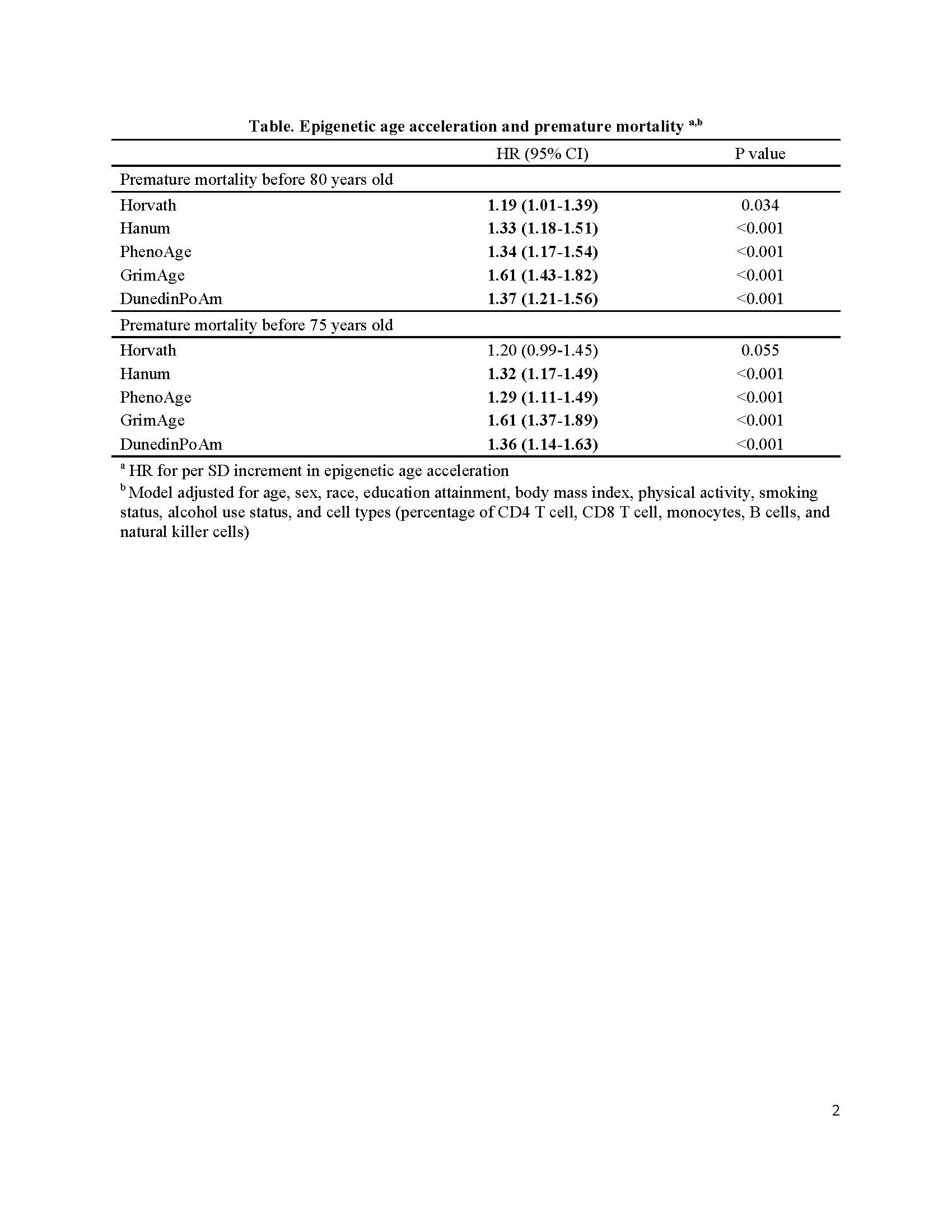
Results: We found that faster epigenetic age acceleration was significantly associated with a 19% to 61% higher risk of premature mortality across the 5 clocks, adjusting for demographic, socioeconomic, and behavioral factors (Table). GrimAge age acceleration was the strongest predictor, while Horvath age acceleration was the weakest. The associations were consistent when premature mortality was defined as death before age 75.
Conclusions: Our examination of epigenetic age acceleration measures in a representative U.S. population lends innovative evidence to support the potential application of epigenetic clocks as hallmarks for monitoring biological aging and a promising target for prevention of premature mortality and aging-related disorders in the broader US populations.
  • Kou, Minghao  ( Tulane University , New Orleans , Louisiana , United States )
  • Ma, Hao  ( Tulane university , Metairie , Louisiana , United States )
  • Wang, Xuan  ( Tulane University , New Orleans , Louisiana , United States )
  • Heianza, Yoriko  ( TULANE UNIVERSITY , New Orleans , Louisiana , United States )
  • Manson, Joann  ( Brigham and Women’s Hospital , Boston , Massachusetts , United States )
  • Qi, Lu  ( TULANE UNIVERSITY , New Orleans , Louisiana , United States )
  • Author Disclosures:
    Minghao Kou: DO NOT have relevant financial relationships | Hao Ma: No Answer | Xuan Wang: DO NOT have relevant financial relationships | Yoriko Heianza: DO NOT have relevant financial relationships | JoAnn Manson: No Answer | Lu Qi: No Answer
Meeting Info:
Session Info:

PS01.01 Aging in Older Adults

Thursday, 03/06/2025 , 05:00PM - 07:00PM

Poster Session

More abstracts on this topic:
An Epigenetic Drug, GSK126 Mitigates Endothelial to Mesenchymal Transition Attenuating Atherosclerosis in Diabetes

Aziz Misbah, Jandeleitdahm Karin, Khan Abdul Waheed

A Multicenter Study of Detection of Pulmonary Hypertension Based on Point-of-Care 12- Lead ECG Data

Dubrock Hilary, Wieczorek Mikolaj, Hackett Sarah, Alger Heather, Carlson Katherine, Klugherz Paul, Carter Rickey, Wagner Tyler, Johnson Patrick, Frantz Robert, Strom Jordan, Waks Jonathan, Agarwal Richa, Hemnes Anna, Steinberg Benjamin, Pandey Ambarish

More abstracts from these authors:
You have to be authorized to contact abstract author. Please, Login
Not Available