
Serum Metabolomic Markers of Dietary Potassium and Incident Chronic Kidney Disease Risk
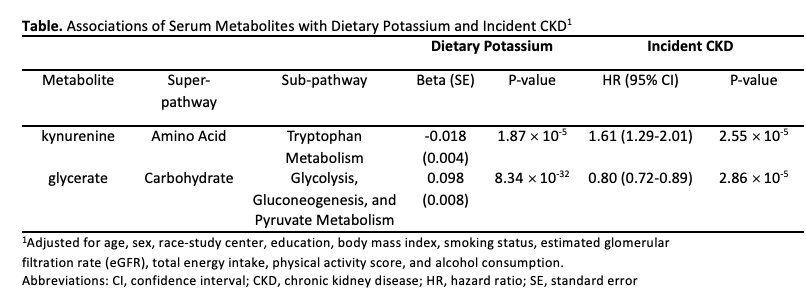
Abstract Body: Introduction: Potassium is found in many foods and has been inversely associated with incident chronic kidney disease (CKD). Untargeted metabolomic profiling is a powerful approach for discovery of novel diet biomarkers and to highlight metabolic pathways that explain associations between dietary potassium and CKD. Methods: Dietary potassium was derived from food items assessed using an interviewer-administered questionnaire administered at visit 1 (1987-89). Incident CKD was a composite outcome using reduced estimated glomerular filtration rate (<60 mL/min/1.73 m2 and ≥25% eGFR decline), hospitalization and death codes related to CKD stage 3+, or end-stage kidney disease identified via US Renal Data System registry. Participants were followed for CKD until December 31, 2020. Cross-sectional associations between dietary potassium (mg/1000 kcal) and 359 serum metabolites were evaluated with linear regression models. Prospective associations between significant potassium-related metabolites and CKD were studied with Cox regression models. Analyses were adjusted for covariates and accounted for multiple comparisons. Results: In 3,822 U.S. adults, we identified 53 significant associations between dietary potassium and serum metabolites, representing 6 super-pathways (amino acids, n=17; lipids, n=11; cofactors and vitamins, n=9; xenobiotics, n=8; carbohydrate, n=5; peptides, n=3). Over two decades of follow-up, 1,618 (42%) of participants developed incident CKD. Ten of the 53 metabolites from the cross-sectional analysis were prospectively associated with incident CKD. Two metabolites, kynurenine and glycerate, had the a priori expected directions of associations with dietary potassium and CKD (Table). There was a significant trend of CKD risk across quartiles of kynurenine and glycerate. Conclusions: Kynurenine and glycerate and their respective pathways may be representative of dietary potassium’s metabolic impact on CKD development.
Bernard, Lauren
( University of Maryland
, Columbia
, Maryland
, United States
)
Yang, Jiaqi
( Welch Center for Prevention, Epidemiology, and Clinical Research
, Baltimore
, Maryland
, United States
)
Chen, Jingsha
( Welch Center for Prevention, Epidemiology, and Clinical Research
, Baltimore
, Maryland
, United States
)
Sullivan, Valerie
( Welch Center for Prevention, Epidemiology, and Clinical Research
, Baltimore
, Maryland
, United States
)
Yu, Bing
( UNIV OF TX HEALTH SCI CTR HOUSTON
, Houston
, Texas
, United States
)
Rhee, Eugene
( Massachusetts General Hospital
, Boston
, Massachusetts
, United States
)
Casey, Rebholz
( Welch Center for Prevention, Epidemiology, and Clinical Research
, Baltimore
, Maryland
, United States
)
Author Disclosures:
Lauren Bernard:DO NOT have relevant financial relationships
| Jiaqi Yang:DO NOT have relevant financial relationships
| Jingsha Chen:No Answer
| Valerie Sullivan:DO NOT have relevant financial relationships
| Bing Yu:DO NOT have relevant financial relationships
| Eugene Rhee:DO NOT have relevant financial relationships
| Rebholz Casey:No Answer