Differences by Race, but not Sex, in Metabolomic Profiles Associated with Red and Processed Meat Consumption in the Coronary Artery Risk Development in Young Adults (CARDIA) Study
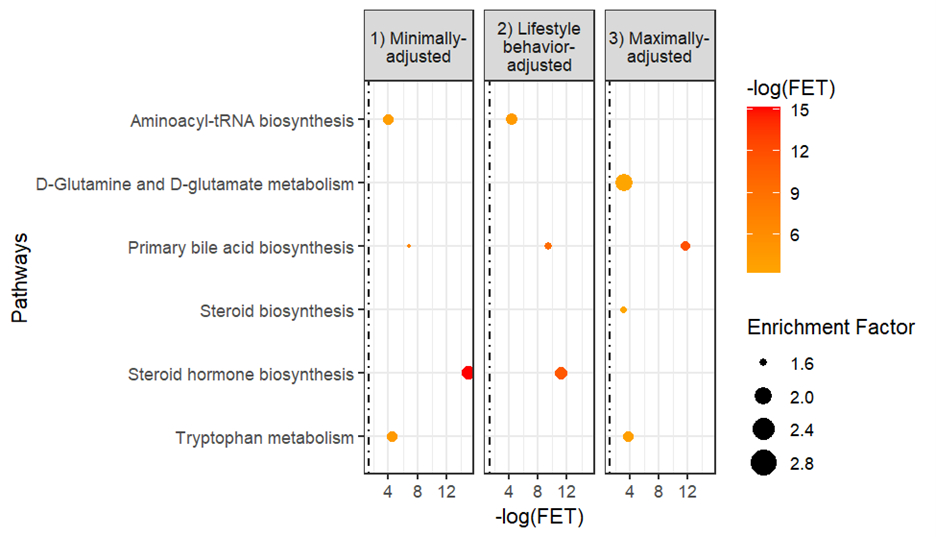
Abstract Body: Introduction: Higher red and processed meat (RPM) consumption is associated with higher cardiometabolic risk. While consumption patterns vary by sex and race in the US population, it is not known whether RPM-associated metabolic signatures differ by sex or race. Methods: We used data from 2,841 women and men of self-reported Black and White race (mean age: 45 years; 45% Black race; 57% women) at the year 20 follow-up (2005-06) of the prospective, U.S.-based CARDIA study, which boasts high-quality, interviewer-administered diet history and well-characterized lifestyle data. Using ultra-high performance liquid chromatography and mass spectrometry, we generated untargeted fasting plasma metabolomics data. We iteratively regressed each of the 7,522 metabolite peaks onto RPM consumption (servings/day, continuous variable), with race- and sex-interactions, and adjustment for multiple comparisons using false discovery rate<0.1 with three covariate-adjusted linear regression models: Minimally-adjusted=age+race+sex+center+education+metabolite batch+energy intake; Lifestyle behavior-adjusted=Minimally-adjusted+smoking status+physical activity+alcohol intake+diet quality, and Maximally-adjusted=Lifestyle behavior-adjusted+anti-hypertensive and lipid-lowering medication use+BMI. We used Mummichog software to identify enriched metabolic pathways with higher activity than expected (Fisher’s Exact Test (FET) p<0.05). We also fit orthogonal partial least squares regression (OPLS-R) models to identify metabolic signatures that distinguished participants by race and sex, with evaluation of principal components via variance explained in RPM consumption. Results: We identified metabolic pathways that were differentially enriched according to race (FET p<0.05; Figure), but not sex. Based on race- and sex-specific OPLS-R models, the full set of metabolite peaks was more strongly associated with RPM consumption among participants of White race (Q2:0.25) compared to participants of Black race (Q2:0.14). Moreover, metabolite peaks among men (Q2:0.098) and women (Q2:0.065) were similarly associated with RPM consumption. Conclusions: Metabolic pathway activity differed by race, but not sex, with slightly different strength of association between metabolite peak data and RPM consumption across groups. While we expected differences by metabolic profile reflecting biological sex-related differences, the observed race differences suggest potential environment-related metabolic activity.
Shetye, Aditya
(
UNC - Chapel Hill
, Raleigh , North Carolina , United States )
Howard, Annie Green
(
UNC - Chapel Hill
, Chapel Hill , North Carolina , United States )
Meyer, Katie
(
UNC - Chapel Hill
, Raleigh , North Carolina , United States )
Hullings, Autumn
(
UNC - Chapel Hill
, Raleigh , North Carolina , United States )
Mhatre, Sachin
(
Atrium Health
, Charlotte , North Carolina , United States )
Li, Yuanyan
(
UNC - Chapel Hill
, Raleigh , North Carolina , United States )
Rushing, Blake
(
UNC - Chapel Hill
, Raleigh , North Carolina , United States )
Sha, Wei
(
Atrium Health
, Charlotte , North Carolina , United States )
Lewis, Cora
(
Univeristy of Alabama at Birmingham
, Birmingham , Alabama , United States )
Avery, Christy
(
UNC - Chapel Hill
, Chapel Hill , North Carolina , United States )
North, Kari
(
UNC - Chapel Hill
, Chapel Hill , North Carolina , United States )
Gordon-larsen, Penny
(
UNC - Chapel Hill
, Chapel Hill , North Carolina , United States )
Author Disclosures:
Aditya Shetye:DO NOT have relevant financial relationships
| Christy Avery:No Answer
| Kari North:DO NOT have relevant financial relationships
| Penny Gordon-Larsen:No Answer
| Annie Green Howard:DO NOT have relevant financial relationships
| katie meyer:No Answer
| Autumn Hullings:DO NOT have relevant financial relationships
| Sachin Mhatre:DO NOT have relevant financial relationships
| Yuanyan Li:No Answer
| Blake Rushing:No Answer
| Wei Sha:No Answer
| Cora Lewis:No Answer