Logo

American Heart Association

  4
  0


Final ID: Tue111

Pathological Shear Stress Drives Immunoepigenomic Reprogramming of Circulating T Cells in Aortic Valvular Stenosis

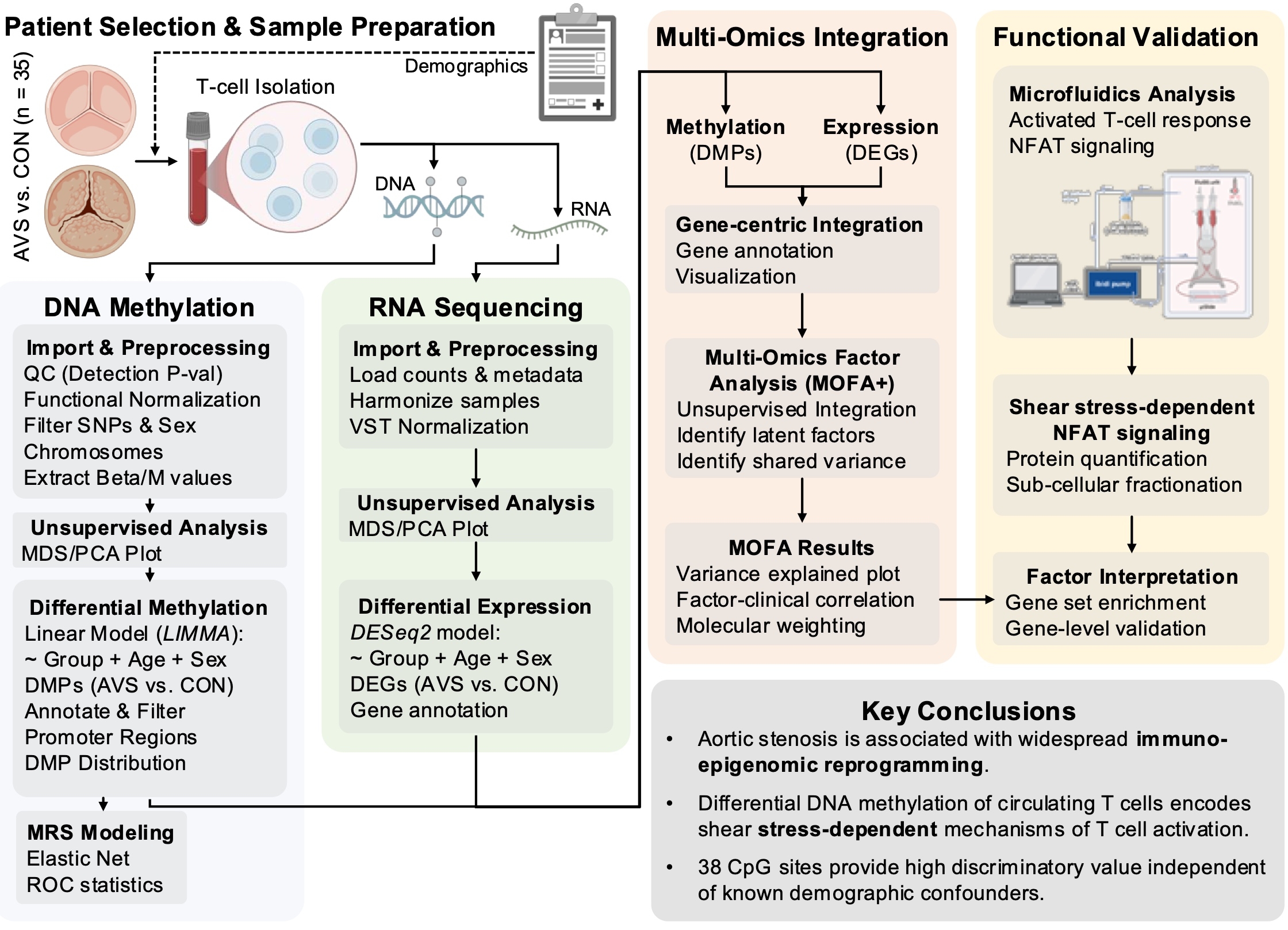
Abstract Body: Background. Calcific aortic valve stenosis (AVS) is the most prevalent valvular heart disease in the Western world, for which no disease-modifying therapy yet exists. High shear stress (HSS) generated by progressive valvular obstruction is a known initiator of endothelial injury and immune-mediated inflammation, but the mechanistic contribution of circulating T cells to AVS pathogenesis remains undefined. We hypothesized that chronic HSS induces an epigenomic reprogramming of peripheral T cells, contributing to immunomodulatory dysregulation that drives disease progression.
Methods. We enrolled a prospective cohort of 35 patients with severe, symptomatic AVS scheduled for transcatheter aortic valve replacement (TAVR) and 35 age- and sex-matched controls with intact valve hemodynamics. Genome-wide CpG methylation profiling of peripheral T cells was performed using the Illumina Infinium MethylationEPIC BeadChip array alongside RNA-sequencing (n=54) as a functional readout.
Results. Unsupervised clustering of the most-variable CpG loci separated AVS from control T cells (PC1; 15.8% variance; P = 3.9×10⁻⁶), and MOFA integration identified the latent factor that independently predicts AVS (P = 2.4x10⁻⁴); this factor robustly enriched chemokine receptor (P = 1.1×10⁻⁶) and TNF ligand-receptor (P = 6.9×10⁻⁵) interactions. Using a novel microfluidics-based in vitro system, we established a mechanistic link between hemodynamic stress and T cell activation via NFAT siganling. To predict AVS severity using only the T cell epigenome, we developed a methylation risk score (MRS) derived from 30 elastic-net–selected CpGs, which uncovered a diagnostic-level precision (AUC=0.99; DeLong P = 0.047); MRS quartile stratification revealed a monotonic increase in AVS discrimination (P = 3.3×10⁻⁵). Multivariable regression further confirmed MRS as an independent predictor of aortic valve area (β=−0.112±0.08 cm2/SD; P = 0.008) even after adjustment for age and sex.
Conclusions. Severe AVS is accompanied by widespread, promoter-enriched epigenomic remodeling of circulating T cells that converge onto shear stress-dependent CpG methylation programs. A 30-CpG methylation risk score offers the first liquid biopsy-based diagnostic approach to uncover both the presence and severity of AVS. Together, we describe the first evidence that peripheral immunoepigenetic reprogramming is both a mechanistic mediator of immune dysregulation and a clinically informative biomarker in human AVS.
  • Pepin, Mark  ( Stanford University , Stanford , California , United States )
  • Zhang, Yunyang  ( University Hospital Bonn , Bonn , Germany )
  • Zheng, Jimmy  ( Stanford University , Stanford , California , United States )
  • Splettstoesser, Frank  ( University Hospital Bonn , Bonn , Germany )
  • Zimmer, Sebastian  ( University Hospital Bonn , Bonn , Germany )
  • Frede, Stilla  ( University Hospital Bonn , Bonn , Germany )
  • Author Disclosures:
Meeting Info:

Basic Cardiovascular Sciences 2026

2026

Boston, Massachusetts

Session Info:

Poster Session 2

Tuesday, 07/14/2026 , 04:30PM - 07:00PM

Poster Session and Reception

More abstracts on this topic:
Anatomic Physiological Scoring is a Comparable Predictor of Adult Congenital Operative Morbidity and Mortality

La Brenda, Taylor-fishwick Jon, Macbeth Morgan, Soohoo Megan

Activated T cells from Bph/2 Mice Have an Attenuated Cytokine Response to a Polyclonal T Cell Activator Compared to T cells from Bpn/3 Mice

Rockwell Cheryl, Dattmore Devon, Mcdonald Paiton, Chowdhury Afrin, Awali Saamera, Boss Allison, Sather Lisa, Lauver Adam

More abstracts from these authors:
Patient-Reported Health Status Among Patients with Heart Failure with Improved Ejection Fraction

Vasti Elena, Zheng Jimmy, Kalwani Neil, Dejong Colette, Bhatt Ankeet, Ambrosy Andrew, Din Natasha, Heidenreich Paul, Sandhu Alexander

Treating Elderly Cardiogenic Shock Patients with a Microaxial Flow Pump; Is It DANGERous?

Klein Anika, Nordbeck Peter, Clemmensen Peter, Panoulas Vasileios, Zimmer Sebastian, Schaefer Andreas, Engstrom Thomas, Holmvang Lene, Junker Anders, Schmidt Henrik, Terkelsen Christian, Beske Rasmus, Moller Jacob, Hassager Christian, Jensen Lisette Okkels, Eiskjaer Hans, Mangner Norman, Polzin Amin, Schulze Christian, Skurk Carsten

You have to be authorized to contact abstract author. Please, Login
Not Available