
Logo

American Heart Association

  12
  0


Final ID: Wed135

Diurnal Variation in Cardiac Electrophysiology and Arrhythmia Susceptibility in Rats

Abstract Body: Cardiac arrhythmias are leading cause of death in the United States. Evidences indicates that many cardiac events occur in a time-of-day–dependent manner. However, the intrinsic electrophysiological mechanisms underlying these diurnal variations in arrhythmia susceptibility remain incompletely understood. We hypothesized that cardiac electrophysiological properties exhibit 24-hour fluctuations and that arrhythmia susceptibility increases during periods associated with shorter refractory periods.

In this ex vivo study, 24 rat hearts were used. Rat hearts were excised at six Zeitgeber time (ZT) points across the 24-h circadian cycle (n=4/time point). Dual optical mapping was performed to simultaneously quantify transmembrane voltage (Vm) and intracellular calcium (Ca++) dynamics. In parallel cohorts, tissues were collected and rapidly flash frozen for molecular study of important downstream regulatory proteins.

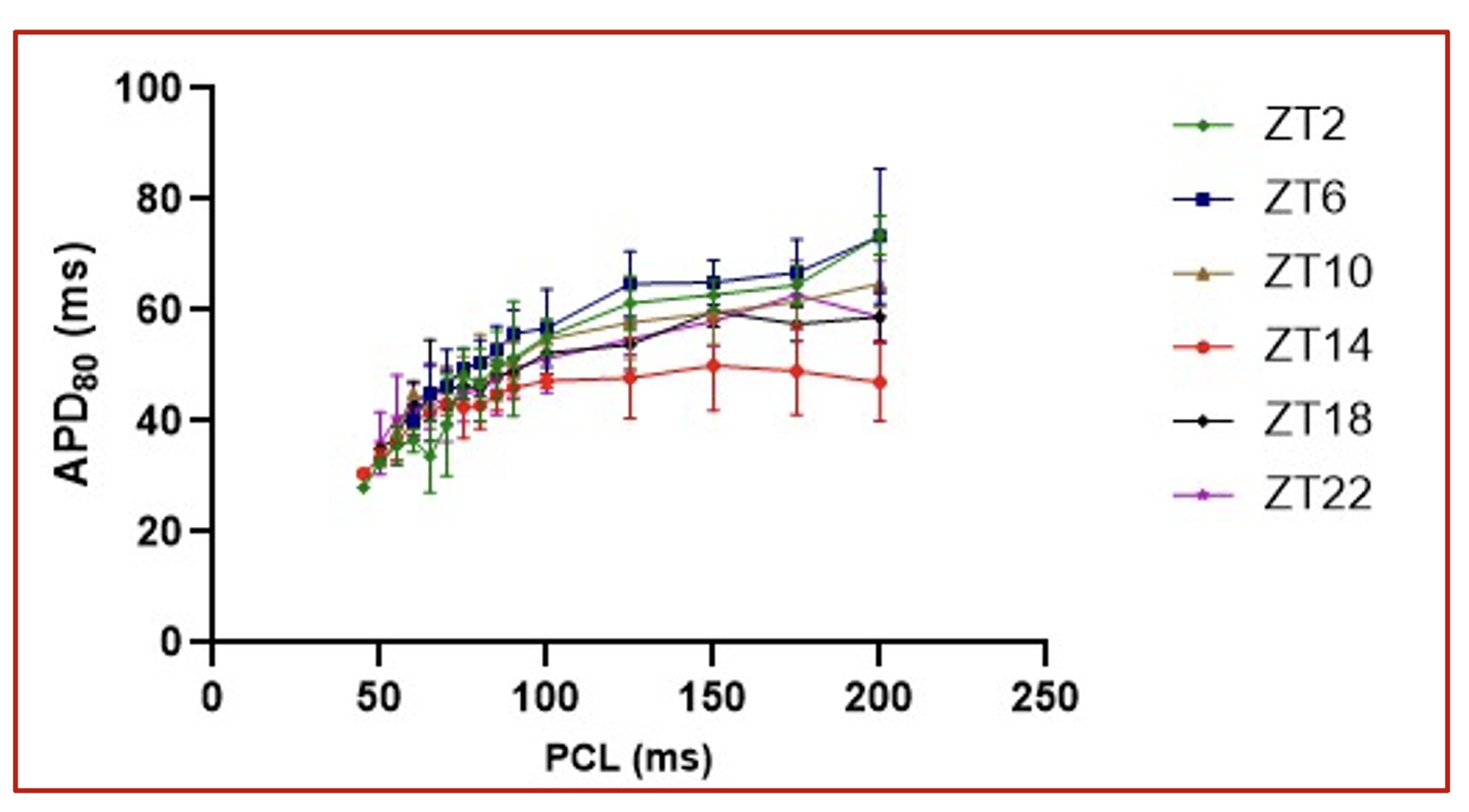
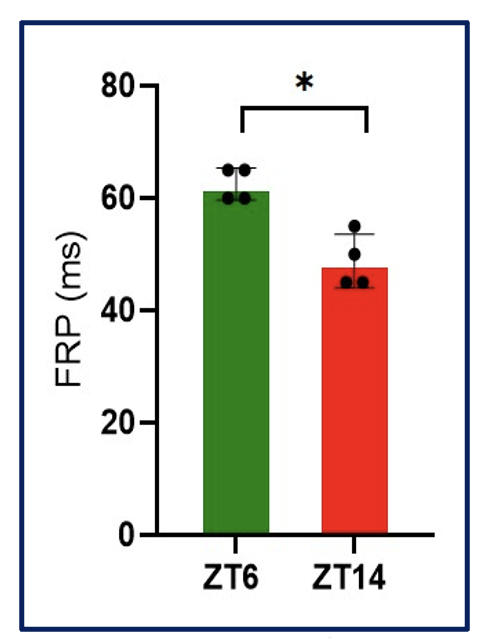
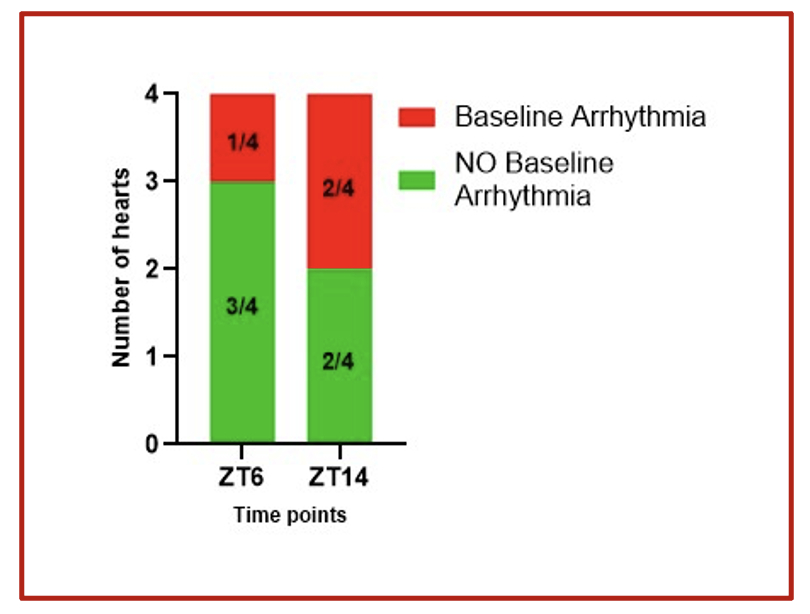
Our results shows that cardiac electrophysiology exhibited circadian variation in rat whole hearts, with action potential duration (APD80) (fig 1) and functional refractory period (FRP) showing clear diurnal oscillations with the largest differences observed between ZT6 and ZT14 (fig 2). Calcium transient duration (CaTD80) showed minimal circadian variation, while arrhythmia inducibility was significantly higher during the active phase under both baseline (fig 3) and isoproterenol stimulation.

Our findings suggest that cardiac electrophysiology, mediated by intrinsic circadian clock regulation of ion channels, contributes to time-of-day differences in electrical activity and arrhythmia vulnerability. These observations highlight the potential for time-of-day–guided therapeutic interventions in arrhythmia prevention.
  • Adelakun, Adedayo  ( University at Buffalo , Buffalo , New York , United States )
  • Grisewood, Ryan  ( UNIVERSITY AT BUFFALO , Buffalo , New York , United States )
  • Lichtenberger, Alexis  ( University at Buffalo , Buffalo , New York , United States )
  • Minnella, Ethan  ( University at Buffalo , Buffalo , New York , United States )
  • Qadus, Neelam  ( University at Buffalo , Buffalo , New York , United States )
  • Young, Martin E  ( University at Alabama , Birmingham , Alabama , United States )
  • Canty, John  ( UNIVERSITY AT BUFFALO , Buffalo , New York , United States )
  • Aras, Kedar  ( SUNY Buffalo , Buffalo , New York , United States )
  • Author Disclosures:
Meeting Info:

Basic Cardiovascular Sciences 2026

2026

Boston, Massachusetts

Session Info:

Poster Session 3

Wednesday, 07/15/2026 , 04:30PM - 07:00PM

Poster Session and Reception

More abstracts on this topic:
4D Cardiac Optogenetics Enable Complex Arrhythmia Modelling and Precise Interventional Simulation

Wexler Yehuda, Grinstein Harel, Landesberg Michal, Glatstein Shany, Huber Irit, Arbel Gil, Gepstein Lior

Chronotype and Cardiovascular Disease Risk Factors among Middle-aged and Older Adults: A Mendelian Randomization Study

Kianersi Sina, Potts Kaitlin, Wang Heming, Sofer Tamar, Noordam Raymond, Rutter Martin, Rexrode Kathryn, Redline Susan, Huang Tianyi

You have to be authorized to contact abstract author. Please, Login
Not Available