
Elucidating Arrhythmogenic Mechanisms in Brugada Syndrome Using Voltage Mapping of Patient-Derived iPSC-Cardiomyocyte Syncytia
Abstract Body: Brugada syndrome (BrS) is a life-threatening inherited arrhythmia classically characterized by sodium channel dysfunction, contributing to up to 12% of Sudden Cardiac Deaths (SCDs) worldwide. Current definitive therapy for patients with BrS is ICD implantation, which does not resolve the underlying disease pathogenesis, while also representing a significant burden for BrS patients. Given this unmet pharmacological demand, human-relevant platforms to model BrS and enable mechanism-based drug discovery are urgently needed. We hypothesize that BrS induced pluripotent stem cell–derived cardiomyocytes (iPSC CMs) can model the disease electrophysiology through voltage mapping of syncytia.
We established three lines of patient-specific iPSC-CMs carrying either pathogenic or likely pathogenic BrS variants from clinically diagnosed Brugada patients to model the disease in vitro. BrS phenotypes were unmasked using clinically relevant provocation paradigms, including temperature elevation and sodium-channel blockade with flecainide. Voltage optical mapping of iPSC-CM syncytia was used to quantify conduction abnormalities and arrhythmic events in a high-throughput manner. Sodium channel expression on the surface of iPSC-CMs was measured using IF staining for NaV1.5.
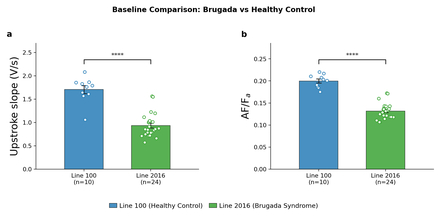
BrS iPSC-CMs exhibited robust arrhythmic phenotypes at baseline, including reduced Normalized Action Potential Amplitude (AF/Fa), increased time to peak, and reduced upstroke slope. Furthermore, BrS iPSC-CMs demonstrated increased susceptibility to pro-arrhythmic stimulation. These findings coincide with BrS cardiomyocyte electrophysiology due to reduced NaV1.5 function. IF for NaV1.5 showed an inverse correlation between surface expression and action potential dysfunction when compared to healthy controls.
In conclusion, patient-specific iPSC-CM monolayers from multiple BrS patients, combined with voltage mapping and clinically relevant provocation paradigms, provide a robust human-relevant model of Brugada syndrome. This platform enables validation and safety profiling of small-molecule modulators that suppress arrhythmogenic phenotypes, supporting a translational path toward New Approach Methodologies (NAM)-based therapies for Brugada syndrome.
Sadek, Ali
(
University of Texas at Southwestern
, Dallas , Texas , United States )
Venkateshappa, Ravichandra
(
STANFORD UNIV SCH OF MEDICINE
, Stanford , California , United States )
Zdanstevich, Kristina
(
STANFORD UNIV SCH OF MEDICINE
, Stanford , California , United States )
Herron, Todd
(
Greenstone Biosciences
, Palo Alto , California , United States )
Pandya, Raj
(
STANFORD UNIV SCH OF MEDICINE
, Stanford , California , United States )
Xie, Qiu
(
STANFORD UNIV SCH OF MEDICINE
, Stanford , California , United States )
Wu, Joseph
(
STANFORD UNIV SCH OF MEDICINE
, Stanford , California , United States )