Longitudinal assessment of endothelial and short chain fatty acid profiles in older adults with and without COVID 19
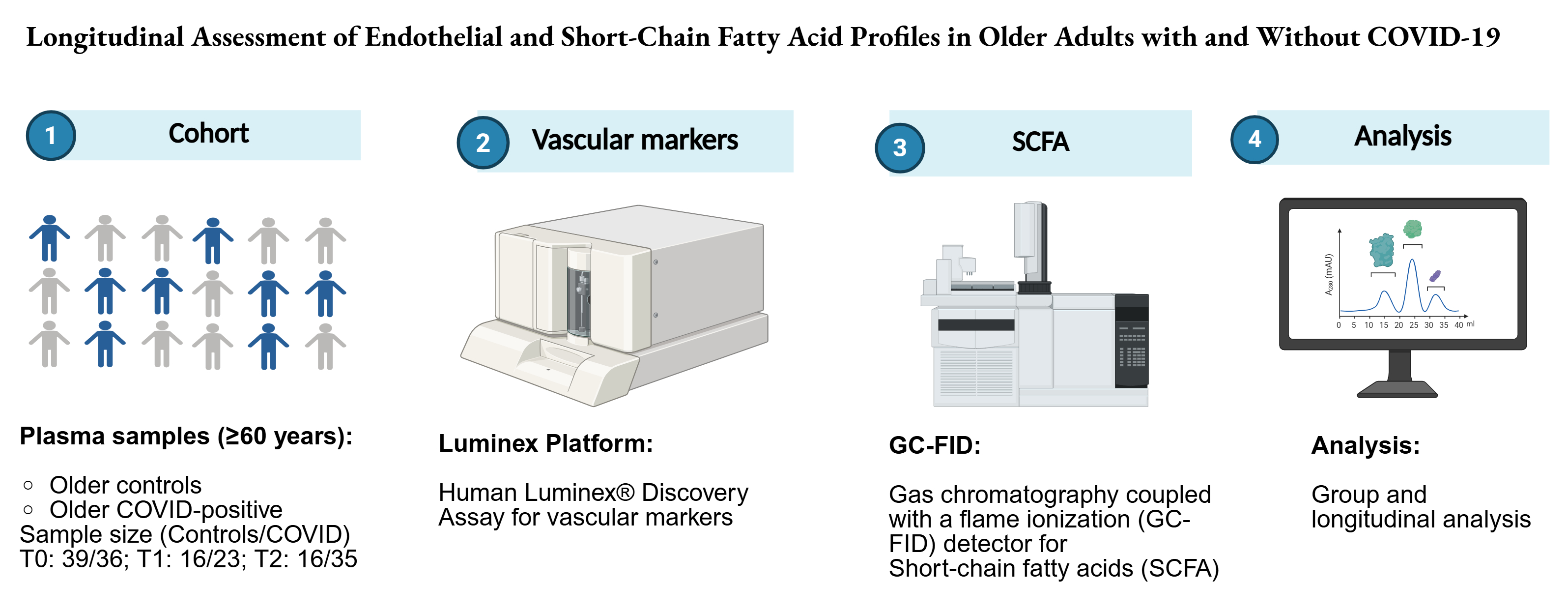
Abstract Body: Introduction. Endothelial dysfunction and altered gut vascular signaling have been implicated in cardiovascular complications of COVID 19 in older adults, yet their coordinated longitudinal dynamics remain poorly defined in non-hospitalized individuals. Hypothesis. We hypothesized that SARS CoV 2 infection in older adults is associated with persistent endothelial activation accompanied by altered circulating short chain fatty acids (SCFAs) over a one year period. Goal. To characterize longitudinal changes in endothelial and SCFA profiles in older adults with COVID 19 compared with age matched controls at baseline (T0), 6 months (T1), and 12 months (T2). Methods. Plasma samples from adults aged more than 60 years with COVID 19 or age matched controls were collected at baseline (T0: 39 controls, 36 COVID), 6 months (T1: 16 controls, 23 COVID), and 12 months (T2: 16 controls, 35 COVID). Endothelial and hemostatic markers were quantified using a Human Luminex® Discovery Assay, and short chain fatty acids were measured by gas chromatography with flame ionization detection. Group and time-point differences between COVID-19 and control participants were assessed using parametric or non-parametric tests, with two-sided p<0.05 considered significant. Adjusted post hoc pairwise comparisons were conducted to identify specific between group and longitudinal differences for each endothelial marker and SCFA. Results. At 6 months, COVID participants exhibited pronounced endothelial activation. T1 COVID levels exceeded controls and/or earlier COVID timepoints for ADAMTS13, endoglin, syndecan-1, u-plasminogen activator, ICAM-1, E-selectin, and VCAM-1 (p≤0.05), with several markers remaining elevated or evolving at T2. SCFA profiles were also altered. At baseline, COVID participants showed lower propionic, butyric, valeric, heptanoic, and isocaproic acids compared with controls (p≤0.05) and higher isobutyric acid (p<0.0001). During follow-up, COVID participants had persistently lower butyric and heptanoic acids at T1 and T2 (p≤0.05), reduced isobutyric acid at T1 and T2 (p≤0.05), and increased isovaleric acid at T1 and T2 (p≤0.05), while acetic and hexanoic acids remained unchanged. Conclusions. Older adults with COVID-19 demonstrate sustained endothelial activation alongside a persistent SCFA signature, supporting disruption of a gut vascular axis in post-acute vascular vulnerability and highlighting circulating SCFAs as potential biomarkers and therapeutic targets.
Vayalanellore Giridharan, Vijayasree
(
UTHealth, Houston
, Houston , Texas , United States )
Polk, Shahrazad
(
UTHealth, Houston
, Houston , Texas , United States )
Vargas Lidio, Adrielly
(
University of Southern Santa Catarina
, Circiuma , Brazil )
Behenck Medeiros, Eduarda
(
University of Southern Santa Catarina
, Circiuma , Brazil )
Budni, Josiane
(
University of Southern Santa Catarina
, Circiuma , Brazil )
Barichello, Tatiana
(
UTHealth, Houston
, Houston , Texas , United States )