
Logo

American Heart Association

  10
  0


Final ID: Tue062

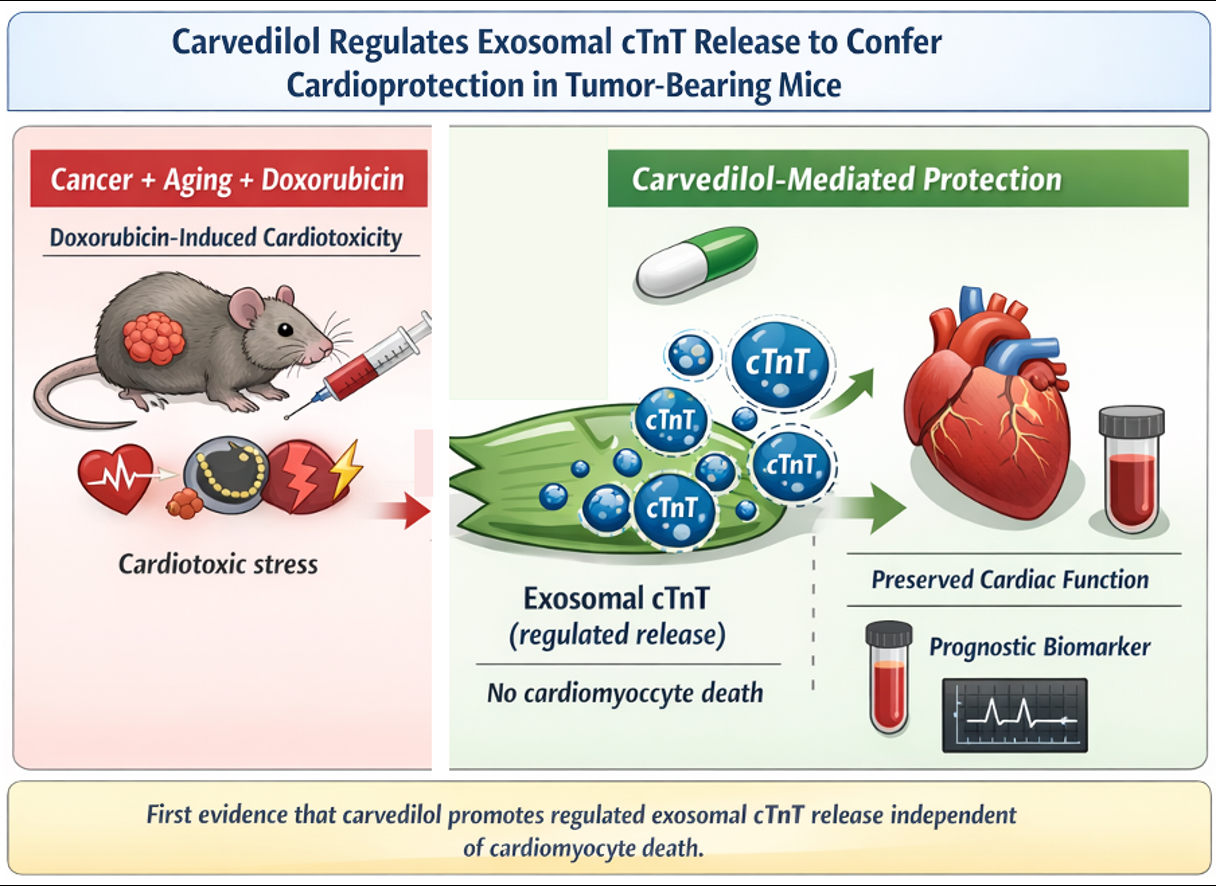
Exosomal Troponin as Prognostic Biomarker of Carvedilol-Mediated Cardioprotection Revealed in Aged Tumor Mice

Abstract Body: Carvedilol is commonly prescribed to cardiovascular disease patients. However, clinical studies evaluating its efficacy in preventing chemotherapy-induced cardiotoxicity remain controversial.
Investigate the underlying cardioprotective mechanisms of carvedilol to mitigate doxorubicin (Dox)-induced cardiotoxicity in human cardiomyocytes in vitro and in clinically relevant aged tumor mice in vivo.
Viability of human cardiomyocytes AC16 exposed to carvedilol and Dox was assessed longitudinally using real-time cell analysis (Agilent), confirmed by MTT assay. To mimic the clinical scenario, we implanted MDA-MB-231 human breast cancer cells in the mammary fat pads of 18-month-old female BALB/cJ mice. Mice were either untreated (n=3) or injected with 5 mg/kg of Dox weekly for 4 consecutive weeks, with or without 5 mg/kg of carvedilol (n=13) given weekly. Echocardiography and pulse oximetry were performed before, during, and 1 week after Dox/carvedilol. At the endpoint, cardiac tissue and plasma were harvested for exosome isolation using size exclusion columns. An equal number of particles was loaded for Western blots of Alix, CD63 (exosomal markers), and cardiac troponin T.

AC16 cell viability was significantly improved by carvedilol co-treatment at 27 hours post Dox exposure, and persists until the endpoint at 92 hours. Carvedilol given after Dox withdrawal also improved AC16 survival, sustained for 72 hours, compared to vehicle control. In tumor mice, troponin in cardiac exosomes was significantly and specifically elevated with carvedilol and Dox co-treatment, and was present at low/basal levels in plasma exosomes regardless of treatment. The cardiac exosomal troponin elevation preceded detectable changes in cardiopulmonary function. Carvedilol did not impact tumor volume.

We report for the first time that the regulated sorting of troponin into exosomes for secretion, seen in the absence of cardiomyocyte death, may underlie the cardioprotective effects of carvedilol. Our data further supports that the elevated exosomal troponin seen with carvedilol in the presence of Dox may provide a viable prognostic biomarker of the early cellular response to cardioprotective intervention.
  • Majidipur, Amene  ( Tufts Medical Center , Boston , Massachusetts , United States )
  • Yu, Ada  ( Tufts Medical Center , Boston , Massachusetts , United States )
  • Xu, Purui  ( Tufts Medical Center , Boston , Massachusetts , United States )
  • Hidden, Nathanael  ( Tufts University , North Grafton , Massachusetts , United States )
  • King, Thomas  ( Tufts University , North Grafton , Massachusetts , United States )
  • Valencia, Dylan  ( Tufts Medical Center , Boston , Massachusetts , United States )
  • Martin, Gregory  ( Tufts Medical Center , Boston , Massachusetts , United States )
  • Savvidou, Maria  ( Tufts University , North Grafton , Massachusetts , United States )
  • Yang, Vicky  ( Tufts University , North Grafton , Massachusetts , United States )
  • Blanton, Robert  ( TUFTS MEDICAL CENTER , Boston , Massachusetts , United States )
  • Pulakat, Lakshmi  ( Tufts Medical Center , Boston , Massachusetts , United States )
  • Chen, Howard  ( Tufts Medical Center , Boston , Massachusetts , United States )
  • Author Disclosures:
Meeting Info:

Basic Cardiovascular Sciences 2026

2026

Boston, Massachusetts

Session Info:

Poster Session 2

Tuesday, 07/14/2026 , 04:30PM - 07:00PM

Poster Session and Reception

More abstracts on this topic:
More abstracts from these authors:
A Rationally Designed Cardioprotective Nanoparticle to Treat Chemotherapy-Induced Cardiotoxicity

Khatun Zehedina, Blanton Robert, Baleja James, Yang Vicky, Yuan Hushan, Chen Howard, Kung Andrew, Boukhalfa Asma, Thompson Anna-lee, Weng Sydney, Wei Lan, Meng Lin, Martin Gregory, Mekkaoui Choukri

Carvedilol Exerts Evolutionarily Conserved Cardioprotective Effects via Autophagy Modulation and Energetics Restoration

Boukhalfa Asma, Yang Vicky, Chen Howard, Shin Pei-tsz, Meola Dawn, Showers Annie, Yu Ada, Upshaw Jenica, London Cheryl, Jaffe Iris, Pulakat Lakshmi

You have to be authorized to contact abstract author. Please, Login
Not Available