FAP-CAR iNKT Cells Penetrate the Plaque Microenvironment to Mitigate Atherosclerotic Progression
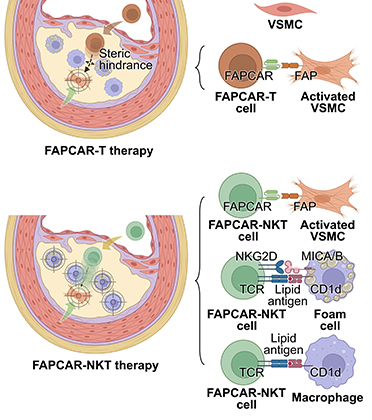
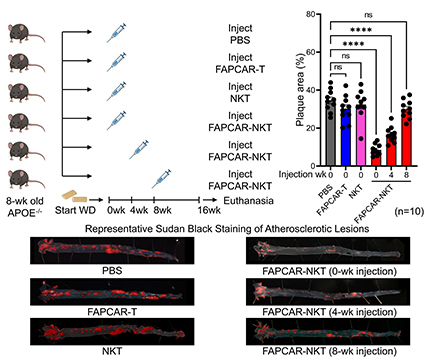
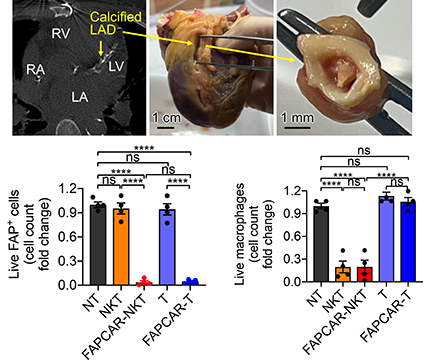
Abstract Body: Background: Atherosclerosis remains a leading cause of myocardial infarction and stroke. Despite advances in lipid-lowering and anti-inflammatory therapies, substantial residual risk persists, particularly in advanced, fibrotic plaques characterized by heterogeneous immune-stromal cell populations and limited therapeutic penetration. Fibroblast activation protein (FAP)-targeted chimeric antigen receptor (CAR) T cell therapy has shown efficacy in fibrotic diseases; however, its effectiveness in atherosclerosis is constrained by restricted plaque infiltration, limited persistence within fibrotic lesions, and incomplete clearance of pathogenic stromal and immune cell populations within plaques. Methods: To overcome these barriers, we developed FAP-targeted CAR invariant natural killer T (FAP-CAR iNKT) cells, designed for enhanced tissue infiltration, innate-like multi-lineage cytotoxicity, and reduced systemic toxicity. Therapeutic efficacy was evaluated in ApoE-/- mice with established atherosclerosis and in ex vivo human atherosclerotic plaque assays. Results: In ApoE-/- mice with established atherosclerosis, FAP-CAR T cells showed limited suppression of plaque progression, comparable to control treatment (p ≥ 0.05 vs. control, n = 10). In contrast, FAP-CAR iNKT cells significantly reduced atherosclerotic plaque burden (p < 0.001 vs. control and FAP-CAR T, n = 10), as quantified by Sudan Black staining of aortas. Consistently, in ex vivo human atherosclerotic plaques explanted from patients with ischemic cardiomyopathy and advanced coronary artery disease, FAP-CAR iNKT cells demonstrated robust cytotoxicity against both FAP+ vascular smooth muscle cells and macrophage-derived foam cells, as quantified by flow cytometry (p < 0.0001 vs. control, n = 3), whereas FAP-CAR T cells exhibited negligible cytotoxic activity against foam cells (p ≥ 0.05 vs. control, n = 3). Conclusions: To date, no cell-based immunotherapies have been successfully applied to atherosclerosis. Our findings demonstrate that FAP-CAR iNKT cells can overcome key structural and cellular barriers that have limited CAR-T-based approaches, offering a promising strategy to disrupt the immune-fibrotic plaque niche and attenuate atherosclerotic progression. Collectively, this work establishes that CAR-engineered iNKT cells are capable of penetrating and remodeling the immune-fibrotic plaque microenvironment, thereby introducing a conceptual framework for cell-based immunotherapy in atherosclerosis.
Zhu, Enbo
(
UCLA
, Los Angeles , California , United States )
Li, Charlie
(
UCLA
, Los Angeles , California , United States )
Cho, Jae Min
(
UCLA
, Los Angeles , California , United States )
Zhao, Peng
(
UCLA
, Santa Monica , California , United States )
Kropp, Robert
(
UCLA
, Santa Monica , California , United States )
Zhang, Yunpei
(
UCLA
, Los Angeles , California , United States )
Gu, Mingxia
(
UCLA
, Los Angeles , California , United States )
Benharash, Peyman
(
UCLA
, Santa Monica , California , United States )
Yang, Lilly
(
UCLA
, Los Angeles , California , United States )
Hsiai, Tzung
(
UCLA SCH OF MED CARDIOLOGY DIV
, Los Angeles , California , United States )