FAPCAR-iNKT Cells Penetrate Plaque Microenvironment to Mitigate Atherosclerotic Progression
Abstract Body: Atherosclerosis, the underlying cause of myocardial infarction and cerebrovascular stroke, arises from chronic immune-fibrotic interactions within advanced plaques composed of macrophages, foam cells, activated vascular smooth muscle cells (VSMCs), fibroblasts, and a dense extracellular matrix that limits therapeutic penetration. Although lipid-lowering and anti-inflammatory therapies improve clinical outcomes, they fail to eliminate the immune-activated microenvironment. Even surgical revascularization through coronary artery bypass (CABG) does not resolve the inflammatory niche driving disease recurrence. To address these limitations, this study explores fibroblast activation protein (FAP)–targeted CAR-T cells and CAR-engineered invariant natural killer T (CAR-iNKT) cells as next-generation immunotherapies for atherosclerosis.
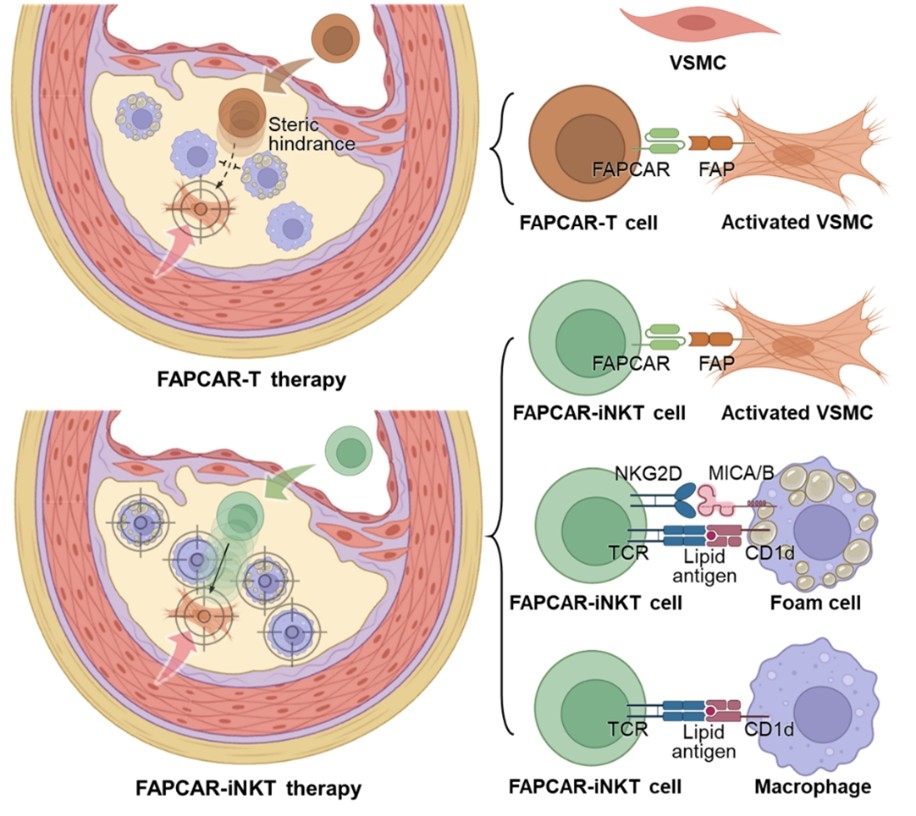
FAP, a membrane-bound serine protease, is known to be upregulated in fibroatheromata compared with normal aortae, primarily on activated VSMCs within fibrotic and inflammatory lesions. Previous studies demonstrated that FAPCAR-T cells reduce cardiac fibrosis and restore ventricular function after ischemic injury; however, their therapeutic benefit in atherosclerosis remains limited. Our data indicate that FAPCAR-T cells exhibit restricted access to activated VSMCs because macrophages and foam cells form steric barriers within the plaque. Moreover, foam-cell–derived insulin-like growth factor 1 (IGF-1) promotes VSMC activation and migration, further contributing to lesion progression. In contrast, CAR-iNKT cells, combining semi-invariant T-cell receptors, natural-killer receptors, and the same FAP-targeted CAR, demonstrate enhanced infiltration and cytotoxicity toward macrophages, foam cells, and activated VSMCs within the plaque microenvironment (Fig. 1).
By targeting multiple pathogenic cell types and dismantling the immune-fibrotic niche, CAR-iNKT cells overcome limitations of conventional CAR-T therapy. Preliminary data from mouse models and ex vivo human coronary tissues suggest that CAR-iNKT cells can infiltrate and modulate inflammatory plaques resistant to CAR-T therapy, offering a promising vascular-specific immunotherapy to mitigate atherosclerosis and prevent recurrent cardiovascular events.
Zhu, Enbo
(
UCLA
, Los Angeles , California , United States )
Li, Charlie
(
UCLA
, Los Angeles , California , United States )
Cho, Jae Min
(
UCLA
, Los Angeles , California , United States )
Yang, Lilly
(
UCLA
, Los Angeles , California , United States )
Hsiai, Tzung
(
UCLA SCH OF MED CARDIOLOGY DIV
, Los Angeles , California , United States )
Author Disclosures:
Enbo Zhu:DO NOT have relevant financial relationships
| Charlie Li:No Answer
| Jae Min Cho:DO NOT have relevant financial relationships
| Lilly Yang:No Answer
| Tzung Hsiai:No Answer