
Logo

American Heart Association

  5
  0


Final ID: Mon124

Directional Stiffening of the Pulmonary Artery in a Rodent Model of Pulmonary Hypertension

Abstract Body: Introduction. Pulmonary hypertension (PH) is characterized by an elevation in mean pulmonary arterial pressure (mPAP) and affects 1% of the world population. Stiffening of the pulmonary artery (PA) is known to contribute to PA pressure overload. Studies have commonly used pulmonary vascular compliance (PVC) to quantify alterations in the mechanical behavior of the PA. However, PVC fails to account for directional changes in PA mechanics (i.e., anisotropy) that affect the pulsatile behavior of afterload. Our objective in this study was to investigate the directionality of PA stiffening due to PH.
Methods. The animal model of PH was established by administering a single dose of SU5416 (20 mg/kg, sc) to CDF rats (n = 8). The animals were placed in a hypoxia chamber (10% O2) for 3 weeks, followed by one week of normoxia. Control rats (n = 8) were maintained in normoxia at all times. Each group consisted of half males and half females. The main PA tissue specimens were harvested and characterized through mechanical tests. Tissue stiffness was calculated as the slope of the stress-strain curve along the circumferential and longitudinal directions at a large strain for the PA specimens.
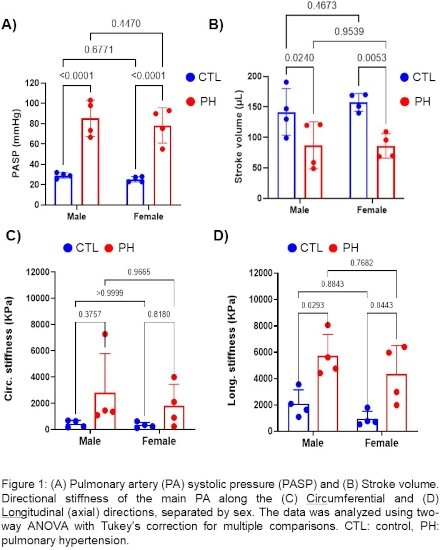
Results. PH caused a significant increase in PA systolic pressure (Fig. 1A) and a significant decrease in stroke volume (Fig. 1B), with the changes being comparable in both sexes. The increase in circumferential stiffness was not significant in either sex (Fig. 1C), but the increase in longitudinal stiffness in PH was significant across both sexes (Fig. 1D).
Conclusions. These findings indicate that stiffening of the main PA tissue was elevated in a single direction, suggesting a directional bias in structural remodeling of the PA towards the longitudinal direction. Our results underscore the need for higher-fidelity, tissue-level biomarkers that could provide additional insight into the vascular remodeling in PH. A detailed analysis of the PA anisotropy-RV afterload relationship could further delineate factors contributing to RV-PA uncoupling in PH.
  • Neelakantan, Sunder  ( TAMU , College Station , Texas , United States )
  • Mehdi, Rana Raza  ( Texas AM University , Bryan , Texas , United States )
  • Mukherjee, Tanmay  ( Texas A and M University , College Station , Texas , United States )
  • Zhang, Peng  ( Ocean State Research Institute , Providence , Rhode Island , United States )
  • Choudhary, Gaurav  ( PROVIDENCE VAMC, BROWN UNIVERSITY , Providence , Rhode Island , United States )
  • Avazmohammadi, Reza  ( Texas AM University , College Station , Texas , United States )
  • Author Disclosures:
Meeting Info:

Basic Cardiovascular Sciences 2026

2026

Boston, Massachusetts

Session Info:

Poster Session 1

Monday, 07/13/2026 , 04:30PM - 07:00PM

Poster Session and Reception

More abstracts on this topic:
A Single-Cell and Spatial Transcriptomic Atlas of Human Pulmonary Arterial Hypertension

Zhao Hanqiu, Liu Bin, Hong Jason, Lee Janet, Dai Zhiyu

Catheter-Directed Intervention for High-Risk Acute Pulmonary Embolism in Chronic Kidney Disease

Kumar Manoj, Ricciardi Mark, Arman Qamar, Ali Shafaqat, Jamshed Aneeza, Murthi Mukunthan, Kumar Nomesh, Kumar Sanjay, Kumari Rinkle, Alraies M Chadi, Gomez Valencia Javier

More abstracts from these authors:
Viscoelastic remodeling of the left ventricular myocardium in myocardial infarction

Neelakantan Sunder, Mehdi Rana Raza, Xiang Qian, Zhang Xiaoxiao, Vanderslice Peter, Avazmohammadi Reza

Mechanistic Insights into Right Ventricular Remodeling in Pulmonary Hypertension via Combined Stress and Contractility Measurements

Mukherjee Tanmay, Zhang Peng, Choudhary Gaurav, Avazmohammadi Reza

You have to be authorized to contact abstract author. Please, Login
Not Available