
Logo

American Heart Association

  4
  0


Final ID: Mon121

Mechanistic Insights into Right Ventricular Remodeling in Pulmonary Hypertension via Combined Stress and Contractility Measurements

Abstract Body: Introduction: Pulmonary hypertension (PH) is characterized by increased right ventricular (RV) afterload and is frequently accompanied by significant RV remodeling and dysfunction. Mechanistic contributors to RV remodeling, such as alterations in active force generation, have been independently linked to poor survival outcomes. However, the relationship between passive forces and impaired contractility, as well as the underlying transition from adaptive to maladaptive remodeling in PH, remains unclear. In this study, we hypothesize that a combined index of passive stress and active contractility is a key indicator of maladaptive RV remodeling in PH.
Methods: PH was induced in Sprague-Dawley rats (PH; n =4) by an injection of SU5416, followed by 3 weeks of hypoxia and 1 week of normoxia. Wild-type rats receiving a vehicle and maintained normoxia were used as controls (CTL; n = 4). Mechanical testing of the RV free wall (RVFW) was used to assess active force generation and contractility. RVFW samples were chemically skinned in 12.5% Triton X-100 and stored overnight. Isometric testing: The passive RVFW was stretched to 20% of its initial length, immersed in an activation solution and activated at pCa 4.5. Isotonic testing: Contractility was assessed using 1-mm-thick RVFW strips, mounted with one end fixed and the other free to contract in the activation solution.
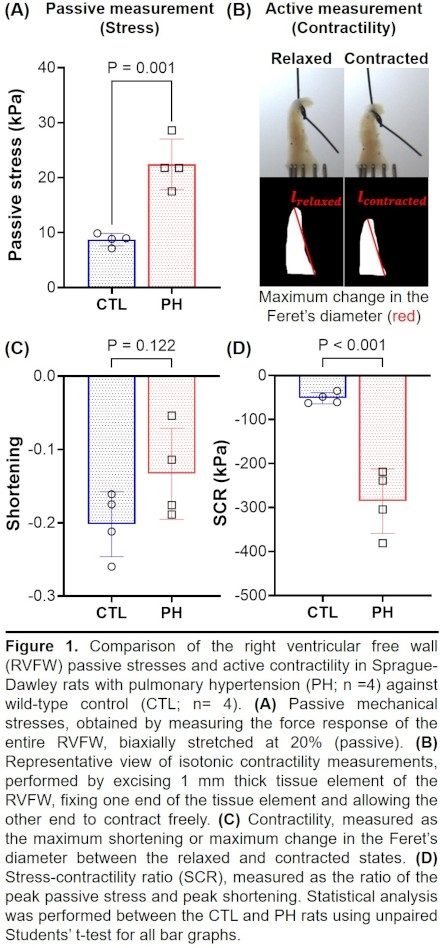
Results: PH rats exhibited enhanced passive stiffening compared to CTL (Fig. 1A). Contractility, measured as maximal shortening of the RVFW strips between relaxed and contracted states (Fig. 1B), showed a trend toward reduced shortening in PH rats versus CTL, but this difference was not statistically significant (Fig. 1C). Notably, the combined stress-contractility ratio (SCR) was significantly decreased in PH rats, with narrower confidence intervals than those of peak stress or contractility measured individually (Fig. 1D).
Conclusion: The measurement of SCR as a mechanistic marker highlights the competing contributions of active contractility and passive stiffening to overall RV remodeling. Identifying the role and relative contribution of individual remodeling events is highly significant for optimizing treatment strategies in PH patients, potentially targeting wall stiffening and/or improving contractility.
  • Mukherjee, Tanmay  ( Texas A and M University , College Station , Texas , United States )
  • Zhang, Peng  ( Ocean State Research Institute , Providence , Rhode Island , United States )
  • Choudhary, Gaurav  ( PROVIDENCE VAMC, BROWN UNIVERSITY , Providence , Rhode Island , United States )
  • Avazmohammadi, Reza  ( Texas AM University , College Station , Texas , United States )
  • Author Disclosures:
Meeting Info:

Basic Cardiovascular Sciences 2026

2026

Boston, Massachusetts

Session Info:

Poster Session 1

Monday, 07/13/2026 , 04:30PM - 07:00PM

Poster Session and Reception

More abstracts on this topic:
Altered Nanoscale Organization of Calcium Channels in Failing Hearts with Low T3

Dehghani Ashkezari Atieh, Schmalzle Megha, Charest Amanda, Stout Randy, Ojamaa Kaie

BMP10 as novel marker for right atrial dilatation and pressure in precapillary pulmonary hypertension

Llucia-valldeperas Aida, Van Wezenbeek Jessie, Groeneveldt Joanne, Sanchez-duffhues Gonzalo, Vonk Noordegraaf Anton, Bogaard Harm, Goumans Marie Jose, De Man Frances

More abstracts from these authors:
Directional Stiffening of the Pulmonary Artery in a Rodent Model of Pulmonary Hypertension

Neelakantan Sunder, Mehdi Rana Raza, Mukherjee Tanmay, Zhang Peng, Choudhary Gaurav, Avazmohammadi Reza

Integrated mechano-metabolic measures of diastolic function in mice

Mukherjee Tanmay, Venkategowda Sunil, Tong Carl, Choudhury Mahua, Avazmohammadi Reza

You have to be authorized to contact abstract author. Please, Login
Not Available