Glycolytic Beige Fat Activation Modulates Lipoprotein Metabolism and Atherosclerosis in Uncoupling Protein-1 Knockout Mice
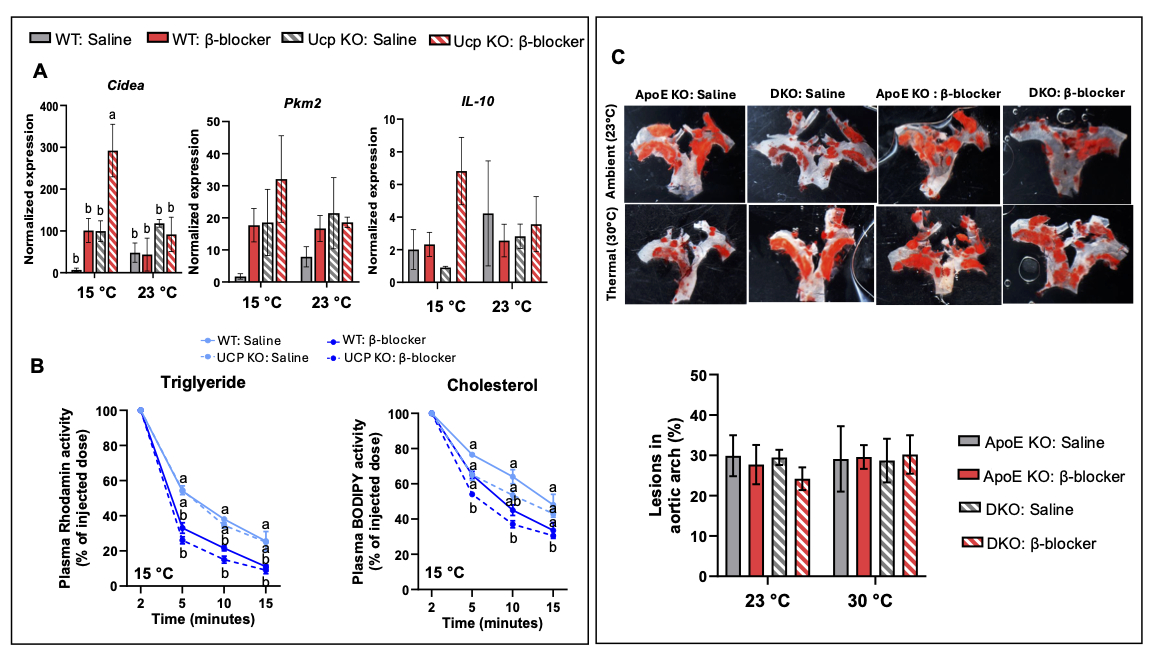
Abstract Body: Introduction: Obesity is a major risk factor for dysregulated lipid metabolism and the development of atherosclerosis. Classical thermogenic activation of brown and beige fat relies on uncoupling protein-1 (UCP1) and β-adrenergic receptor (β-AR) signaling; however, these pathways have limited benefits in obesity and cardiovascular disease. We recently identified a glycolytic beige (g-beige) fat phenotype in subcutaneous adipose tissue (SAT) of cold-challenged mice, characterized by enhanced glycolysis and UCP1-independent thermogenesis. Because g-beige fat can be induced independently of β-AR signaling, we hypothesize that activation of g-beige fat through UCP1- and β-AR-independent pathways modulates atherosclerosis by protecting against diet-induced obesity, enhancing lipoprotein remnant clearance, and ultimately reducing atherosclerotic risk. Methods: To assess lipoprotein metabolism, male Ucp1 knockout (KO) and wild-type (WT) mice received a β-blocker (propranolol, 25 mg/kg) or saline for 5 days, followed by cold exposure (15°C) or ambient control (23°C) for 5 days with continued treatment. Rhodamine-triglyceride (Rh-TG) and BODIPY-cholesterol (BO-C) labeled VLDL-like particles were injected intravenously, and plasma was collected at 5, 10, and 15 min to assess clearance kinetics. To evaluate anti-atherogenic effects, male Ucp1/ApoE double KO (DKO) miceand ApoE KO controls were fed an atherogenic diet (42% fat, 0.2% cholesterol) for 16 weeks at ambient (23°C) and thermoneutral (30°C) conditions. The β-blocker or saline was administered intraperitoneally twice weekly. The aortic arch was collected for lesion quantification. Results: Cold-challenged Ucp1 KO mice treated with a β-blocker had the lowest body weight and highest mRNA levels of thermogenic (Cidea, Cox7a1, Elovl3), glycolytic (Eno1, Pkm2), and anti-inflammatory (Il10) in SAT (Figure A), indicating activation of g-beige fat. Consistently, these mice exhibited markedly accelerated plasma clearance of Rh-TG and BO-C (Figure B), indicating enhanced fatty acid uptake by SAT. In the anti-atherogenic study, DKO mice housed at 23°C had smaller aortic-arch lesions than those housed at 30°C, with the smallest lesions in β-blocker-treated DKO mice (Figure C). Conclusion: An alternative thermogenic pathway, independent of UCP1 and β-AR signaling, may provide a promising strategy for reducing obesity and atherosclerosis.
Funding: AHA 23AIREA1052889; 26BAIREA1560968
Morovati, Ashti
(
Texas Tech University
, Lubbock , Texas , United States )
Walker, Tatum
(
Texas Tech University
, Lubbock , Texas , United States )
Scoggin, Shane
(
Texas Tech University
, Lubbock , Texas , United States )
Moustaid-moussa, Naima
(
Texas Tech University
, Lubbock , Texas , United States )
Zu, Yujiao
(
Texas Tech University
, Lubbock , Texas , United States )