Sex and Ionizing Radiation Modulate Reactive Oxygen Species in Neonatal Rat Cardiac Myocytes
Abstract Body: Introduction: Women and men respond differently to ionizing radiation (IR). We previously showed that 20Gy cardiac targeted irradiation in mice led to sex-dependent changes in cardiac function and mitochondrial oxidative phosphorylation. Here, we use 10Gy IR on male and female neonatal rat cardiac myocytes (NRCMs) to identify sex-dependent differences in reactive oxygen species (ROS) and mitochondrial metabolism, and their response to sex hormone treatment.
Hypothesis: Sex-dependent differences in the response of cardiac myocytes to IR are, at least in part, sex-hormone independent.
Methods: Flow cytometry (LSR Violet II, BD) measured 250,000-300,000 cells per well in 6 well plates using 10 µM dihydroethidium (DHE) or 1 µM MitoSOX Red (MSR) to detect intracellular ROS (iROS) or mitochondrial ROS (mROS), respectively; N=4, 3 replicates each. Oxygen Consumption Rate (OCR; Seahorse XF96) measured 20,000 cells per well in 96 well plates; N=3, 3-5 replicates each. Briefly, pups were separated by sex, NRCMs harvested and grown in 21% O2, 5% CO2 at 37°C. 10 µM Antimycin-A was the ROS positive control for DHE and MSR assays. NRCMs were dosed with 1 µM estradiol (E2) or placebo, once prior to 10Gy or sham IR and 24 h later followed by flow cytometry analysis 48 h after first E2 or placebo dose.
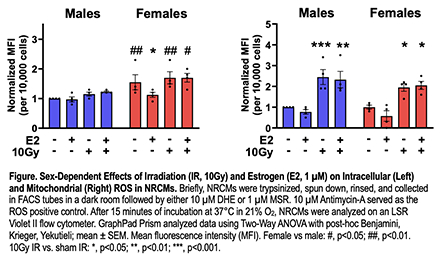
Results: iROS was not changed by 10Gy IR or E2 in male NRCMs (Figure). iROS was higher in control female vs. male NRCMs (p<0.01), as it was in female vs. male NRCMs treated with 10Gy IR (p<0.01) or E2 + 10Gy IR (p<0.05). iROS was lower in female NRCMs treated with E2 compared to E2 + 10Gy IR (p<0.05). mROS was increased by 10Gy IR in both male and female NRCMs with E2 (p<0.01; p<0.05, respectively) or without E2 (p<0.001; p<0.05, respectively). There were no significant differences between male and female NRCMs. Seahorse assays have not identified significant differences in OCR between male and female NRCMs with and without E2 and/or 10Gy IR.
Conclusions: 10Gy IR increased mROS, but not iROS, in control and 10Gy IR-treated male vs. female NRCMs. Thus, sex differences in iROS but not mROS concentrations are present in a model lacking circulatory gonadal hormones. Additional studies of the sex-dependent pathways controlling iROS and its response to IR and sex hormones are warranted.
Current, Kyle
(
University of Iowa
, Iowa City , Iowa , United States )
Dierdorff, Jason
(
University of Iowa
, Iowa City , Iowa , United States )
Mapuskar, Kranti
(
University of Iowa
, Iowa City , Iowa , United States )
Yoon, Jin-young
(
University of Iowa
, Iowa City , Iowa , United States )
Spitz, Douglas
(
University of Iowa
, Iowa City , Iowa , United States )
Allen, Bryan
(
University of Iowa
, Iowa City , Iowa , United States )
London, Barry
(
University of Iowa
, Iowa City , Iowa , United States )
Current Kyle, Allen Bryan, London Barry, Dierdorff Jason, Mapuskar Kranti, Mehdi Haider, Yoon Jin-young, Wipf Peter, Epperly Michael, Greenberger Joel, Spitz Douglas
Current Kyle, Allen Bryan, London Barry, Dierdorff Jason, Mapuskar Kranti, Mehdi Haider, Yoon Jin-young, Wipf Peter, Epperly Michael, Greenberger Joel, Spitz Douglas