
Logo

American Heart Association

  10
  0


Final ID: Wed050

Automatic Analysis of Cardiovascular Doppler Blood Flow Velocity Spectrograms

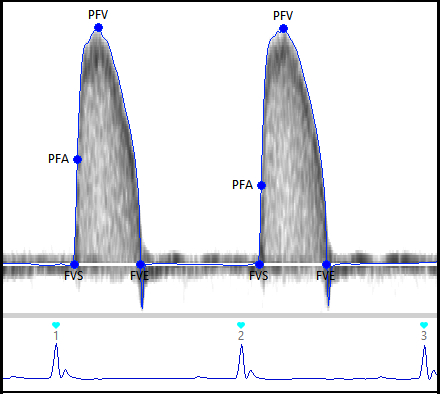
Abstract Body: Introduction: Cardiovascular (CV) blood flow velocity spectrograms generated by pulsed Doppler system are analyzed using manual placement of markers (MPM) at specific fiducial points within each cardiac cycle to extract CV parameters. MPM however is tedious, user dependent, and can take up to 10 minutes to analyze each spectrogram file. We developed software that will automatically place markers (APM) on the spectrogram and extract parameters in under 1 minute. In this study we sought to demonstrate and validate the performance and utility of APM in analyzing several types of mouse blood flow velocity spectrograms.

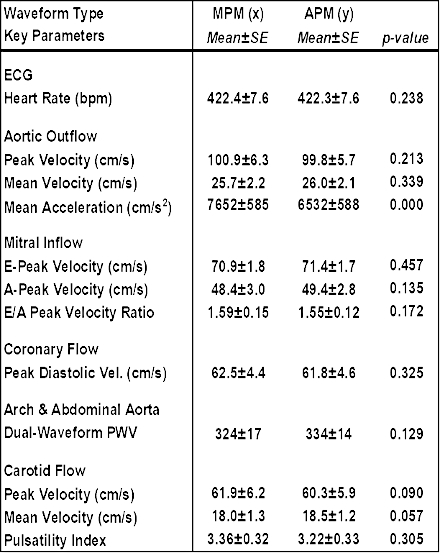
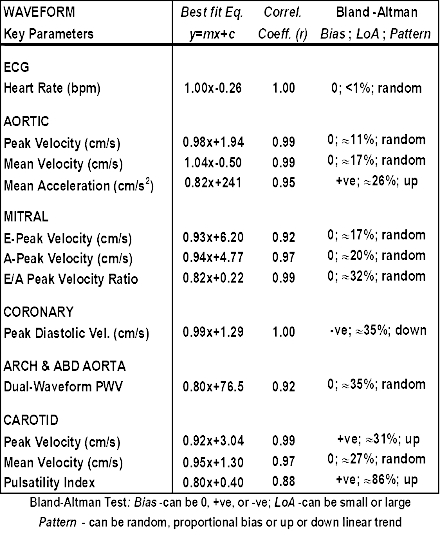
Methods & Results: Spectrograms of aortic, mitral, coronary, aortic arch-abdominal aorta for pulse wave velocity calculation, carotid, and other peripheral arterial sites of several mice were used in the study. PDS signals (20/arterial site; total of 120) acquired from different mice on different day/times were analyzed by MPM and APM. Extracted parameters were compared using scatter plots, best fit equations, correlations, and Bland-Altman tests to look for potential bias between methods. Out of 41 extracted parameters 12 of the most often used are shown (see table) along with mean±SE, p-value (paired t-test p>0.05), best fit equation, correlation coefficient (r), and Bland-Altman observations. Means of most parameters were not different. Scatter plots showed almost all APM and MPM extracted parameters were highly correlated (r > 0.90). Bland-Altman plots show that most of differences have minimal bias between methods and fall within limits of agreement (LoA).

Conclusion: APM-generated parameters agree with MPM counterparts. While some LoA were broad, they may be narrowed with larger sample sizes. APM reduced analysis time from 10 minutes to under one minute, offering a significant advantage for high-throughput phenotyping. This consistent, reliable method supports machine learning applications and meets NIH standards for scientific rigor and reproducibility.
  • Reddy, Anilkumar  ( Indus Instruments , Webster , Texas , United States )
  • Molebny, Sergey  ( Indus Instruments , Webster , Texas , United States )
  • Caro, Walter  ( Indus Instruments , Webster , Texas , United States )
  • Madala, Sridhar  ( Indus Instruments , Webster , Texas , United States )
  • Author Disclosures:
Meeting Info:

Basic Cardiovascular Sciences 2026

2026

Boston, Massachusetts

Session Info:

Poster Session 3

Wednesday, 07/15/2026 , 04:30PM - 07:00PM

Poster Session and Reception

More abstracts on this topic:
Anesthetic Strategies in Hybrid Aortic Arch Repair: Benefits and Limitations of Volatile and Total Intravenous Anesthesia

Tuchman Kate, Babayev David, Shayegan Mona, Sakaria Rhea

4D Cardiac Magnetic Resonance Identifies Differences in Regional Strain Patterns Among Pediatric Heart Transplant Patients with Acute Rejection or Cardiac Allograft Vasculopathy

Henderson Christopher, Starnes Joseph, Samyn Margaret, Damon Bruce, Hernandez Lazaro, Goergen Craig, Soslow Jonathan, Prado Marco Aurélio, Earl Conner, Georgedurrett Kristen, Lee Simon, Nandi Deipanjan, Chan Kak-chen, Shugh Svetlana, Kikano Sandra

You have to be authorized to contact abstract author. Please, Login
Not Available