Nationwide Trends and Disparities in Atrial Fibrillation and Sepsis–Associated Mortality Among U.S. Adults, 1999–2023
Abstract Body: Background Atrial fibrillation (AF) and sepsis are major contributors to cardiovascular and systemic mortality in the United States (U.S.), particularly among individuals with multiple chronic comorbidities. Their coexistence is associated with increased risks of hemodynamic instability, thromboembolic complications, and adverse outcomes. However, population-level trends and disparities in AF- and sepsis-associated mortality remain incompletely characterized.
Methods We analyzed CDC WONDER mortality data from 1999–2023 to identify U.S. adults aged ≥25 years whose death certificates listed both AF (ICD-10: I48) and sepsis (ICD-10: A40.0–A40.9, A41.0–A41.9) as underlying or contributing causes. Age-adjusted mortality rates (AAMRs) per 100,000 were calculated and stratified by sex, age group, race/ethnicity, and state. Temporal trends were assessed using annual percent changes (APCs) with 95% confidence intervals (CIs). A p-value <0.05 was considered significant.
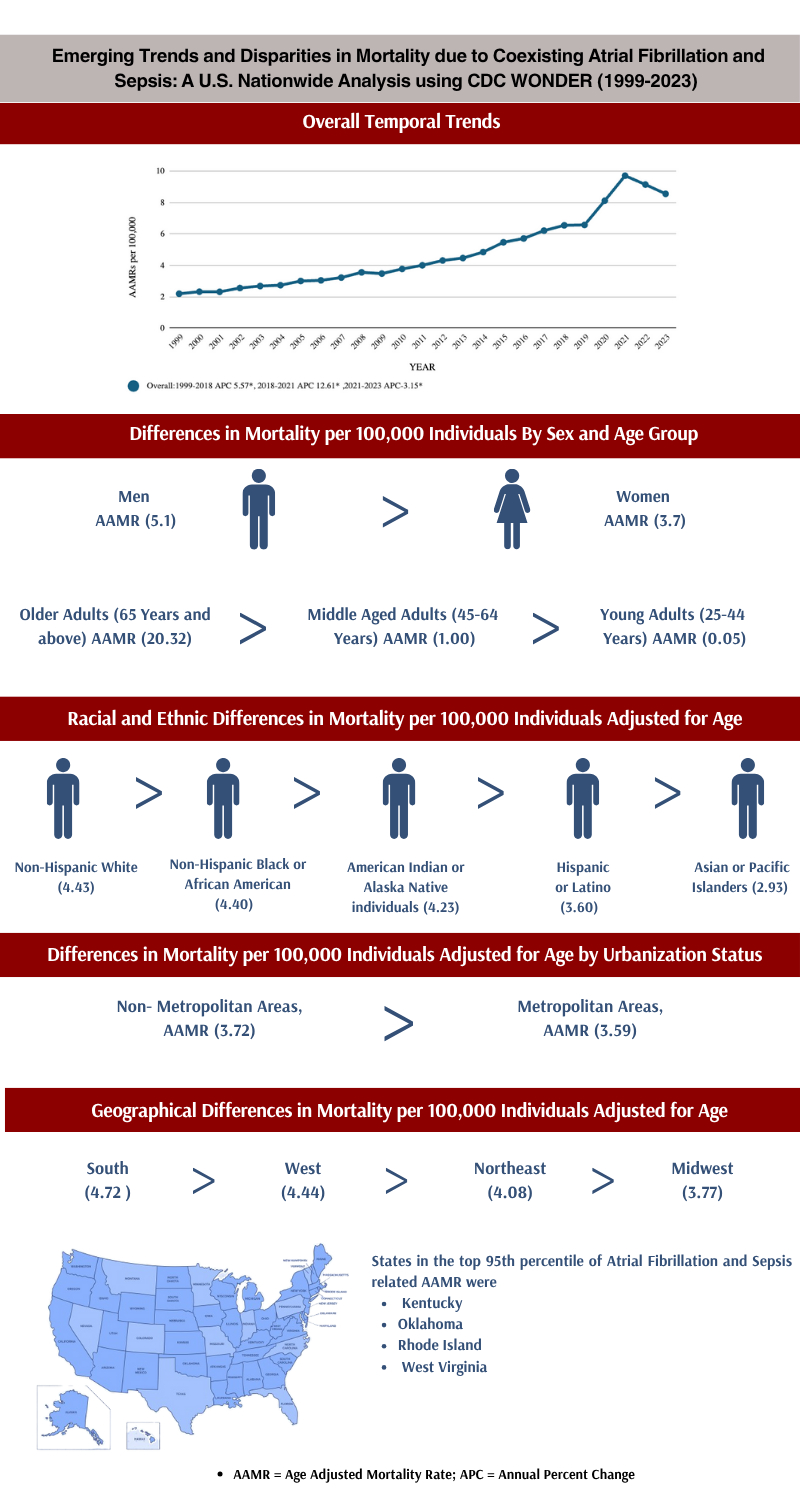
Results A total of 238,584 deaths were identified. The AAMR increased from 2.0 in 1999 to 5.5 in 2018 (APC: 5.65; 95% CI: 4.75–6.18; p=0.001), followed by a steeper rise from 5.6 to 7.8 between 2018 and 2021 (APC: 12.33; 95% CI: 8.01–14.60; p<0.001). From 2021 to 2023, rates showed a non-significant decline (APC: −3.17; 95% CI: −8.16 to 2.92; p=0.201). Men consistently had higher AAMRs than women (4.7 vs 3.6). Mortality increased markedly with age, with the highest rates among adults ≥65 years (18.9), compared to 45–64 years (1.0), while rates in those aged 25–44 years remained low. By race/ethnicity, AAMRs were highest among non-Hispanic American Indian or Alaska Native individuals (4.7), followed by non-Hispanic White (4.2), non-Hispanic Black (4.0), Hispanic (3.0), and non-Hispanic Asian or Pacific Islander (2.5) populations. Maryland, Oklahoma, and Kentucky consistently ranked in the top 95th percentile.
Conclusions AF- and sepsis-associated mortality has risen substantially in the U.S., with the sharpest increase between 2018 and 2021. Significant disparities persist across sex, age, race/ethnicity, and geography. High-risk populations warrant targeted prevention and management strategies to reduce mortality.
Kiyani, Madiha
(
Medstar Georgetown University Internal Medicine Baltimore program
, Baltimore , Maryland , United States )
Ali, Masab
(
Faisalabad Medical University
, Faisalabad , Pakistan )
Abdullah, Muhammad
(
Faisalabad Medical University
, Faisalabad , Pakistan )
Ashraf, Ali
(
Faisalabad Medical University
, Faisalabad , Pakistan )
Hassan, Muhammad
(
Faisalabad Medical University
, Faisalabad , Pakistan )
Khan, Sunnia
(
Faisalabad Medical University
, Faisalabad , Pakistan )
Naseer Ahmad, Rehan
(
King Edward Medical University
, Lahore , Pakistan )
Yasin, Muhammad Usama
(
Faisalabad Medical University
, Faisalabad , Pakistan )
Mehmood, Taha
(
Faisalabad Medical University
, Faisalabad , Pakistan )