
Logo

American Heart Association

  16
  0


Final ID: Mon048

Effect of Furosemide on Survival and Cardiac Function in a Rat Model of Heart Failure: A Pilot Study

Abstract Body: Background:
Chronic heart failure (CHF) is one of the most common causes of acute hospitalization. Diuretic therapy represents the cornerstone of symptomatic CHF treatment, as it alleviates congestion and improves quality of life. However, long-term prognostic data for loop diuretics in CHF are lacking.

Purpose:
A placebo-controlled study in an animal model of CHF investigating the effect of diuretic therapy on mortality and selected hemodynamic, laboratory, and echocardiographic parameters. Here we present a pilot substudy of feasibility, optimal dosage of furosemide and necessity of potassium supplementation.

Methods:
Aortocaval fistula (ACF) was created in Ren-2 transgenic rats (TGR), a model of angiotensin II-dependent hypertension, at the animal age of 8 weeks. Sham-operated animals served as controls. One week after surgery, animals were randomized into five groups: placebo, low-dose diuretic (5 mg/kg/day, n=12), and high-dose diuretic (15 mg/kg/day, n=12) administered in drinking water, both doses with and without potassium supplementation, also dissolved in drinking water. The follow-up period was 8 weeks. GraphPad Prism 10 was used for statistical analysis with a log-rank (Mantel-Cox) test to analyse survival data.

Results:
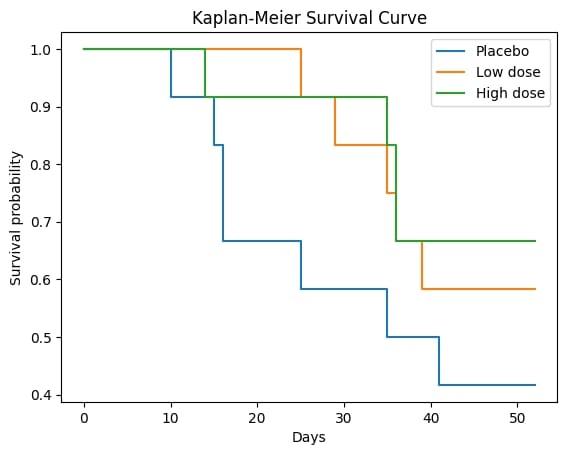
All sham-operated animals survived until the end of the experiment. Survival in untreated animals was 42%. The treatment with furosemide improved the survival rate: 67% in the high-dose group (p=0.18 vs. placebo) and 58% in the low-dose group (p =0.39 v.s. placebo). Although the results were not statistically significant due to small sample size, they demonstrated a clear trend toward improved survival. The diuretic-treated groups had also lower organ weights at the end of the study, reflecting reduced congestion, higher hemoglobin levels, and a smaller inferior vena cava diameter. Renal parameters remained unchanged across all groups. The mortality benefit was not observed in any group receiving potassium supplementation, suggesting a potential negative effect of excessive potassium substitution in CHF.

Conclusion:
Furosemide treatment improved congestion in an animal model of CHF induced by aortocaval fistula. A bigger sample size in the following study will be necessary to statistically prove improvement in survival. There will be no need for routine potassium supplementation in this model.
  • Mikula, Jan  ( IKEM , Prague , Czechia )
  • Miklovic, Matus  ( IKEM , Prague , Czechia )
  • Melenovsky, Vojtech  ( IKEM , Prague , Czechia )
  • Ostadal, Petr  ( Motol University Hospital , Prague , Czechia )
  • Cervenka, Ludek  ( IKEM , Prague , Czechia )
  • Kala, Petr  ( IKEM - Center of Experimental Med , Prague , Czechia )
  • Author Disclosures:
Meeting Info:

Basic Cardiovascular Sciences 2026

2026

Boston, Massachusetts

Session Info:

Poster Session 1

Monday, 07/13/2026 , 04:30PM - 07:00PM

Poster Session and Reception

More abstracts on this topic:
Association of assessment of clinical congestion in patients with heart failure compared with assessment using bioimpedance and microwave spectroscopy

Bielecka-dabrowa Agata, Zasada Ilona, Olejniczak Wielislaw, Sakowicz Agata, Slot Maciej

9-Year Longitudinal Assessment of the 12-lead Electrocardiogram of Volunteer Firefighters

Bae Alexander, Dzikowicz Dillon, Lai Chi-ju, Brunner Wendy, Krupa Nicole, Carey Mary, Tam Wai Cheong, Yu Yichen

More abstracts from these authors:
A soluble guanylate cyclase stimulator improves survival in a rat model of heart failure with reduced ejection fraction and chronic kidney disease induced by aorto-caval fistula and 5/6 nephrectomy

Kala Petr, Miklovic Matus, Molnar Matej, Mikula Jan, Skaroupkova Petra, Gawrys Olga, Ostadal Petr, Melenovsky Vojtech, Cervenka Ludek

Tissue deficiency and altered eicosanoids levels in rodent and human heart failure.

Kala Petr, Cervenka Ludek, Mikula Jan, Hnat Tomas, Miklovic Matus, Skaroupkova Petra, Vanourkova Zdenka, Kotaska Karel, Ostadal Petr, Melenovsky Vojtech

You have to be authorized to contact abstract author. Please, Login
Not Available