
Logo

American Heart Association

  6
  0


Final ID: Wed113

The Potassium Selectivity of KCa2.2 Channels is Redox-sensitive

Abstract Body: Objectives: The objective is to elucidate the allosteric modulation of the potassium selectivity of the small-conductance calcium-activated potassium (KCa2.2) channels by the redox environment. KCa2.2 (also called SK2) channels are critical modulators of cardiac excitability. A non-selective modulator of KCa2.2 channels has been shown to increase the conversion rates of atrial fibrillation into sinus rhythm in phase 2 clinical trials, making KCa2.2 channels one of a few targets for which novel anti-arrhythmic drugs are in active clinical development.
Hypothesis: Potassium channels mediate highly selective conduction of potassium ions, while being impermeable to other cations, especially sodium. The selectivity filter, a narrow region on the extracellular side of the channel pore, is the structural element directly responsible for the potassium selectivity. We hypothesize that the redox environment allosterically regulates the potassium selectivity of the KCa2.2 channels through reversibly forming and breaking disulfide bonds surrounding the selectivity filter.
Methods: We investigate the structure (using ingle particle cryo-EM), dynamics (using Molecular Dynamics (MD) simulations), and function (using patch-clamp electrophysiology) of the KCa2.2 channels.
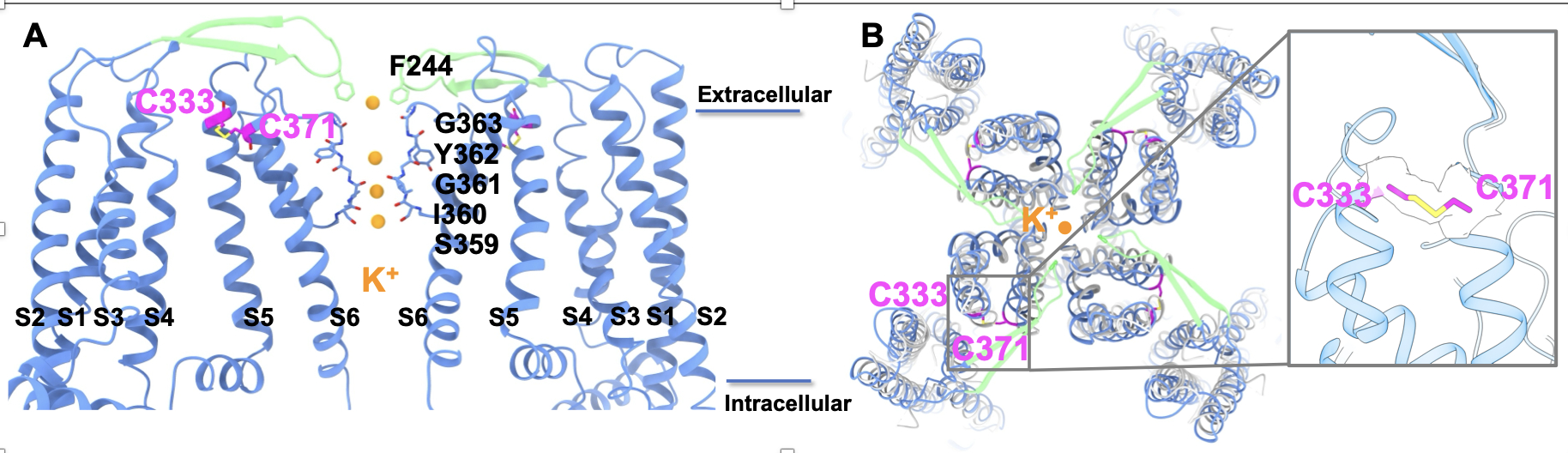
Results: We identified a disulfide bond between two cysteine residues (C333 and C371) at the extracellular ends of the S5 and S6 transmembrane helices. This pair of cysteine residues is conserved among the KCa2.x channels. The signature sequence of the potassium selectivity filter (SIGYG) is flanked by these two cysteine residues, which serves as the structural determinants for the allosteric regulation of potassium selectivity by the redox environment in the KCa2.2 channels. In the KCa2.2 homo-tetramer, four disulfide bonds surround the selectivity filter, the structural element directly responsible for selective conduction of potassium ions. Disruption of this disulfide bond by reducing agents right-shifted reversal potential in electrophysiology recordings by decreasing the relative selectivity of KCa2.2 for potassium over sodium. Mutation of one specific cysteine (KCa2.2_C333A) in the disulfide bond is sufficient to abolish the right shift of the reversal potential by reducing agents.
Conclusion: The potassium selectivity of KCa2.2 channels is upregulated under oxidative environment, which may compensate for the much-needed “repolarization reserve.”
  • Nam, Youngwoo  ( UNIVERSITY of ARIZONA , Phoenix , Arizona , United States )
  • Ramanishka, Alena  ( UNIVERSITY of ARIZONA , Phoenix , Arizona , United States )
  • Cui, Meng  ( Northeastern University , Lexington , Massachusetts , United States )
  • Chiamvimonvat, Nipavan  ( University of Arizona , Phoenix , Arizona , United States )
  • Zhang, Miao  ( UNIVERSITY of ARIZONA , Phoenix , Arizona , United States )
  • Author Disclosures:
Meeting Info:

Basic Cardiovascular Sciences 2026

2026

Boston, Massachusetts

Session Info:

Poster Session 3

Wednesday, 07/15/2026 , 04:30PM - 07:00PM

Poster Session and Reception

More abstracts on this topic:
Large arteries exist in an intrinsically oxidized redox state that limits H2O2-Endothelium-derived hyperpolarizing factor signaling

Lee Hyeryeong, O-uchi Jin, Bae Young Min, An Jin Ryeol, Seo Mi Seon, Park Sang Woong, Kim Jae Gon, Noh Hyun Ju, Park Solah, Lim Yeji, Jhun Bong Sook

Andersen-Tawil KCNJ2 mutation causes arrhythmia in novel in vivo model

Reilly Louise, Taylor Rachel, Yang Fuchi, Blosch Conrad, Orland Kate, Eckhardt Lee

More abstracts from these authors:
You have to be authorized to contact abstract author. Please, Login
Not Available