
Logo

American Heart Association

  8
  0


Final ID: Mon066

Predictive role of blood volume status and right ventricular-pulmonary arterial coupling in chronic heart failure

Abstract Body: Background: In heart failure (HF) patients, heterometric adaptation is accompanied by blood volume (BV) expansion, right heart dilatation/dysfunction, and right ventricular-pulmonary arterial (RV-PA) uncoupling. The impact of noninvasive evaluations of RV-PA coupling on outcomes of HF patients is incompletely understood.

Purpose: We hypothesize that BV expansion is associated with myocardial dysfunction, RV-PA arterial uncoupling, and unfavorable outcomes in patients with chronic HF and heterogeneous BV status.

Methods: Patients hospitalized with decompensated HF and who had BV by the indicator-dilution nuclear methodology were included. Patients were considered hypervolemic if BV was ≥25% over expected. The primary endpoint was the composite of all-cause mortality or heart transplantation. The closest TTE to the time of BV was used to measure various indexes of myocardial performance. In addition to standard echo parameters, global and chamber-specific strain parameters were measured with a commercially available software package.

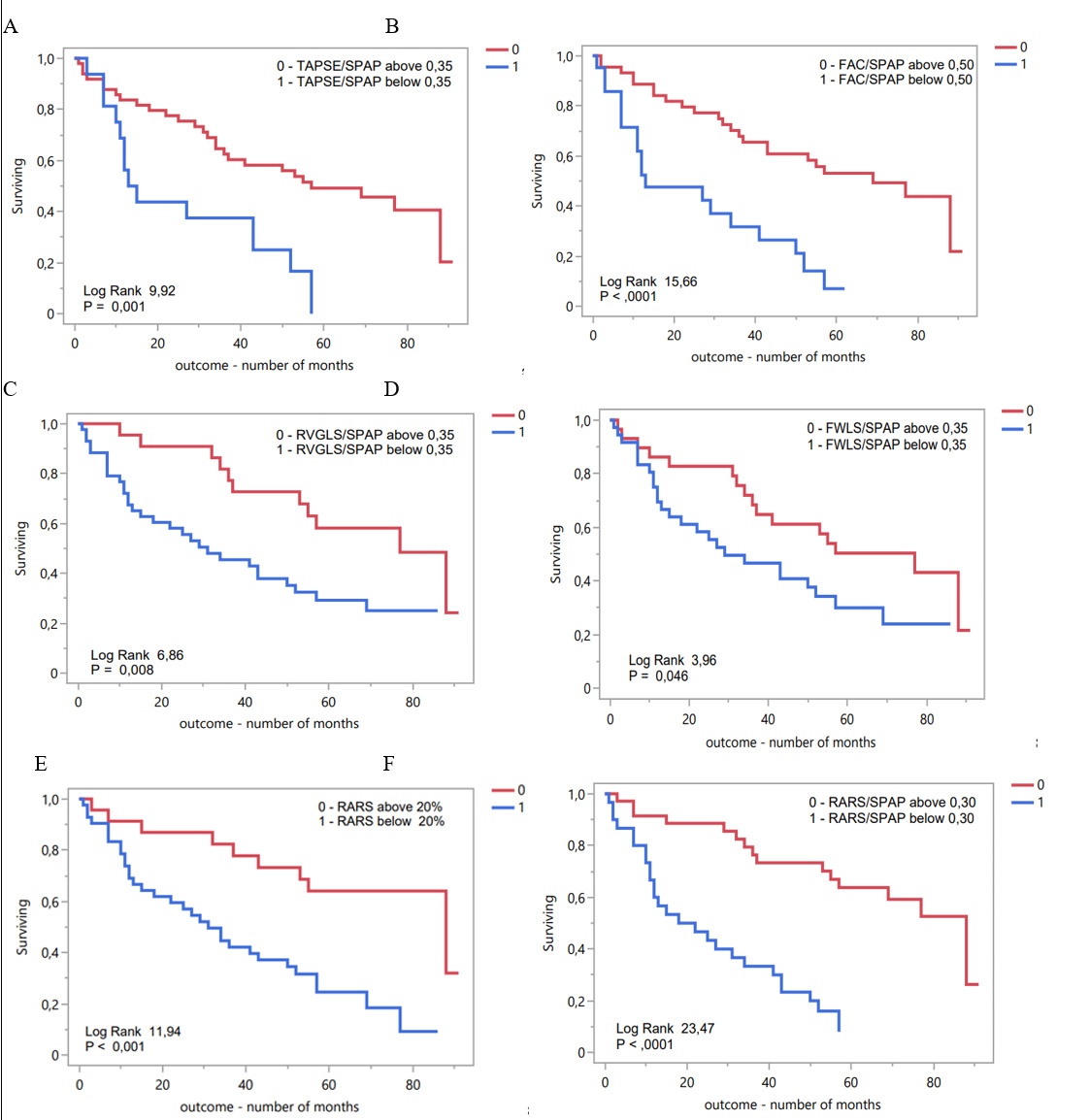
Results: A total of 65 patients were enrolled in the study. There were 44 events (32 deaths, 12 heart transplants) after a median follow-up of 43 months (IQR 14-65). Our main findings were: 1) the majority of the strain parameters and considered echo surrogates of RV-PA coupling were related to the adverse outcomes at Cox proportional hazards analysis (Table 1); 2) at multivariate analysis for TBV model right atrial reservoir strain (RARS) as well as ratio of RARS/SPAP and FWLS/SPAP were independently associated with the primary outcome; 3) all studied parameters of RV-PA uncoupling can be considered as the long-term predictors of worse clinical outcomes; 4) in the Kaplan–Meier survival analysis, RARS and RASR/SPAP (Figure 1) demonstrated notable predictive capability among the evaluated parameters.

Conclusion: An expansion of intravascular and interstitial compartments accompanied by BV redistribution from venous reservoirs, right atrium reservoir function alterations, and right ventricular-pulmonary arterial uncoupling increased the risk of the primary endpoint of all-cause mortality or heart transplantation. Reduced right atrium function affects the left ventricular preload, cardiac output and systolic right ventricular function. Right atrial strain reservoir and right ventricular-pulmonary arterial uncoupling showed the highest predictive value in patients with chronic heart failure and heterogeneous blood volume status
  • Skidan, Viktoria  ( MAYO CLINIC , Rochester , Minnesota , United States )
  • Challa, Apurva  ( MAYO CLINIC , Rochester , Minnesota , United States )
  • Pislaru, Sorin  ( MAYO CLINIC , Rochester , Minnesota , United States )
  • Nkomo, Vuyisile  ( MAYO CLINIC , Rochester , Minnesota , United States )
  • Miller, Wayne  ( MAYO CLINIC , Rochester , Minnesota , United States )
  • Author Disclosures:
Meeting Info:

Basic Cardiovascular Sciences 2026

2026

Boston, Massachusetts

Session Info:

Poster Session 1

Monday, 07/13/2026 , 04:30PM - 07:00PM

Poster Session and Reception

More abstracts on this topic:
BMP10 as novel marker for right atrial dilatation and pressure in precapillary pulmonary hypertension

Llucia-valldeperas Aida, Van Wezenbeek Jessie, Groeneveldt Joanne, Sanchez-duffhues Gonzalo, Vonk Noordegraaf Anton, Bogaard Harm, Goumans Marie Jose, De Man Frances

A Case Presentation of Severe Left Ventricular Dysfunction from Focal Myocarditis due to Immune Checkpoint Inhibitor

Patel Romil, Hussain Kifah, Gordon Robert

More abstracts from these authors:
Machine learning identifies clinically distinct phenotypes in patients with aortic regurgitation.

Deb Brototo, Scott Christopher, Michelena Hector, Pislaru Sorin, Nkomo Vuyisile, Kane Garvan, Crestanello Juan, Pellikka Patricia, Anand Vidhu

Quantitative Assessment of Mitral Annular Calcification Severity Predicts Outcomes in Severe Aortic Stenosis Patients Undergoing Transcatheter Aortic Valve Replacement

Tsai Chieh-mei, Nkomo Vuyisile, Rahme Serena Joseph, Foley Thomas, Scott Christopher, Thaden Jeremy, Alsidawi Said, Greason Kevin, Pislaru Sorin, Guerrero Mayra E

You have to be authorized to contact abstract author. Please, Login
Not Available