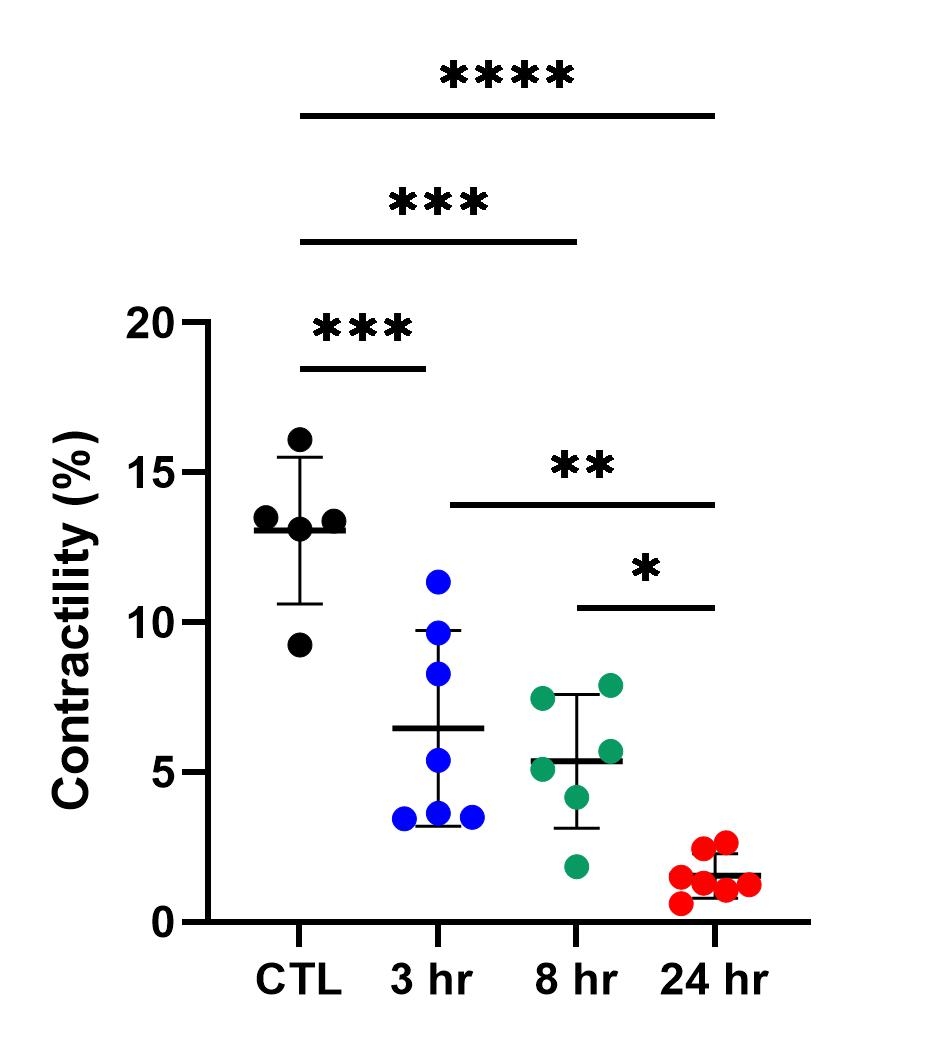
“Hypoxia impairs cardiac organoid contractility in a multi-cell type model of Ischemia-Reperfusion Injury.”
Abstract Body: Ischemia-reperfusion injury (IRI), caused by myocardial infarction and subsequent treatment with tissue reperfusion, is characterized by oxidative stress and mitochondrial dysregulation, leading to cell death, scarring, and further complications. Preclinical research has relied on small animal models, yet novel IRI therapeutic approaches often fail in human clinical trials. New predictive approaches are needed.
We aimed to develop an in vitro model that recapitulates microstructural, functional, and redox features of IRI. Specifically, we hypothesized that hypoxia would damage cardiac organoid contractile function, increase mitochondrial superoxide, and trigger cell death.
First, we generated 3D cardiac organoids (COs) containing human iPSC-derived cardiomyocytes, fibroblasts, and endothelial cells. Then, we exposed the COs to an ischemia mimetic solution and hypoxia for 3, 8, or 24 hours. Then, we replaced media with a reperfusion mimetic solution and measured contractile function, viability, and mitochondrial superoxide.
TEM revealed the structure of control COs, including Z-discs, glycogen deposits, and myofibril-like structures. Isoproterenol exposed COs beat significantly faster than control organoids (34.9 BPM ± 11.03 compared to 14.9 BPM ± 7.4, n=13, p=0.0004), indicating physiological responsiveness. Critically, a one-way ANOVA revealed a significant difference in contractility between hypoxia exposure times (F(3,21)=23.6, n=5, p<0.0001). Live/dead staining reflected significant differences between exposure groups (F(3,15), n=4, p=0.011). However, mitochondrial superoxide staining showed no significant differences between IRI and control.
In conclusion, we confirmed that hypoxia impaired function of our in vitro cardiac model. Next, we plan to examine the effects of our model on calcium kinetics, cardiac troponin, and OCR, then evaluate stem cell-derived exosome therapies as potential treatments for IRI.
Heathershaw, Caleb
(
Wake Forest
, Winston Salem , North Carolina , United States )
Shakeriastani, Kiarash
(
Wake Forest
, Winston Salem , North Carolina , United States )
Parsons, Megan
(
Wake Forest
, Winston Salem , North Carolina , United States )
Latham, Olivia
(
Wake Forest
, Winston Salem , North Carolina , United States )
Diaz, Jonathan
(
Wake Forest
, Winston Salem , North Carolina , United States )
Maxwell, Joshua
(
Wake Forest
, Winston Salem , North Carolina , United States )
Author Disclosures:
Caleb Heathershaw:DO NOT have relevant financial relationships
| Kiarash Shakeriastani:No Answer
| Megan Parsons:No Answer
| Olivia Latham:No Answer
| Jonathan Diaz:No Answer
| Joshua Maxwell:No Answer