Logo

American Heart Association

  62
  0


Final ID: Fri124

Linoleic acid and Elamipretide Can Improve Mitochondrial Function in Pediatric Dilated Cardiomyopathy

Abstract Body: Introduction: Pathological insults to the human heart results in mitochondrial dysfunction. Our group showed that primary cardiomyocytes treated with pediatric dilated cardiomyopathy (DCM) serum exhibit decreased mitochondrial function associated with cardiolipin (CL) composition. Cardiolipin plays an important role in maintaining mitochondrial membrane and electron transport chain stability. Healthy hearts show preference for linoleic acid (LA) to compose most or all of four of its side chains however, DCM heart’s cardiolipin is largely composed of other polyunsaturated fatty acids. Additionally, we have shown that mitochondrial-targeted peptide Elemipretide, thought to work though cardiolipin interaction, can improve mitochondrial function in explanted hearts, however that study was not isolated to the pediatric DCM population.
Hypothesis: Cardiolipin remodeling with linoleic acid or Elemipretide treatment can improve mitochondrial function in NRVMs pathologically remodeled with pediatric DCM serum.
Aim: Investigate mitochondrial function changes following chronic Linoleic acid or Elamipretide treatment in NRVMs.
Methods: Neonatal rat ventricular myocytes (NRVMs; N=5) were isolated and treated for 72 hours with 0.2% serum from pediatric DCM patients. Cells were co-treated with LA or Elamipretide for 48 hours. Seahorse was performed to assess mitochondrial function using a fatty acid oxidation protocol.
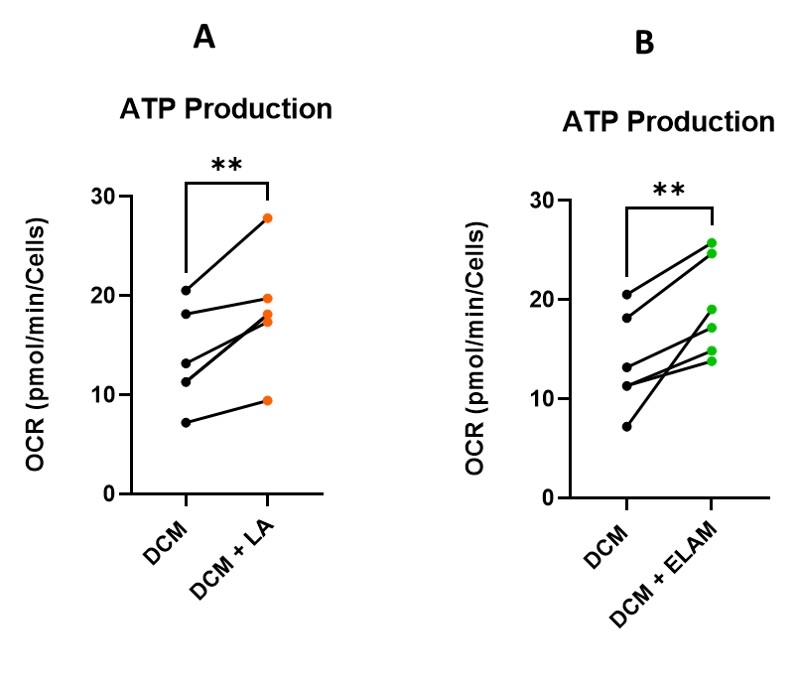
Results: Cross sectional analysis of OCR (pmol/min/Cells) from pediatric DCM serum-treated cells showed significant increase in ATP production (Mean+SEM – 4.9.1+1.2; P=0.01) and basal respiration (8.7+2.1; P=0.01) with chronic LA treatment. In addition, there was an increase in ATP production (Mean+SEM – 5.9+1.6; P=0.02) and basal respiration (8.3+2.9; P=0.04) with chronic Elamipretide. Maximal respiration trended higher with both treatments.
Conclusions: Cardiac mitochondrial function can be improved by treatment with the mitochondrial-targeting peptide Elamipretide. Improvement with LA is thought to be through cardiolipin remodeling however, future studies looking at cardiolipin composition through mass spectrometry will shed light on those results and we will move on to mechanistic studies.
  • Casa De Vito, Mariana  ( University of Colorado Anschutz , Denver , Colorado , United States )
  • Sparagna, Genevieve  ( University of Colorado Anschutz , Denver , Colorado , United States )
  • Sucharov, Carmen  ( UNIVERSITY OF COLORADO Anschutz , Aurora , Colorado , United States )
  • Miyamoto, Shelley  ( CHILDRENS HOSPITAL COLORADO , Aurora , Colorado , United States )
  • Stauffer, Brian  ( UNIVERSITY OF COLORADO Anschutz , Aurora , Colorado , United States )
  • Author Disclosures:
    Mariana Casa de Vito: DO NOT have relevant financial relationships | Genevieve Sparagna: DO have relevant financial relationships ; Consultant:Stealth:Active (exists now) | Carmen Sucharov: No Answer | Shelley Miyamoto: No Answer | Brian Stauffer: No Answer
Meeting Info:

Basic Cardiovascular Sciences 2025

2025

Baltimore, Maryland

Session Info:

Poster Session and Reception 3

Friday, 07/25/2025 , 04:30PM - 07:00PM

Poster Session and Reception

More abstracts on this topic:
A Stepwise Approach to Identifying and Assessing the Content Validity of Patient-Reported Outcome (PRO) Measures for Use with Adults with Acute Heart Failure

O'connor Meaghan, Loughlin Anita, Waldman Laura, Rucker Sloan, Vaghela Shailja, Kwon Namhee, Sikirica Vanja

Assessing the Therapeutic Time Window for Tranexamic Acid in Intracerebral Hemorrhage A Systematic Review and Meta-analysis

Riya Israt Jahan, Piya Ifrat, Menezes Shenelle, Hariyanto Jesslyn, Quiros Marco, Koduru Sriharsha

More abstracts from these authors:
Ketones as an Optimal Substrate in Single Ventricle Heart Disease

Casa De Vito Mariana, Sparagna Genevieve, Sucharov Carmen, Stauffer Brian, Miyamoto Shelley

A novel Notch and WNT signaling mechanism contribute to pediatric DCM: a pathway to new therapeutics

Nyarko Obed, Miyamoto Shelley, Stauffer Brian, Sucharov Carmen

You have to be authorized to contact abstract author. Please, Login
Not Available