
Splenic Follicular B Cells Promote Adverse Cardiac Remodeling in Ischemic Cardiomyopathy via MHC-II-Dependent Antigen Presentation
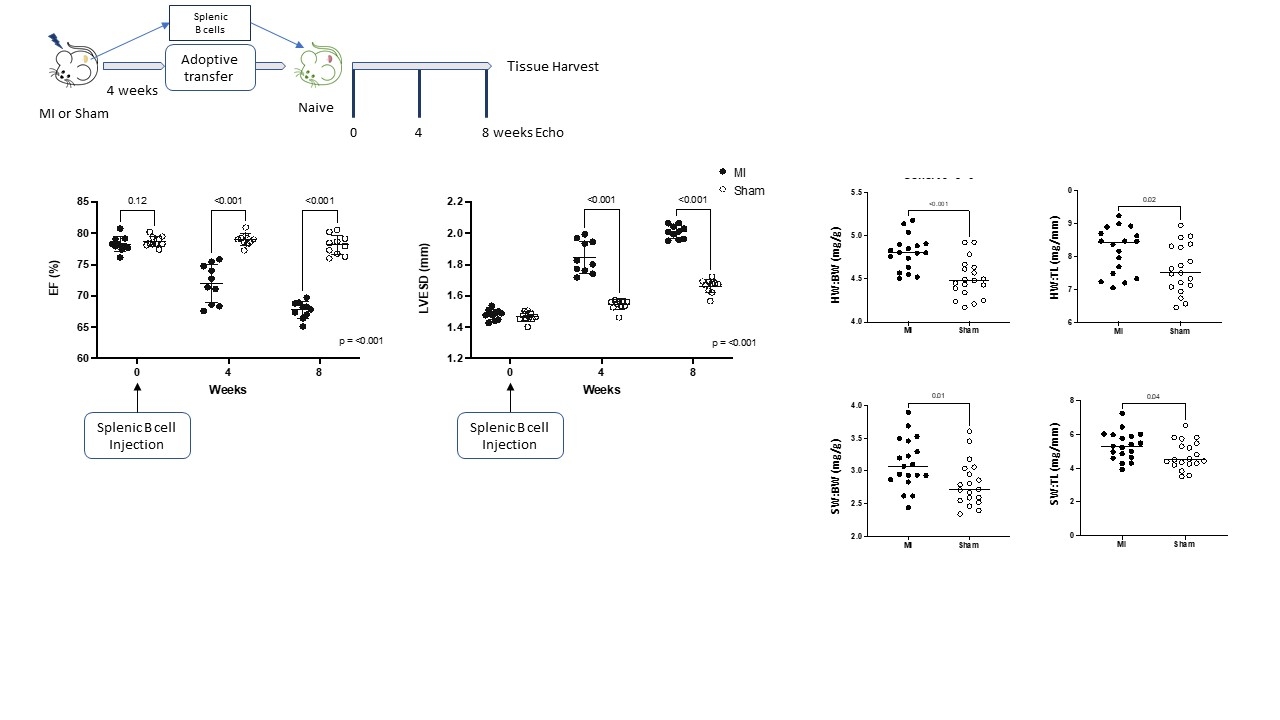
Abstract Body: BACKGROUND- Adoptive transfer of splenocytes from mice, post-myocardial infarction (MI), into naïve recipients has been shown to induce adverse cardiac remodeling along the cardiosplenic axis. The presence of a cardiosplenic axis in ischemic cardiomyopathy has also been confirmed in humans, highlighting a potential target for a specific therapeutic strategy against MI-induced cardiac dysfunction. B lymphocytes account for about 50% of splenocytes in vertebrates; yet, their role within the cardiosplenic axis in ischemic heart failure remains unexplored. RESEARCH GOAL-Thus, we investigated the role of B lymphocytes within the cardiosplenic axis in ischemic heart failure. METHODS AND RESULTS- Adoptive transfer of splenic B cells from mice subjected to MI into naïve recipients resulted in adverse cardiac remodeling. At the scRNAseq level, MI was associated with activation of antigen presentation pathways in splenic, circulating and myocardial B cells. Mass spectrometry analysis of the MHC-II-associated peptidome showed that MI triggered the loading of myocardial antigens on the MHC-II molecules of splenic B cells. Flow cytometry and scRNAseq showed that the adoptive transfer of splenic B cells triggered the activation of splenic and myocardial CD4 and CD8 T cells. Deletion of MHC-II on B cells showed that MHC-II expression was necessary for B cell- mediated adverse cardiac remodeling. Adoptive transfer of splenic B cell subtypes identified splenic follicular B cells as the main mediators of adverse cardiac remodeling along the cardio-splenic axis. scRNAseq of circulating B cells from post-MI patients and controls showed that MI modulates antigen-processing presentation in human B cells. CONCLUSION- Collectively, these findings broaden our understanding of B cell biology, reshape current models of immune activation in response to cardiac injury, and point towards MHC II-mediated signaling in B cells as a novel and specific therapeutic target to prevent adverse cardiac remodeling in ischemic heart failure.
Ebenebe, Oby
( Johns Hopkins University
, Baltimore
, Maryland
, United States
)
Sidoli, Simone
( Albert Einstein College of Medicine
, Bronx
, New York
, United States
)
Adamo, Luigi
( Johns Hopkins University
, Baltimore
, Maryland
, United States
)
Lovell, Jana
( Johns Hopkins University
, Baltimore
, Maryland
, United States
)
Duque, Carolina
( Johns Hopkins University
, Baltimore
, Maryland
, United States
)
Song, Yiran
( Johns Hopkins University
, Baltimore
, Maryland
, United States
)
Rousseau, Sylvie
( Johns Hopkins University
, Baltimore
, Maryland
, United States
)
Krummey, Scott
( Johns Hopkins University
, Baltimore
, Maryland
, United States
)
Bhalodia, Aashik
( Yale University
, New Haven
, Connecticut
, United States
)
Bermea, Kevin
( Texas Institute for GME and Research
, San Antonio
, Texas
, United States
)
Cohen, Charles
( Johns Hopkins University
, Baltimore
, Maryland
, United States
)
Author Disclosures:
Oby Ebenebe:DO NOT have relevant financial relationships
| Simone Sidoli:No Answer
| Luigi Adamo:No Answer
| Jana Lovell:No Answer
| Carolina Duque:No Answer
| Yiran Song:No Answer
| Sylvie Rousseau:No Answer
| Scott Krummey:No Answer
| Aashik Bhalodia:No Answer
| Kevin Bermea:No Answer
| Charles Cohen:No Answer