The Changing Landscape of Heart Failure Mortality Trends Among Metabolic Syndrome Patients in the United States (1999–2023
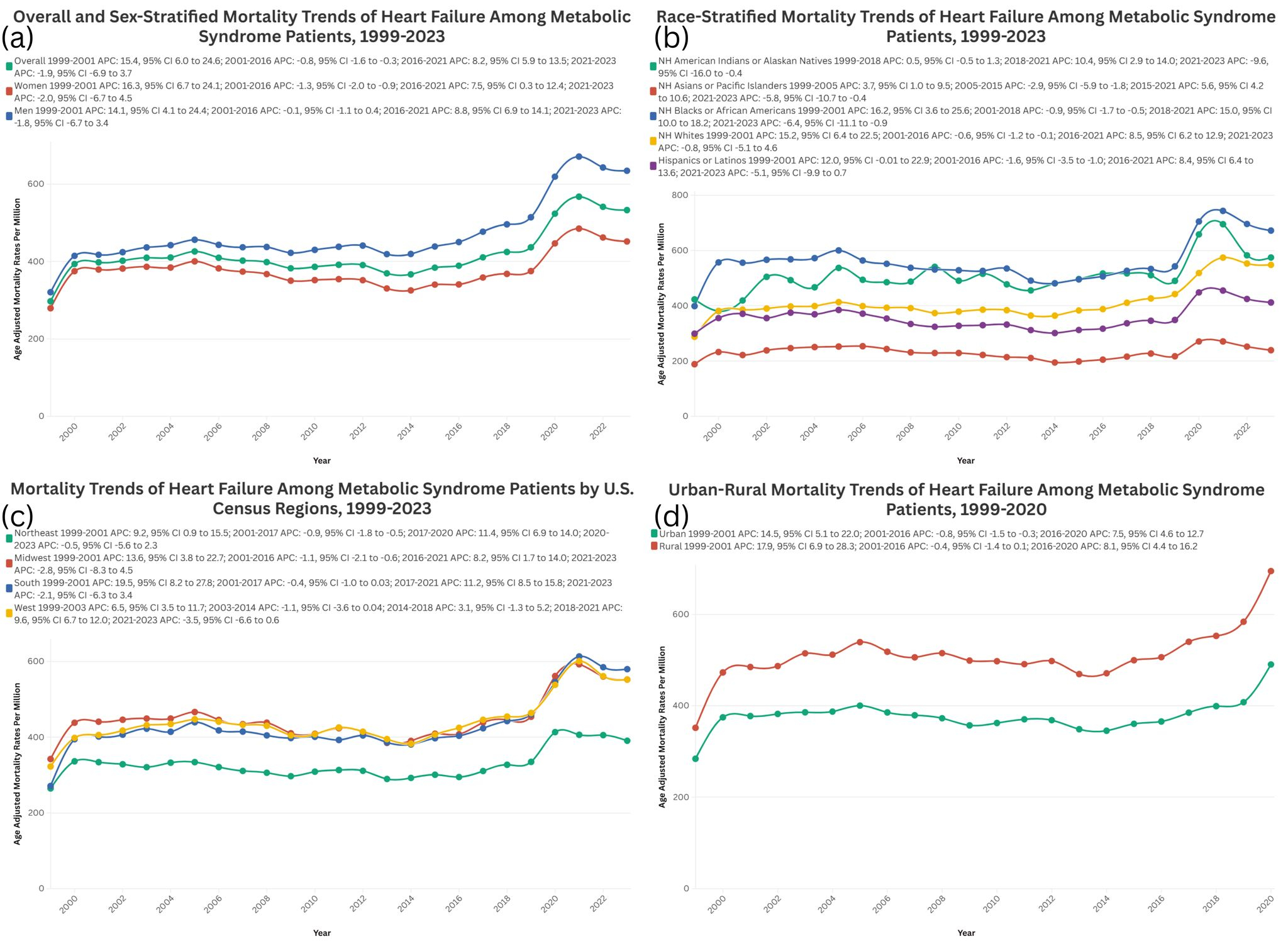
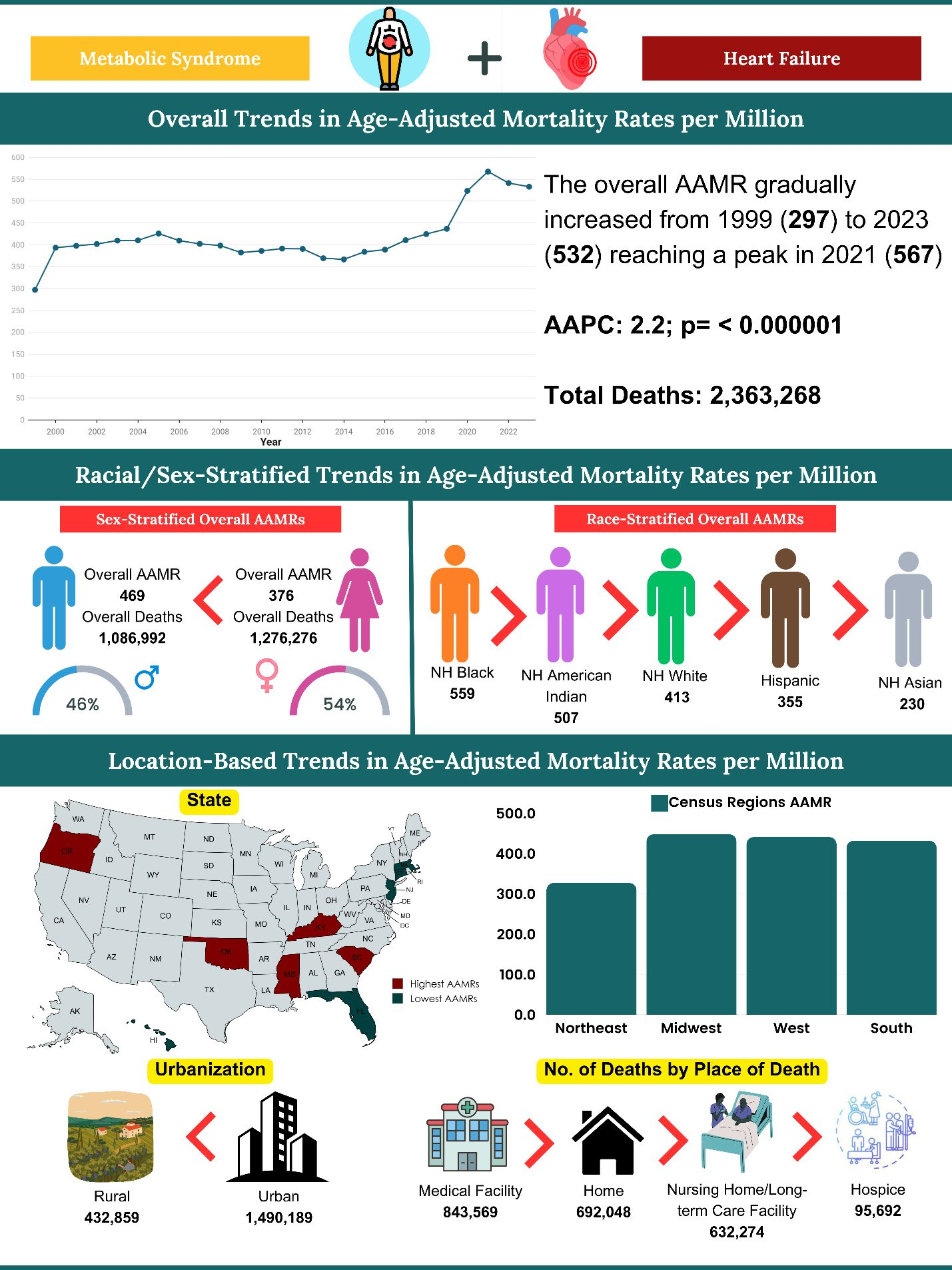
Abstract Body: Introduction: Metabolic syndrome (MetS) is a known risk factor for cardiovascular dysfunction, with insulin resistance, diabetes, hypertension and lipid abnormalities contributing to heart failure (HF). Research Question: How have HF and MetS-related mortality trends changed in the U.S. from 1999 to 2023? Aims:- To identify disparities and assess variations in mortality by age, sex, race/ethnicity, and geographic region. Methods: Age-adjusted mortality rates (AAMRs) per million among adults (25+) were extracted from CDC WONDER using ICD codes for HF (I50) and MetS (E10–E14, E66, E78, E88, I10). Joinpoint regression estimated Annual Percent Change (APC) and Average APC (AAPC) with significance at p<0.01. Results: Between 1999 and 2023, 2.36 million HF-related deaths occurred among MetS adults, primarily in hospitals (36%) and homes (29%). AAMR rose from 297 in 1999 to 532 in 2023 (AAPC: 2.2%, 95% CI: 1.7–2.9, p<0.000001), peaking in 2021 (567). Men had higher AAMRs than women (469 vs. 376) and a greater increase (AAPC: 2.7%, 95% CI: 2.2–3.4, p<0.000001). NH Blacks had the highest AAMR (559), while NH Whites had the greatest rise (AAPC: 2.5%, 95% CI: 2.0–3.0, p<0.000001). Elderly (75Y+) had higher AAMRs (3254 vs. 127 in 25–44Y), but younger adults showed a steeper increase (AAPC: 4.6% vs. 2.3%, p<0.01). Geographically, AAMRs ranged from 999 (Mississippi) to 258 (Connecticut), with the South showing the highest increase (AAPC: 2.8%, 95% CI: 2.3–3.4, p<0.000001). Rural areas had higher AAMRs than urban (509 vs. 376), with both showing increasing trends. Conclusion: Significant mortality disparities exist in HF among MetS patients, warranting targeted interventions for younger men, NH Blacks and Whites, rural residents, and the South
Abdul Malik, Mohammad Hamza Bin
(
Nassau University Medical Center
, East Meadow , New York , United States )
Ahmad, Husnain
(
Shalamar Medical and Dental College
, Lahore , Pakistan )
Ahmed, Faizan
(
Ameeruddin Medical College
, Brooklyn , New York , United States )
Ali, Muhammad Faizan
(
Jinnah Postgraduate Medical Cente
, Karachi , Pakistan )
Arshad, Muhammad Usman
(
Shalamar Medical and Dental College
, Lahore , Pakistan )
Faizan, Muhammad
(
Shalamar Medical and Dental College
, Lahore , Pakistan )
Mirza, Tehmasp
(
Shalamar Medical and Dental College
, Lahore , Pakistan )
Ihsan, Ayesha
(
University Medical and Dental College
, Faisalabad , Pakistan )
Ahmed, Ashraf
(
Bridgeport Hospital
, Bridgeport , Connecticut , United States )
Joshi, Simran
(
Yale University
, Bridgeport , Connecticut , United States )
Morden Md, Alexander
(
Nassau University Medical Center
, East Meadow , New York , United States )
Author Disclosures:
Mohammad Hamza Bin Abdul Malik:DO NOT have relevant financial relationships
| Simran Joshi:No Answer
| Alexander Morden MD:DO NOT have relevant financial relationships
| Husnain Ahmad:DO NOT have relevant financial relationships
| Faizan Ahmed:No Answer
| Muhammad Faizan Ali:No Answer
| Muhammad Usman Arshad:DO NOT have relevant financial relationships
| Muhammad Faizan:DO NOT have relevant financial relationships
| Tehmasp Mirza:DO NOT have relevant financial relationships
| Ayesha Ihsan:No Answer
| Ashraf Ahmed:No Answer
Abdul Malik Mohammad Hamza Bin, Morden Md Alexander, Ahmad Husnain, Ali Muhammad Faizan, Ahmed Faizan, Arshad Muhammad Usman, Faizan Muhammad, Mirza Tehmasp, Joshi Simran, Ahmed Ashraf
Abdul Malik Mohammad Hamza Bin, Joshi Simran, Eltawansy Sherif, Morden Md Alexander, Ali Muhammad Faizan, Ahmad Husnain, Arshad Muhammad Usman, Ahmed Faizan, Faizan Muhammad, Mirza Tehmasp, Ihsan Ayesha, Ahmed Ashraf
4305795_File000000.jpg
4305795_File000001.jpg
You have to be authorized to contact abstract author. Please, Login