Lenvatinib Exhibits Cell Type-Specific Cardiotoxicity in Human Induced Pluripotent Stem Cell-Derived Cardiac Spheroids and Organ-Chips
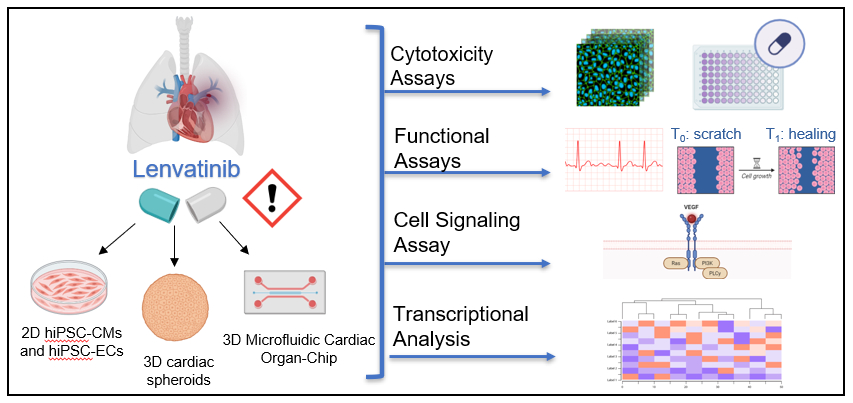
Abstract Body: Lenvatinib is a multi-targeted tyrosine-kinase inhibitor (TKI) that inhibits the vascular endothelial growth factor (VEGF) signaling pathway for the treatment of differentiated thyroid cancer (DTC), renal cell carcinoma (RCC), and hepatocellular carcinoma (HCC). Despite the improved specificity of lenvatinib over prior TKIs, there have been reports of patients experiencing hypertension and cardiac dysfunction after treatment. Since it is challenging to obtain primary human cardiomyocytes for pre-clinical studies, human induced pluripotent stem cells (hiPSCs) have opened new avenues for in vitro applications in personalized medicine. hiPSCs can be used to model the cardiovascular system, including major cardiovascular cell types like cardiomyocytes (hiPSC-CMs), cardiac fibroblasts (hiPSC-CFs), and endothelial cells (hiPSC-ECs). In order to model the cardiotoxic impacts of lenvatinib on cardiac and endothelial cell populations, drug dose-response and time-course assays were conducted on hiPSC-CMs and hiPSC-ECs both in 2D and advanced multi-lineage 3D in vitro models (cardiac spheroids, microfluidic heart-on-chip). Additionally visual analyses, viability assays, metabolic analyses, and functional, and signaling assays were also conducted on drug-treated cells. Lenvatinib causes cytotoxicity of vascular endothelial cells, while also causing significant alteration to cardiomyocyte and endothelial cell signaling. The phosphorylation of vascular endothelial growth factor receptor (VEGFR) was significantly altered in both hiPSC-CMs and hiPSC-ECs treated with lenvatinib. We also observed wound-healing capabilities of hiPSC-ECs and contractility of 3D cardiac spheroids and calcium handling of heart-on-chip being impacted by lenvatinib treatment. Further, we performed bulk RNA transcriptomics to identify the gene pathways significantly affected by lenvatinib treatment. Genes known to have an important role in cardiovascular cell adhesion, cell proliferation, and cell survival, such as CDH5 and PECAM1, were significantly downregulated in both lenvatinib treated 2D hiPSC-CMs and hiPSC-ECs. We summarize that lenvatinib has an off-target cardiotoxic impact on vascular endothelial cells, and we also demonstrate the utility of 2D and 3D hiPSC-derived cardiovascular model systems in unveiling the mechanisms of drug-induced cardiotoxicity.
Moses, Jemima
(
Cedars Sinai Medical Center
, Beverly Hills , California , United States )
Pohlman, Stephany
(
California Institute for Regenerative Medicine
, Los Angeles , California , United States )
Arzt, Madelyn
(
Cedars Sinai Medical Center
, Beverly Hills , California , United States )
Escopete, Sean
(
Cedars Sinai Medical Center
, Beverly Hills , California , United States )
Mozneb, Maedeh
(
Cedars Sinai Medical Center
, Beverly Hills , California , United States )
Sharma, Arun
(
Cedars Sinai Medical Center
, Beverly Hills , California , United States )
Author Disclosures:
Jemima Moses:DO NOT have relevant financial relationships
| Stephany Pohlman:No Answer
| Madelyn Arzt:DO NOT have relevant financial relationships
| Sean Escopete:No Answer
| Maedeh Mozneb:DO NOT have relevant financial relationships
| Arun Sharma:No Answer