
Logo

American Heart Association

  71
  0


Final ID: Fri028

Fibroblast-derived CSF-1 protects the infarcted heart from adverse post-MI remodeling by promoting reparative macrophage function

Abstract Body: Background: Macrophages play a pivotal role in cardiac development, homeostasis and disease. After myocardial infarction (MI), macrophages expand and regulate inflammation, repair, angiogenesis and fibrosis. Colony-Stimulating Factor -1 (CSF-1), a critical regulator of macrophage function, is significantly upregulated following MI and acts through its receptor CSF-1R. However, the role and the molecular mechanisms of CSF-1/CSF-1R signaling in repair and remodeling after MI are unknown. We hypothesize that the CSF1-CSF1R axis may play a central role in repair and remodeling after MI, modulating infarct macrophage phenotype.
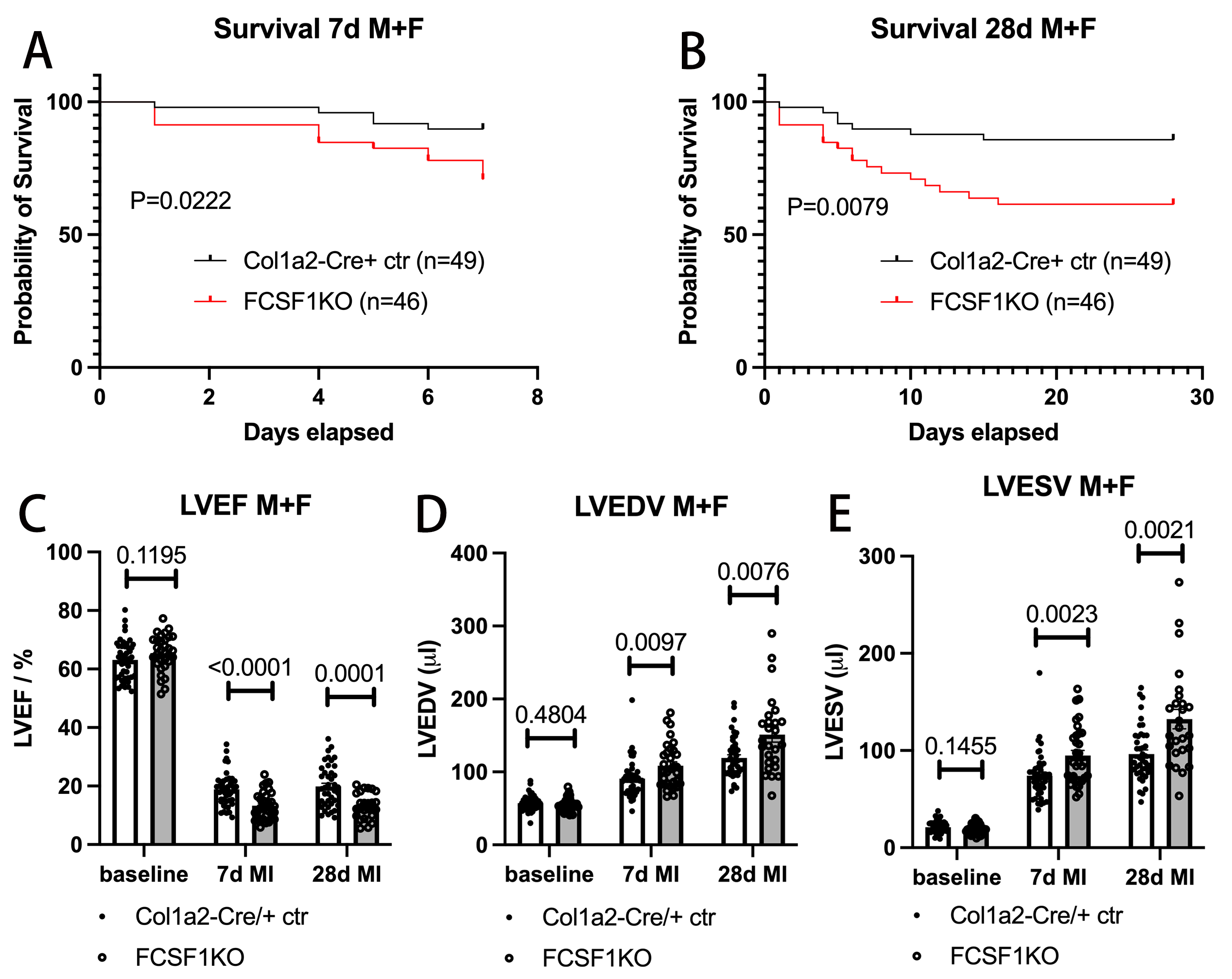
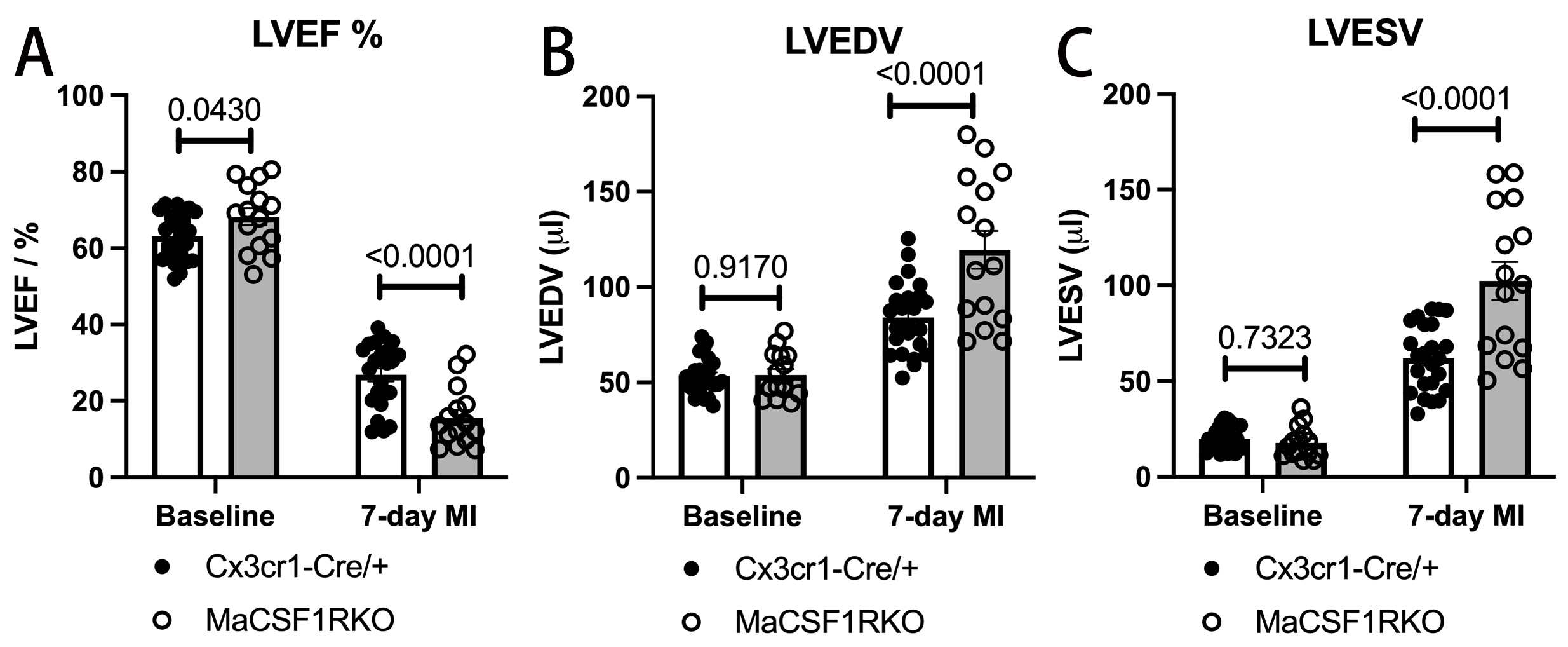
Methods and Results: ScRNA-Seq identified a large cluster of reparative macrophages (RMp) 7 days after MI. Ingenuity Pathway Analysis (IPA) identified CSF-1 as the top-ranked upstream regulator mediating the RMp molecular signature. ScRNA-seq showed that Csf1 is predominantly expressed by infarct fibroblasts, while Csf1r is mainly expressed by infarct macrophages. To investigate the role of fibroblast-derived CSF-1, inducible fibroblast-specific CSF-1 knockout mice (FCSF1KO) were generated using the Col1a2-CreER driver. FCSF1 KO mice had no short-term baseline defects. In a model of non-reperfused MI, FCSF1KO mice exhibited higher mortality, impaired left ventricular (LV) systolic function, and exacerbated LV dilative remodeling at 7 and 28 days post-MI compared to Col1a2-CreER controls. To investigate the role of macrophage CSF-1R signaling, macrophage-specific CSF-1R knockout mice (MaCSF1RKO) were generated using the CX3CR1-CreER driver. Tamoxifen was administrated before and after MI to continuously target Cx3cr1-expressing macrophages. MaCSF1RKO mice displayed worse LV dysfunction and accentuated LV dilation 7 days after MI. To examine whether CSF1 supplementation had beneficial effects on the infarcted heart, a single intravenous dose of recombinant human CSF-1 (rhCSF-1, 2.5mg/kg) was administrated upon reperfusion in a model of reperfused MI. CSF-1 administration significantly improved systolic function 14 days after MI.
Conclusions: Fibroblast-derived CSF-1 protects the infarcted heart from adverse post-MI remodeling by promoting reparative macrophage function. Macrophage CSF-1R signaling plays a critical role in cardiac repair and remodeling. Early administration of CSF-1 improves cardiac function in reperfused MI. Targeting CSF-1/CSF-1R axis in macrophage may represent a therapeutic strategy to improve outcome after MI.
  • Huang, Shuaibo  ( Albert Einstein College of Medicine , Bronx , New York , United States )
  • Frangogiannis, Nikolaos  ( Albert Einstein College of Medicine , Bronx , New York , United States )
  • Humeres, Claudio  ( Albert Einstein College of Medicine , Bronx , New York , United States )
  • Hanna, Anis  ( Albert Einstein College of Medicine , Bronx , New York , United States )
  • Tuleta, Izabela  ( Albert Einstein College of Medicine , Bronx , New York , United States )
  • Hernandez Velasco, Silvia  ( Albert Einstein College of Medicine , Bronx , New York , United States )
  • Kubota, Akihiko  ( Albert Einstein College of Medicine , Bronx , New York , United States )
  • Venugopal, Harikrishnan  ( Albert Einstein College of Medicine , Bronx , New York , United States )
  • Chitu, Violeta  ( Albert Einstein College of Medicine , Bronx , New York , United States )
  • Stanley, E. Richard  ( Albert Einstein College of Medicine , Bronx , New York , United States )
  • Author Disclosures:
    Shuaibo Huang: DO NOT have relevant financial relationships | Nikolaos Frangogiannis: No Answer | Claudio Humeres: DO NOT have relevant financial relationships | Anis Hanna: DO NOT have relevant financial relationships | Izabela Tuleta: DO NOT have relevant financial relationships | Silvia Hernandez Velasco: No Answer | Akihiko Kubota: No Answer | Harikrishnan Venugopal: DO NOT have relevant financial relationships | Violeta Chitu: DO NOT have relevant financial relationships | E. Richard Stanley: DO NOT have relevant financial relationships
Meeting Info:

Basic Cardiovascular Sciences 2025

2025

Baltimore, Maryland

Session Info:

Poster Session and Reception 3

Friday, 07/25/2025 , 04:30PM - 07:00PM

Poster Session and Reception

More abstracts on this topic:
A novel methodology for simultaneous analysis of electrical activation parameters and myocardial fibrosis in patients with LBBB and indications to cardiac resynchronization therapy

Rimskaya Elena, Chmelevsky Mikhail, Aparina Olga, Bazhutina Anastasia, Budanova Margarita, Khamzin Svyatoslav, Stukalova Olga, Ternovoy Sergey, Golitsyn Sergey

Association of histologic findings with long-term outcomes in symptomatic obstructive hypertrophic cardiomyopathy patients undergoing surgical myectomy

Jadam Shada, Popovic Zoran, Desai Milind, Gaballa Andrew, Alashi Alaa, Xu Bo, Thamilarasan Maran, Rodriguez E, Tan Carmela, Ospina Susan, Smedira Nicholas

More abstracts from these authors:
Pericyte-mediated perivascular fibrosis in the pressure-overloaded heart is dependent on TGF-β signaling and is restrained by ITGB1.

Tuleta Izabela, Hanna Anis, Hernandez Silvia, Huang Shuaibo, Humeres Claudio, Kubota Akihiko, Venugopal Harikrishnan, Frangogiannis Nikolaos

A Cellular Mechanism Mediating Lipomatous Metaplasia In the Infarcted Heart.

Tuleta Izabela, Frangogiannis Nikolaos, Venugopal Harikrishnan, Huang Shuaibo, Humeres Claudio, Hernandez Velasco Silvia, Hanna Anis, Kubota Akihiko, O'leary Kevin, Zheng Deyou

You have to be authorized to contact abstract author. Please, Login
Not Available