
Logo

American Heart Association

  62
  0


Final ID: Fri085

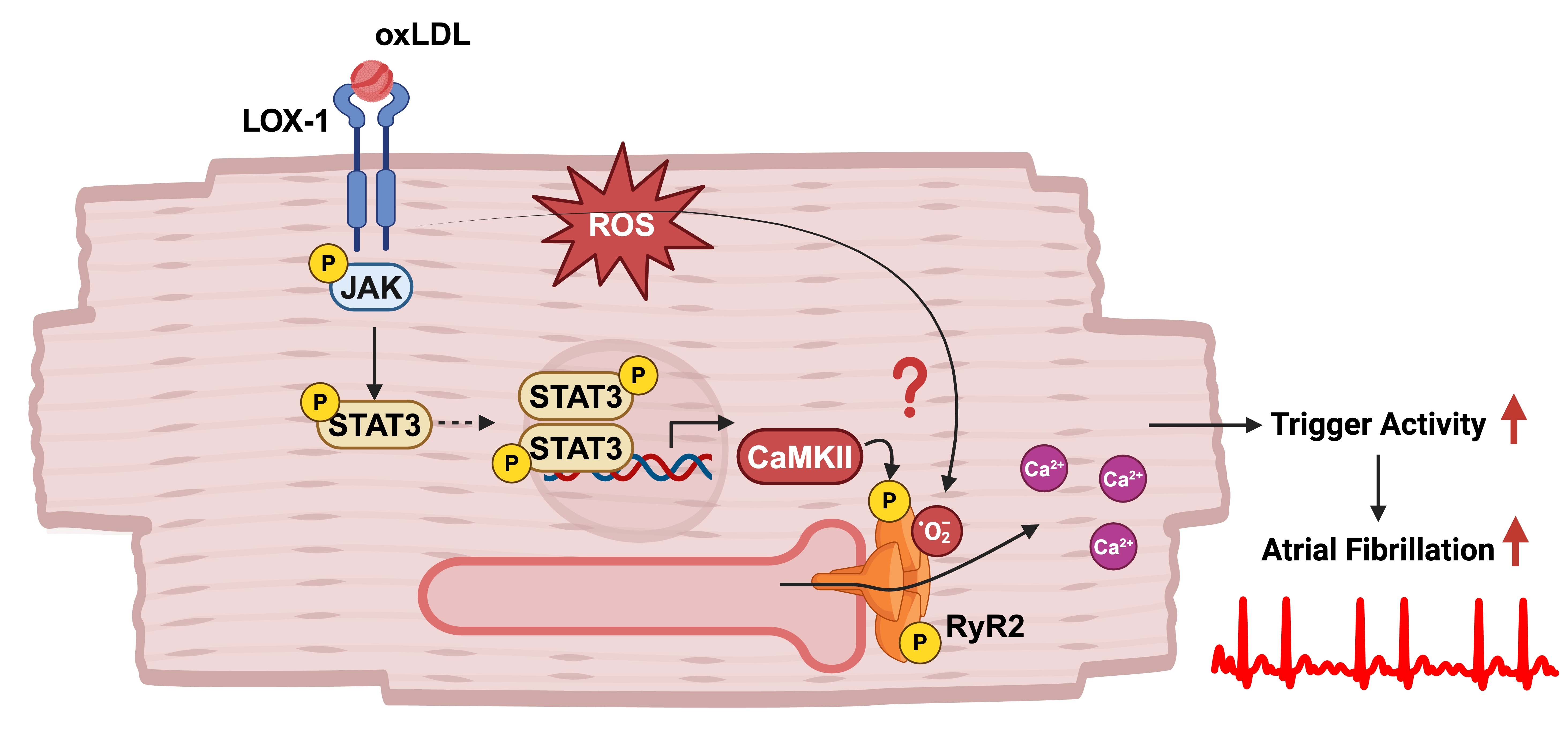
Oxidazed LDL and LOX-1 mediates Atrial Fibrillation in Chronic Kidney Disease

Abstract Body: BACKGROUND. Atrial fibrillation (AF) is the most common sustained arrhythmia. AF risk is higher in chronic kidney disease (CKD) patients. CKD patients show increased oxidative stress, risk factor for AF. Oxidized low-density lipoprotein (oxLDL) is a common marker of lipid oxidative damage. Lectin-like oxLDL receptor-1 (LOX-1) is a receptor for oxLDL expressed in macrophages and cardiomyocytes. Whether LOX-1 is involved in AF onset in CKD is unknown.
METHODS. Blood from dialysis patients was used to assess oxLDL levels in CKD patients in sinus rhythm (SR) and AF. CKD was mimicked in mice by 5/6 nephrectomy surgery. Incidence of AF in mice was measured by pacing electrical stimulation. Single-nuclei RNA sequencing (snRNA-seq) was performed in atria samples from Sham, CKD-SR and CKD-AF mice. Left atria size was assessed by echocardiography. Serum oxLDL levels were measured in all mice groups. Western blotting was used to study the levels of LOX-1 and pSTAT3 in atrial human and mice samples. Confocal microscopy was used to analyze spark-mediated diastolic calcium (Ca2+) leak in atrial cardiomyocytes (ACM). LOX-1 was pharmacologically inhibited with BI-0115 (i.p. 2mg/mg) and genetically by AAV9-ANF-Cre and AAV9-CAG-floxSTOP-shLOX1 (5e11gc/mouse).
RESULTS. CKD-AF patients showed higher serum oxLDL levels (P<0.001) and OXY-Score (P<0.001) than CKD-SR. Serum oxLDL was also higher in CKD-AF than Sham mice (P=0.025). LOX-1 expression was increased in atria from CKD patients (P<0.05) and in CKD-AF mice than Sham mice (P<0.05). No gene markers of activation of fibroblasts neither macrophages were found in CKD-AF compared to Sham mice in snRNA-seq data. Function enrichment analysis showed cardiac muscle contraction and calcium signaling as the most dysregulated in ACMs from CKD-AF versus Sham. CKD-AF mice showed atrial enlargement (P<0.05). Diastolic Ca2+ leak was increased in ACM from CKD-AF versus Sham (P<0.001). Atria from CKD-AF showed increased pSTAT3 levels compared to Sham (P<0.01). LOX-1 blockade by BI-0115 and shLOX1 prevented AF development in CKD (20% and 0%, respectively, vs. 55% in control), increased diastolic Ca2+ leak (P<0.05), increased pSTAT3 (P<0.001), and atrial enlargement (P<0.001).
CONCLUSION. CKD-AF mice show atrial enlargement and Ca2+ mishandling that might be responsible of AF onset. LOX-1 blockade prevented both alterations and reduced inducibility of AF, highlighting LOX-1 receptor as a possible target to prevent AF in CKD patients.
  • Navarro Garcia, Jose  ( Baylor College of Medicine , Houston , Texas , United States )
  • Zhao, Shuai  ( Baylor College of Medicine , Houston , Texas , United States )
  • Lahiri, Satadru  ( Baylor College of Medicine , Houston , Texas , United States )
  • Ruiz-hurtado, Gema  ( Hospital Universitario 12 de Octubre , Madrid , Madrid , Spain )
  • Dobrev, Dobromir  ( University Hospital Essen , Essen , Germany )
  • Wehrens, Xander  ( BAYLOR COLLEGE OF MEDICINE , Bellaire , Texas , United States )
  • Author Disclosures:
    Jose Navarro Garcia: DO NOT have relevant financial relationships | Shuai Zhao: No Answer | Satadru Lahiri: DO NOT have relevant financial relationships | Gema Ruiz-Hurtado: DO NOT have relevant financial relationships | Dobromir Dobrev: DO NOT have relevant financial relationships | Xander Wehrens: DO NOT have relevant financial relationships
Meeting Info:

Basic Cardiovascular Sciences 2025

2025

Baltimore, Maryland

Session Info:

Poster Session and Reception 3

Friday, 07/25/2025 , 04:30PM - 07:00PM

Poster Session and Reception

More abstracts on this topic:
More abstracts from these authors:
Computational Modeling Identifies Estrogen Protective Mechanisms Against Atrial Fibrosis

Khorasani Najme, Ni Haibo, Dobrev Dobromir, Morotti Stefano, Grandi Eleonora

SPEG mediates increased atrial fibrillation incidence in chronic kidney disease

Navarro Garcia Jose Alberto, Lahiri Satadru, Aguilar Yuriana, Keefe Joshua, Song Jia, Li Na, Wehrens Xander

You have to be authorized to contact abstract author. Please, Login
Not Available